
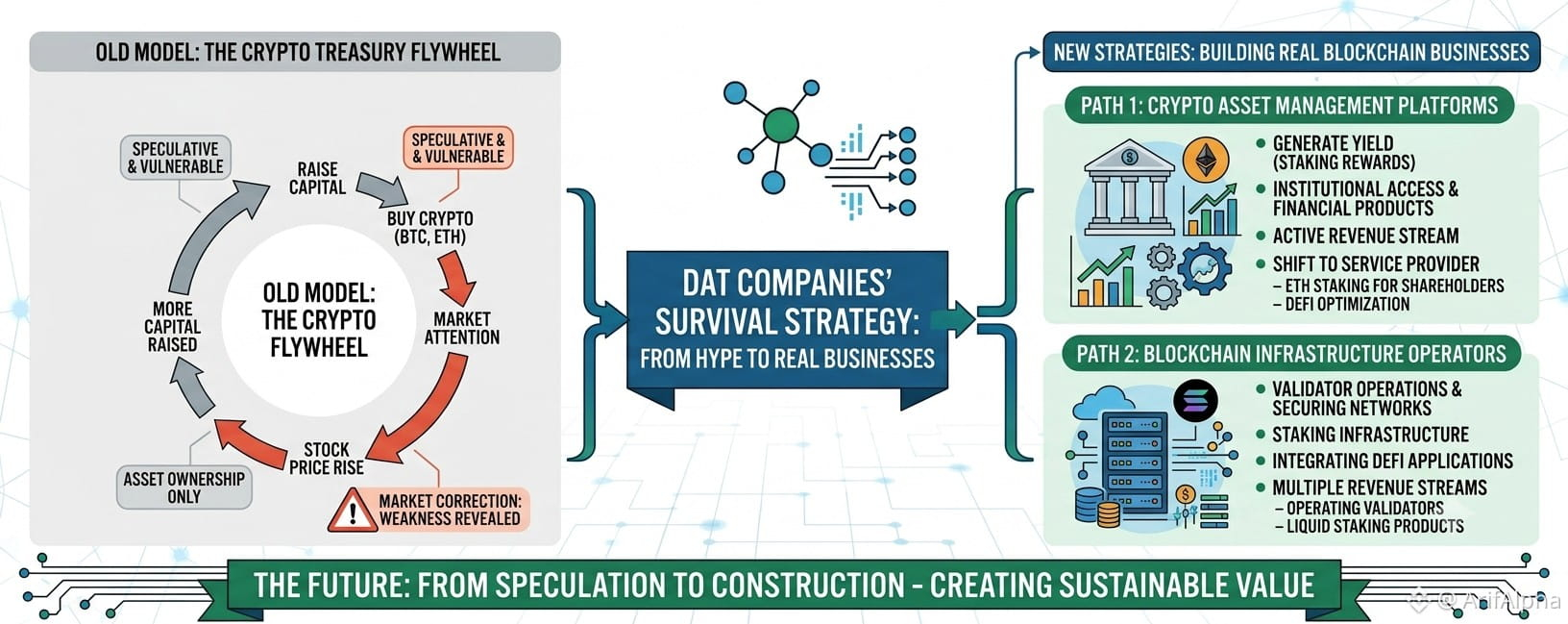
Introduction: The End of the “Crypto Treasury Flywheel” Era
For years, the Digital Asset Treasury (DAT) model became one of the biggest narratives in the crypto market. Companies discovered that holding large amounts of Bitcoin, Ethereum, or other digital assets could attract investors, increase market attention, and potentially create a valuation premium.
The strategy was simple:
Company raises capital → buys crypto assets → market rewards the company → stock price rises → more capital is raised → more crypto is purchased.
This “flywheel” worked during bullish market conditions, but when crypto entered a difficult cycle, the weakness of the model became clear.
As cryptocurrency prices cooled, investor enthusiasm declined, and companies trading below the value of their crypto holdings faced a serious problem: continuing to issue shares no longer created value.
The question changed from:
“Which company holds the most crypto?”
to:
“Which company can actually create value from crypto?”
The Treasury Model Hits a Reality Check
One of the biggest examples is Metaplanet.
The company became one of Asia’s largest Bitcoin treasury holders, aggressively accumulating BTC during the expansion phase. However, as market conditions changed, its strategy evolved.
Instead of constantly increasing Bitcoin holdings through equity dilution, the company explored alternatives such as:
▪ Bitcoin-backed financing
▪ Share buybacks
▪ Building financial products around Bitcoin exposure
The shift showed an important market realization:
Holding an asset is not the same as building a business.
Even Strategy, known for its aggressive Bitcoin accumulation strategy, faced pressure as the market environment changed.
The original idea of “never selling Bitcoin” became more flexible as companies needed liquidity and operational sustainability.
Two Survival Paths Emerging in the DAT Industry
As the treasury model weakened, companies began moving toward two major strategies:
1. Becoming Crypto Asset Management Platforms
The first transformation is turning crypto holdings into income-generating financial products.
Instead of simply holding ETH, companies are trying to become platforms that generate yield and provide institutional access.
A key example is SharpLink Gaming.
Its approach focuses on staking Ethereum and directing staking rewards toward shareholders.
The difference is important:
Traditional treasury model:
“Buy ETH and wait for price appreciation.”
New model:
“Hold ETH, generate yield, and build financial infrastructure around it.”
This moves the company closer to an asset management business.
Another example is GameSquare Holdings.
Instead of only holding Ethereum, the company explored DeFi strategies designed to optimize returns through automated systems and blockchain-based financial products.
The goal is to create active revenue rather than relying only on ETH price growth.
2. Becoming Blockchain Infrastructure Operators
The second path is especially visible in the Solana ecosystem.
Some companies are realizing that owning SOL alone is not enough. The bigger opportunity may come from supporting the network itself.
A leading example is DeFi Development Corp..
The company expanded beyond holding SOL by:
▪ Operating validators
▪ Building staking infrastructure
▪ Creating liquid staking products
▪ Integrating with DeFi applications
This creates multiple revenue streams.
Instead of being only an investor in Solana, the company becomes part of Solana’s economic infrastructure.
Similarly, SOL Strategies moved toward validator operations and institutional staking services.
The business model changes from:
“We own crypto.”
to:
“We provide services that the crypto ecosystem needs.”
Ethereum vs Solana: Different Market Expectations
The transformation also highlights a difference between Ethereum and Solana.
Ethereum’s Advantage: Institutional Recognition
Ethereum has a stronger reputation as a financial asset.
Companies holding ETH can position themselves similarly to crypto investment funds:
▪ Institutional exposure
▪ Staking income
▪ DeFi participation
Ethereum’s narrative is closer to “digital financial infrastructure.”
Solana’s Advantage: Ecosystem Growth
Solana is viewed more as a high-performance blockchain ecosystem.
For Solana treasury companies, simply holding SOL may not be enough.
They need to prove:
▪ Network participation
▪ Infrastructure value
▪ Real revenue generation
The market increasingly rewards companies that contribute to blockchain growth.
Why the Old DAT Model Lost Momentum
The original treasury strategy depended heavily on scarcity and investor excitement.
But several factors changed the environment:
More Competition
When hundreds of companies copied the same strategy, the advantage disappeared.
Crypto treasury companies became less unique.
ETF Competition
The arrival of crypto ETFs changed investor behavior.
If investors can directly buy crypto exposure through traditional financial products, the reason to buy a treasury company’s stock at a premium becomes weaker.
Need for Real Cash Flow
Markets eventually demand business fundamentals.
A company cannot depend forever on:
“Crypto price goes up, therefore our stock goes up.”
Investors increasingly want:
▪ Revenue
▪ Technology
▪ Users
▪ Infrastructure
▪ Sustainable operations
Risks Behind the Transformation
Although the new direction looks promising, it is not without challenges.
DeFi Risks
Yield strategies depend on smart contracts and protocols.
A major exploit or security failure could create significant losses.
Ecosystem Dependency
Infrastructure companies depend on blockchain health.
If an ecosystem loses users, developers, or liquidity, related businesses can suffer.
Execution Risk
Building a real crypto business requires:
▪ Technical expertise
▪ Strong partnerships
▪ Risk management
Not every treasury company can successfully make this transition.
The Future: From Speculation to Construction
The DAT industry is entering a new phase.
The first era was about accumulation:
“Who can collect the most crypto?”
The next era is about execution:
“Who can create the most value around crypto?”
The companies that survive will likely be those that move beyond balance sheets and become active participants in blockchain economies.
The market is sending a clear message:
Crypto businesses cannot rely only on asset ownership. Long-term winners will likely be companies that build infrastructure, create financial products, generate revenue, and provide real utility.
The treasury boom may be slowing down, but the next stage could produce stronger and more mature blockchain companies.
The era of simply holding crypto is changing into the era of building with crypto.
#CryptoMarket #BlockchainInfrastructure #Ethereum #Solana #ArifAlpha