
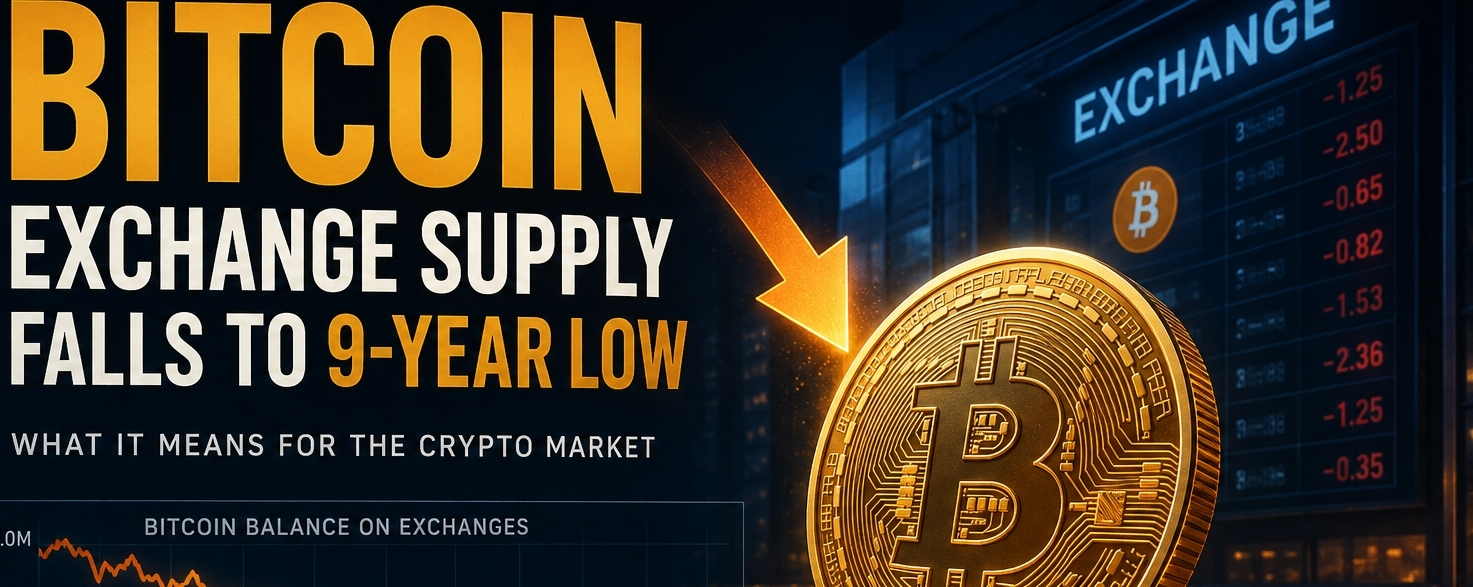
Bitcoin is once again making headlines, but this time the story isn't just about price. One of the most important on-chain indicators has reached a historic milestone: the amount of Bitcoin held on cryptocurrency exchanges has fallen to its lowest level in nine years.$BTC

This trend is attracting the attention of investors, analysts, and institutions because exchange supply often reflects market sentiment. When fewer Bitcoins are available on exchanges, it usually means that investors are choosing to hold their assets rather than sell them.
Why Is Exchange Supply Falling?
Over the past several years, Bitcoin holders have increasingly moved their coins from centralized exchanges to private wallets and institutional custody solutions. This shift is driven by several factors, including stronger long-term confidence, improved self-custody awareness, and growing institutional participation.
Many investors believe Bitcoin's long-term value will continue to rise, making them less willing to keep their coins on exchanges where they can be sold quickly.
What Does This Mean for Bitcoin?
A lower exchange supply can reduce the amount of Bitcoin available for immediate trading. If demand continues to increase while supply remains limited, it may create stronger upward pressure on prices.
Although no indicator guarantees future price movements, a shrinking exchange balance has historically been viewed as a bullish signal, especially when supported by rising demand from retail and institutional investors.
Institutional Demand Continues to Grow:
The increasing adoption of Bitcoin by financial institutions, investment funds, and corporate investors has strengthened market confidence. Many of these large investors purchase Bitcoin with a long-term strategy, removing significant amounts of BTC from the circulating exchange supply.
This trend contributes to a tighter market where available Bitcoin becomes increasingly scarce.
What Should Investors Watch Next?
While the decline in exchange supply is encouraging for long-term holders, investors should also monitor other key factors such as regulatory developments, macroeconomic conditions, ETF inflows, and overall market sentiment.
Bitcoin remains a highly volatile asset, and short-term price fluctuations are always possible despite strong on-chain fundamentals.
Conclusion:
Bitcoin's exchange supply reaching a 9-year low is a significant milestone that highlights growing confidence among long-term investors. As more coins move into private storage and institutional custody, the available supply on exchanges continues to shrink.
If demand remains strong, this supply squeeze could support Bitcoin's long-term bullish outlook. However, investors should continue to combine on-chain data with broader market analysis before making investment decisions.