
I used to think the most dangerous systems were the ones that broke loudly. Explosions get attention. Alarms trigger responses. What took longer to understand was that the systems that worry you most are the quiet ones. The ones that keep working just well enough that nobody questions them anymore.Crypto has a lot of those.
For years, oracle infrastructure sat in the background, rarely discussed unless something went wrong. Prices updated. Liquidations happened. Trades cleared. It felt mechanical, almost boring. And boredom, in complex systems, is usually a warning sign.
Oracle 3.0 doesn’t arrive as a bold announcement. It feels more like an admission. An acknowledgment that the old habit of simplifying reality into a single clean number has limits. APRO Oracle lives in that admission. Not as a perfect answer, but as a system shaped by the idea that hiding complexity doesn’t remove it. It just delays the moment it hurts.
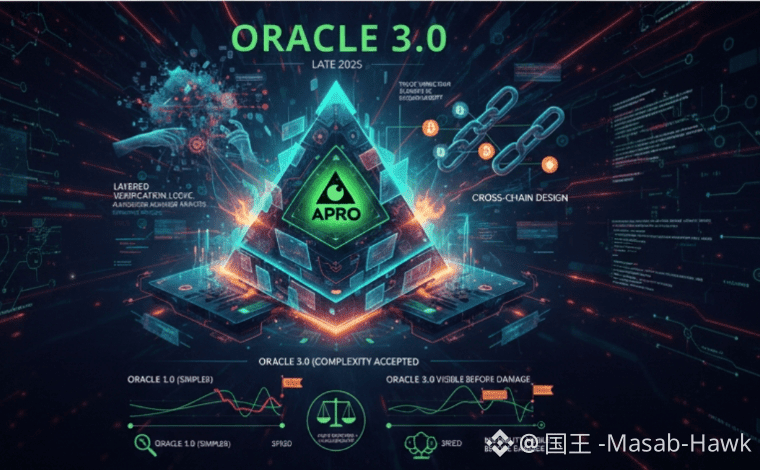
Simple Systems That Fail Quietly:
Blockchains are closed environments. That’s their strength and their weakness. Inside the system, everything is precise. Outside, the world is noisy, uneven, and often contradictory. Oracles sit exactly on that boundary.
Early oracle designs treated this boundary like a math problem. If enough data sources agree, the average must be close to truth. Most of the time, that assumption holds. Until it doesn’t.
Markets jump. Liquidity thins. One data source lags while another overreacts. Averaging smooths the disagreement away, and the system moves on, confident and wrong. No alert. No pause. Just execution.
That’s what quiet failure looks like.
Layered Verification Logic Beneath the Surface:
Oracle 3.0 starts with a less comfortable idea. Disagreement might matter more than agreement.
APRO’s architecture doesn’t try to compress everything into one step. Data passes through layers. Some checks happen off-chain, where heavier computation makes sense. Other checks live on-chain, where rules are enforced openly and consequences are visible.
This layered structure feels slower. Sometimes it is slower. But it also feels more honest. Each stage exists because the system assumes errors won’t announce themselves politely. They’ll blend in.
AI-assisted analysis is part of this, though not in the way marketing usually frames it. It’s not about prediction. It’s about pattern tension. When inputs stop behaving the way they usually do, something flags. Not to panic. Just to say, look closer.
That pause alone changes behavior.
Seeing the Cracks Before They Spread:
One thing that stands out when you actually think about this design is how much it resists the urge to reassure. Many systems are built to make users feel safe. Oracle 3.0 doesn’t really do that. It exposes uncertainty instead.
APRO doesn’t just deliver an output. It leaves a trail. Developers can see where the data came from, where it disagreed, and how the system resolved that disagreement. That visibility feels inconvenient at first. It forces you to confront the fact that real-world data is rarely clean.
But it also shortens the distance between cause and effect. When something goes wrong, it doesn’t feel mysterious. It feels traceable.That matters more than comfort.
Why Legacy Oracle Smoothing Reached Its Limits:
It’s easy to criticize older oracle models with hindsight. That’s not entirely fair. They were built for a different scale. Fewer protocols. Less leverage. Smaller feedback loops.
Today, everything is connected. A distorted feed doesn’t stay local. It travels. One mistake can ripple across lending markets, derivatives, automated strategies, all reacting at machine speed.
In that environment, smoothing becomes a liability. It hides stress right when stress is most dangerous.
APRO’s approach doesn’t pretend this problem disappears. It shifts the focus from hiding instability to managing it earlier. Sometimes that means slowing down. Sometimes it means higher costs. Sometimes it means developers have to make harder choices about trade-offs.
There’s no free lunch here.
Where the Risks Don’t Go Away:
Layered systems are harder to run. They demand more from operators. If requirements grow too heavy, participation can narrow. Decentralization doesn’t erode dramatically. It erodes quietly.
AI introduces its own fog. When a model flags an anomaly, understanding why can take time. That moves trust from simple rules to more complex mechanisms. Some teams will be comfortable with that. Others won’t.
And cost is always present. More verification means more expense. Not every application can justify it. Some will choose speed and accept the risk. That choice won’t disappear.
Oracle 3.0 doesn’t resolve these tensions. It makes them explicit.
Transparency as a Form of Safety:
There’s a subtle shift in mindset here that’s easy to miss. Oracle 3.0 doesn’t ask you to trust the output. It asks you to trust the process.That’s a quieter promise. Less exciting. But in systems where automation leaves little room for human intervention, process matters more than polish.
APRO’s design suggests that trust isn’t something you claim upfront. It’s something you earn by showing your work, especially when the work looks messy. Especially when the data doesn’t line up neatly.
Whether this approach becomes dominant is unclear. Simpler oracles will always exist, and in many cases they’ll be enough. Complexity scares people for good reasons.
Still, as decentralized systems take on more responsibility, quiet failures become more expensive. Systems that surface stress early, even awkwardly, may end up aging better than those that keep everything smooth until it breaks.
Oracle 3.0 doesn’t feel like a breakthrough. It feels like a correction. A step toward infrastructure that admits how fragile the boundary between code and reality really is.
And that honesty, even when uncomfortable, might be the most reliable foundation available right now.

