
Mainnet went live. Builders showed up. Data stopped being something you talked about in theory and started becoming something you had to manage, secure, and reason about in production. For Walrus, 2025 was not a year of loud promises or speculative narratives. It was a year where the system was forced to prove that it could exist under real conditions.
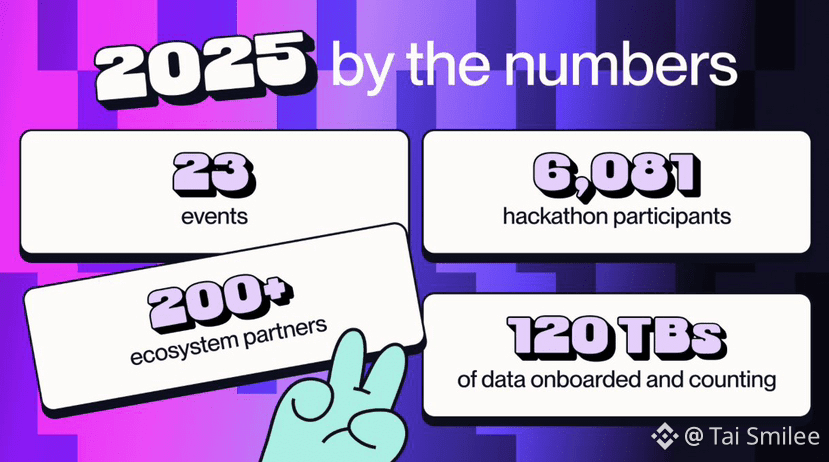
Looking at the numbers alone, it is easy to mistake progress for scale. Twenty-three events. Over six thousand hackathon participants. More than two hundred ecosystem partners. One hundred and twenty terabytes of data onboarded and still counting. These metrics matter, but not because they look good on a slide. They matter because each one represents friction, coordination, and pressure applied to the protocol in environments that cannot be simulated on a whiteboard.
Walrus entered 2025 at a moment when Web3’s relationship with data was changing. Storage was no longer just about persistence. Privacy was no longer just about encryption. And decentralization was no longer just about distribution. Builders were beginning to ask harder questions: who can access data, under what conditions, and how those conditions can change over time without breaking the system.
The launch of mainnet turned those questions from abstract concerns into immediate constraints. Once developers start building, there is no room for ambiguity. Data schemas become commitments. Access rules become attack surfaces. Performance assumptions become bottlenecks. Walrus had to operate not as a concept, but as infrastructure that others depend on.
One of the most telling signs of this transition was the nature of developer engagement throughout the year. Hackathons were not just about experimenting with novel ideas. They became stress tests. Six thousand participants is not just a community statistic; it is six thousand different mental models trying to use the same primitives in different ways. Every misuse, every unexpected integration, exposed edge cases that no internal team could anticipate.
This is where programmable privacy began to reveal its real value. Traditional privacy models in Web3 often rely on binary states: data is either public or private. That simplicity breaks down quickly in real applications. Developers need conditional access. They need data to be private by default, selectively revealed under specific circumstances, and revocable when those circumstances change.
Walrus’s approach to privacy treats it as logic, not configuration. Privacy rules become part of the execution layer, not an external constraint. This distinction is subtle but crucial. When privacy is programmable, it can evolve alongside application logic instead of resisting it. Builders do not have to choose between usability and protection; they can define the trade-offs explicitly.
The growth of the ecosystem partners reflects this shift. Over two hundred partners does not mean two hundred identical integrations. It means two hundred different interpretations of what decentralized data should enable. Some partners focus on storage-heavy applications. Others build privacy-sensitive coordination layers. Others explore entirely new use cases that only become viable when data access is no longer all-or-nothing.
What ties these efforts together is not a single narrative, but a shared assumption: data infrastructure must be composable. Walrus does not attempt to dictate how data should be used. Instead, it provides primitives that allow others to define their own rules. This is a harder path than opinionated design, but it scales better across unknown futures.
The 120 terabytes of onboarded data is another indicator of this maturity. Large data volumes are not impressive by themselves. What matters is that this data is being actively used, queried, and governed under real conditions. Each dataset introduces questions about cost, latency, access control, and long-term persistence. Managing these trade-offs is where infrastructure either proves itself or collapses.
Events played a different role than simple community building. Twenty-three events across regions and ecosystems created feedback loops between builders, researchers, and operators. These were not just showcases. They were alignment mechanisms. When people with different assumptions about privacy, performance, and decentralization sit in the same room, weak ideas fail quickly.
This process shaped how Walrus positioned itself by the end of the year. Rather than framing the protocol as a finished product, the messaging increasingly reflected a system in continuous execution. Mainnet was not the finish line. It was the beginning of accountability. Once live, every design decision becomes visible in how others build on top of it.
The phrase “privacy became programmable” captures this shift more accurately than any feature list. Programmability implies responsibility. When developers can define privacy logic, they also inherit the consequences of those definitions. Walrus provides the tools, but it does not remove the need for judgment. This is an important cultural signal in an ecosystem often tempted by automation without oversight.
By the end of 2025, it became clear that Walrus was not optimizing for hype cycles. The growth pattern was steady, sometimes unremarkable on the surface, but resilient under scrutiny. Builders stayed not because incentives were extreme, but because the infrastructure matched their needs as applications matured.
This is why 2025 feels like a starting point rather than a highlight. The hardest problems around decentralized data are not about launching a network. They are about sustaining trust as complexity increases. They are about handling mistakes without cascading failure. They are about allowing systems to evolve without rewriting their foundations.
Walrus entered this phase earlier than most. By committing to mainnet, embracing developer pressure, and exposing its assumptions to real usage, it accepted short-term friction in exchange for long-term clarity. The numbers tell part of the story, but the deeper signal lies in how those numbers were produced.
Infrastructure that survives contact with reality tends to look quieter than its competitors. It grows through usage rather than announcements. It accumulates data rather than attention. Walrus’s 2025 reflects this pattern.
If this was just the start, it is because the real work begins after validation. Programmable privacy is not a destination. It is a framework for navigating a future where data is valuable, dangerous, and unavoidable. Walrus spent 2025 proving that such a framework can exist. The next phase will test whether it can endure.

