
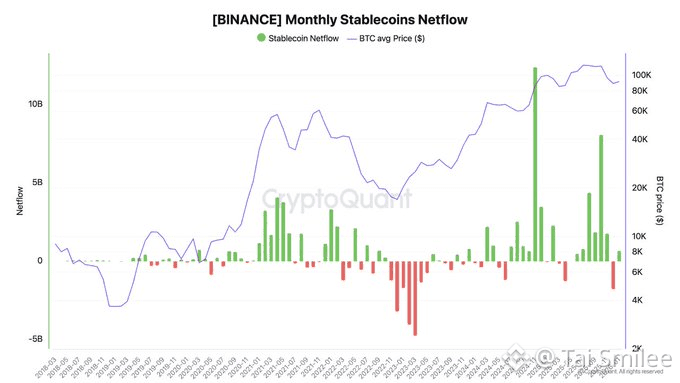
December closed with Bitcoin ( $BTC ) marking its third consecutive monthly decline, posting a correction of around –3.2%. However, the key takeaway wasn’t the price drop itself — it was the liquidity backdrop behind it.
While $BTC gradually corrected, Binance recorded its largest net stablecoin outflow since the market emerged from the bear-market bottom. Stablecoin flows often serve as a clear proxy for investor sentiment:
Stablecoins flowing into exchanges → buying demand, capital preparing to deploy.
Stablecoins flowing out → reduced risk exposure, defensive positioning.
The contrast across the final months of the year is striking.
October saw a strong rebound with over $8B in stablecoin inflows. largely driven by the sharp sell-off on October 10, which created attractive buying opportunities.
November cooled significantly, with inflows dropping to roughly $1.7B.
December officially flipped negative. recording more than $1.8B in net outflows. reflecting heightened caution and capital moving off exchanges.
This shift may be driven by increasing market uncertainty. prompting investors to prioritize capital preservation. Additionally, Binance itself may have adjusted its stablecoin reserves as trading activity softened.
The positive signal emerges as we move into January. In just the first week, Binance has already recorded over $670M in stablecoin inflows. This suggests that liquidity is gradually returning to the market’s largest exchange, and capital is beginning to reposition in anticipation of new opportunities ahead.
#Binance #BTC
