

The Reality of Long-Term Decentralized Storage
In decentralized networks, nothing stays stable for long. Nodes drop offline, hardware fails, people come and go it’s chaos by design. This constant churn makes data availability a real challenge. From my experience, a lot of storage protocols look solid on paper, but when the network gets messy, they just can’t keep up. Walrus doesn’t pretend the network is flawless. It accepts the mess and builds around it.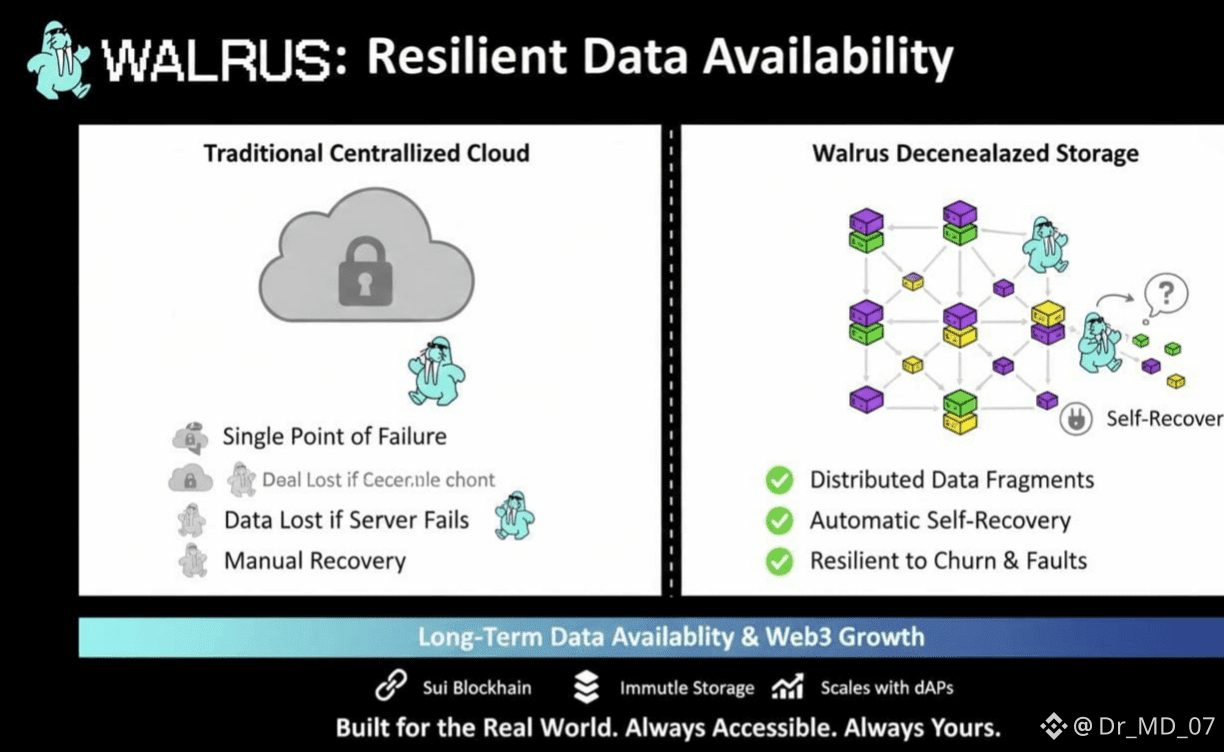
Walrus and Its Core Storage Philosophy
@Walrus 🦭/acc runs as a decentralized, privacy-preserving storage protocol on the Sui blockchain. There’s no single server to trust or to lose. Instead, Walrus splits files into smaller pieces and spreads them across a bunch of independent nodes. If a node vanishes, the data doesn’t go with it. Even if several nodes go dark, your information stays put. That’s the point: resilience through distribution.
Handling Node Churn in a Practical Way
What sets Walrus apart is how it deals with nodes dropping out. Instead of scrambling to rebuild entire files every time a node disappears, Walrus lets the network recover missing pieces as needed. Nodes can request just the parts they’re missing from others that are still online. It’s an approach that expects churn, and adapts. The network doesn’t panic it adjusts and moves on.
Staying Reliable During Network Faults
Network outages, congestion, random disconnects they all happen. Walrus doesn’t freeze up when the network stumbles. Because data lives in many places at once, users can still pull what they need as long as enough fragments are out there. You don’t need a perfect network. Walrus keeps data accessible even when conditions are rough.
Why Self-Recovery Matters
One of Walrus’s best features is self-recovery. When new nodes join or old ones come back online, they rebuild the pieces they’re missing by syncing with the rest of the network. This doesn’t overload the system or demand constant maintenance. In my view, self-recovery isn’t just nice to have it’s essential. For long-term storage, especially for apps that expect their data to stick around for years, you need a network that can heal itself.
Relevance in Today’s Web3 Environment
Web3 projects keep growing, and so does their need for dependable storage. Media files, app states, all the content users create none of it can afford to disappear. Walrus stands out because it meets these demands head-on. Its design lets the network scale, but not at the cost of reliability. That reliability is becoming non-negotiable in the evolving Web3 world.
Conclusion
Walrus keeps data available by treating churn and faults as business as usual. By spreading data out and making recovery simple, it stays reliable even as the network shifts under its feet. From where I stand, this focus on resilience, not perfection, is what gives Walrus its edge for long-term decentralized storage.

