

Let’s start with what most people know. Traditional cloud services are simple upload your files, trust a provider to keep them safe, and hope you can get to them whenever you need. On the surface, Walrus seems to work the same way. You store data and pull it back when you want. But that’s just the beginning. The real difference shows up when you look past this familiar flow. Walrus isn’t just about convenience. It’s about stripping away the hidden strings that come with centralized control.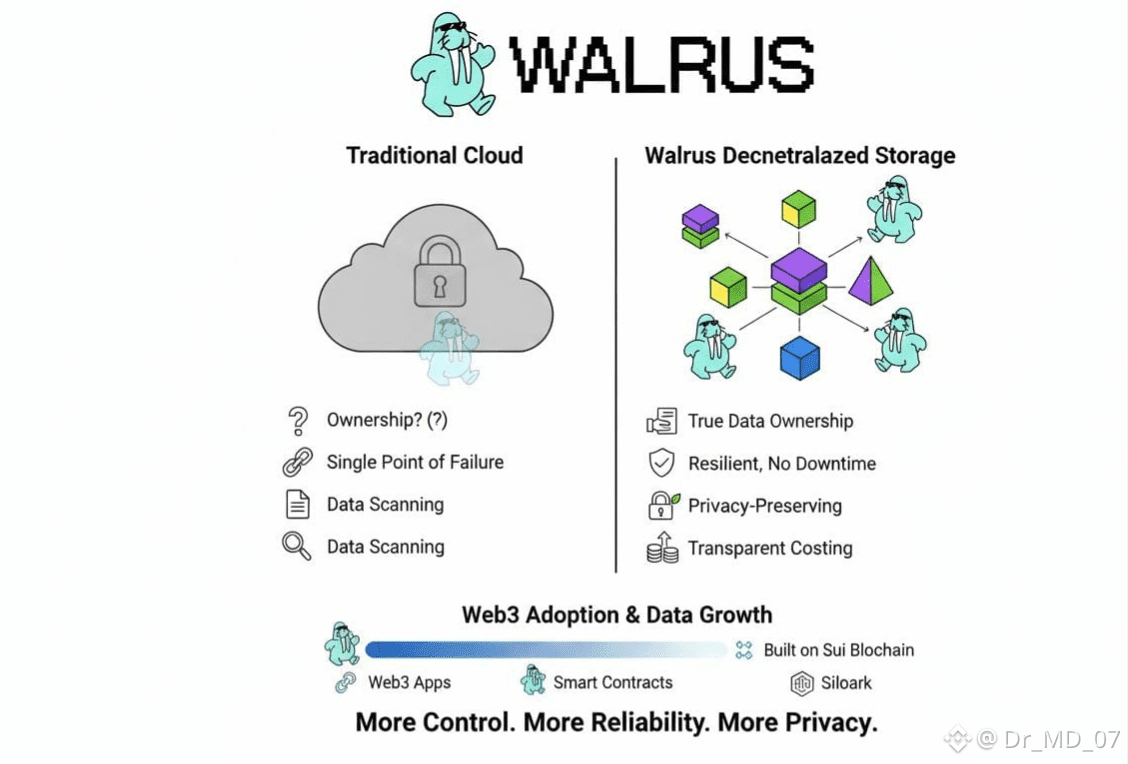
A Shift From Control to Ownership
With the usual cloud providers, you don’t really own your data. A single company calls the shots pricing, rules, even whether your files stay online. Walrus flips this dynamic. Here, your data spreads out across a decentralized network. No single group can suddenly cut you off or take your content away. Using Walrus feels more like actually owning your data, not just renting space from someone else. If you care about independence, this shift feels significant.
How Reliability Really Works
Cloud services seem reliable until they aren’t. Outages, sudden limits, or account bans can hit out of nowhere. Walrus handles reliability in a new way. By distributing data across many nodes, it keeps things running even if some parts go down. You’re not stuck, waiting for one server or company to recover. In practice, this brings a real sense of resilience. Your access doesn’t hinge on one company’s uptime.
Privacy and Data Handling
Privacy stands out even more. Traditional clouds often scan or analyze your files, sometimes without you realizing. Walrus is built for privacy-preserving storage, so you control your information more tightly. That matters if you’re handling sensitive or large-scale data whether you’re an app developer, a business, or just someone who cares about boundaries. With Walrus, the experience feels more respectful and transparent.
Cost Awareness and Transparency
Cloud pricing can get messy fast. The more you use, the harder it becomes to track what you’re actually paying for. Walrus tries to keep things straightforward. It uses decentralized infrastructure to store big files efficiently, and the costs line up with real network usage. You still need to understand some basics about decentralized systems, but at least the pricing feels honest, especially if your data needs keep growing.
Why Walrus Is Getting Noticed
Web3 apps are scaling up fast, and with them, the demand for reliable, always-available storage has exploded. Media, app state, user content it all needs to stick around without putting everything at risk in one place. Walrus runs on the Sui blockchain, using distributed storage to meet this challenge. Its popularity isn’t about chasing buzzwords; it’s about solving a real pain point.
Conclusion
Using Walrus doesn’t feel like depending on a distant service. It feels like you’re part of a shared infrastructure. You get stronger data ownership, better resilience, and a privacy-first mindset. If you want long-term access to your data without the usual centralized strings, Walrus offers a thoughtful new direction one that fits where decentralized systems are headed.

