

In my analysis of infrastructure-layer protocols emerging in 2025–2026, @Walrus 🦭/acc Protocol stands out not because it’s the next altcoin darling, but because it directly addresses one of Web3’s most persistent structural problems how to secure a decentralized network of nodes that store and deliver data at scale without relying on centralized intermediaries. At the center of this design is WAL, the protocol’s native token, which binds economic incentives to node behavior, availability, and decentralization. Understanding how WAL underpins node security is essential for any advanced trader or institutional allocator trying to distinguish durable infrastructure value from speculative narratives.
We are entering an era where data not just transactions defines blockchain infrastructure. AI models, NFT media, on-chain indexing, and complex dApps all require large-file storage with verifiable availability. Centralized cloud providers still dominate this layer, creating a gap for decentralized alternatives that can offer censorship resistance and true digital ownership. Walrus positions itself as a data availability layer integrated with Sui, and WAL is the economic backbone that coordinates behavior across independently operated storage nodes. This matters because blockchains are evolving from transaction engines into platforms that must secure massive off-chain assets while preserving decentralization and WAL is designed to reflect that shift economically.
From a systems perspective, Walrus is not a traditional PoW or PoS chain. It is a decentralized storage network that relies on encoding and on-chain verification rather than block production. When data is uploaded, it is split into smaller slivers using erasure coding (often referred to as Red Stuff). Nodes store subsets of these slivers, and only a portion is required to reconstruct the original data. This lowers storage costs while maintaining high fault tolerance: even if multiple nodes go offline, data remains recoverable. Crucially, nodes must periodically prove cryptographically that they still hold their assigned slivers. These proofs of availability are anchored on Sui and directly tied to WAL-based incentives and penalties.
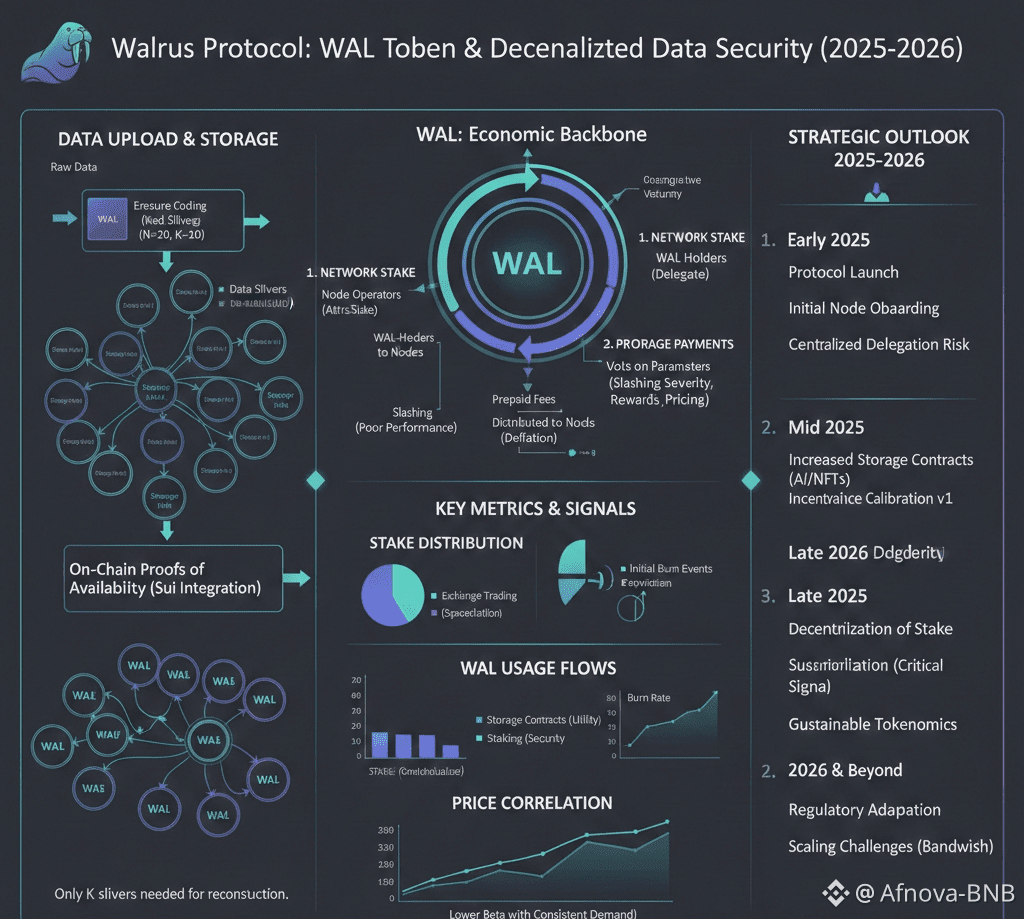
Walrus uses a delegated security model rather than forcing every node operator to self-fund a large stake. WAL holders can delegate tokens to operators they trust, and nodes compete to attract stake based on performance and uptime. This diffuses security responsibility while keeping it anchored in token economics. Nodes that fail availability checks or underperform risk slashing, which affects both operators and their delegators creating a strong alignment between capital and operational reliability.
WAL’s utility extends well beyond simple payments. First, it functions as stake securing the network. Operators must put WAL at risk to participate, and higher-performing nodes attract more delegated stake and, in turn, more data assignments. This creates a feedback loop where capital flows toward reliability. Second, WAL is used to pay for storage. Fees are typically prepaid and distributed to nodes over time, smoothing revenue and discouraging short-term speculation. Portions of payments and penalties can be burned, introducing deflationary pressure that ties real usage to supply reduction. Third, WAL governs the system: holders vote on parameters such as slashing severity, reward curves, and pricing, allowing the security model to adapt as storage demand evolves.
When I look at on-chain and structural signals, I focus less on price and more on stake distribution and usage flows. Early in a network’s life, delegation often concentrates around a few well-known operators—this is a risk to decentralization I’m watching closely. Over time, healthier systems see delegation diversify as performance data accumulates. I also differentiate speculative exchange flows from storage-related WAL movements. WAL used in storage contracts and staking reflects genuine utility, whereas exchange-driven spikes often signal short-term positioning rather than adoption.
For traders, WAL’s design implies that price behavior should increasingly correlate with adoption metrics storage volume, burn rates, and stake distribution rather than pure sentiment. Tokens backed by real usage tend to show lower beta when demand is consistent. Institutions may find WAL attractive because it links revenue (storage fees) to measurable activity and gradually reduces supply through burns. Developers benefit from programmable storage tightly integrated with Sui, which could accelerate adoption in AI, NFT, and data-heavy Web3 applications.
That said, the design has limits. Erasure coding reduces redundancy costs but introduces coordination and bandwidth constraints as usage scales. Adoption is still early, and competing solutions both decentralized and centralized remain entrenched. Incentive calibration is delicate high staking rewards can attract early participation but may create sell pressure if usage lags. Regulatory scrutiny of staking and governance tokens could also force design adjustments over time.
I expect WAL’s trajectory to hinge on measurable adoption growth in storage contracts, diversification of delegated stake, and the balance between token issuance and burns. In the medium term, true decentralization of stake will be a critical signal that network security is robust. From a systemic perspective, WAL exemplifies a tight coupling between economic incentives and data infrastructure demand. For a market increasingly defined by data as value, that linkage is not just interesting it’s foundational.

