
Most tokenization narratives focus on putting assets on-chain. Dusk focuses on something far more difficult: making on-chain assets legally operable at scale. This distinction is where many blockchains fall short and where Dusk’s Confidential Security Contracts (XSCs) become strategically important.
Traditional public blockchains expose ownership and transaction data by default. For regulated assets, this is not a feature; it is a disqualifier. Institutions must comply with investor eligibility rules, disclosure obligations, and jurisdictional restrictions without leaking sensitive information. Dusk was designed specifically to resolve this conflict rather than work around it.
XSCs are not generic smart contracts with privacy added later. They are native Dusk primitives that combine zero-knowledge verification, programmable compliance, and deterministic settlement. Regulatory rules such as transfer restrictions, whitelisting, and disclosure logic are enforced automatically, while transaction details remain confidential. This allows compliance to be proven cryptographically instead of revealed publicly.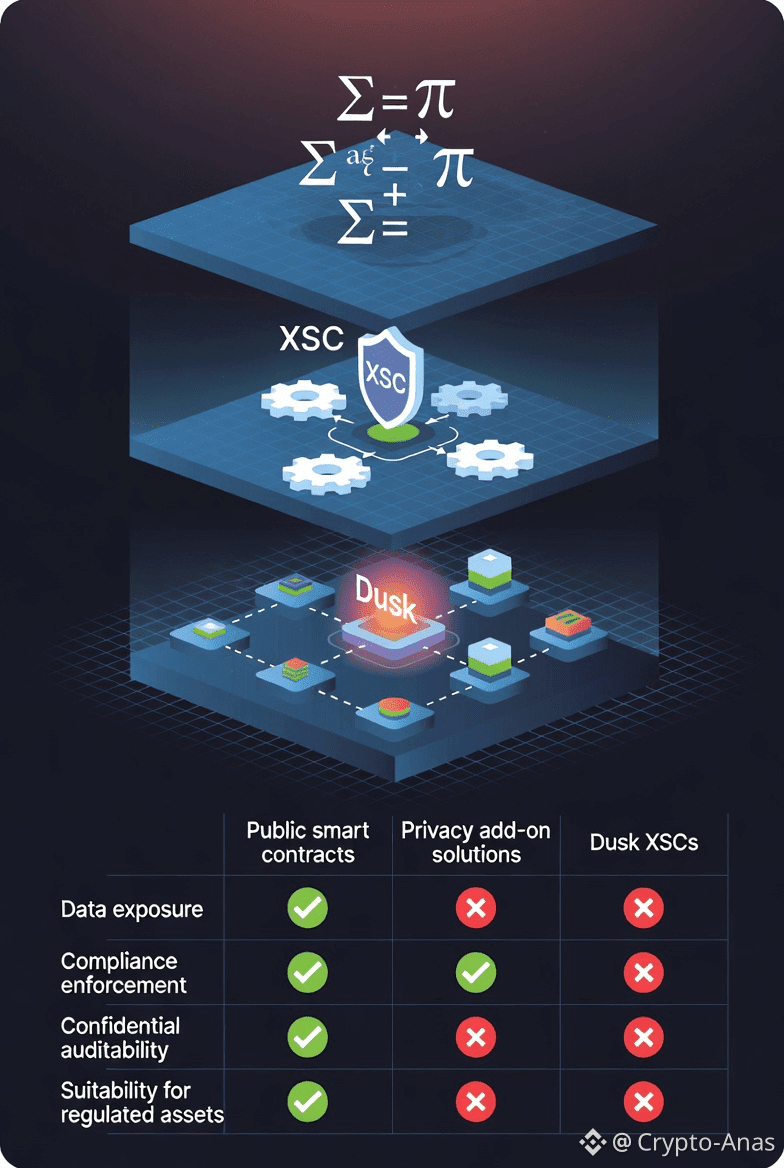
What makes this uniquely relevant to Dusk is how $DUSK secures XSC execution. Validators staking $DUSK are responsible for verifying zero-knowledge proofs and enforcing compliance rules without accessing underlying data. This means token utility scales directly with the volume of regulated activity on the network. As more compliant assets are issued, the network’s security and verification demand increases.
On Dusk, privacy does not reduce trust. It replaces disclosure with cryptographic proof.
Settlement is the final critical piece. Dusk’s Segregated Byzantine Agreement provides instant finality, eliminating reorganization risk. For institutional tokenization, finality is not a performance metric; it is a legal requirement. Once a transaction settles, it is complete and irreversible, aligning on-chain behavior with real-world settlement expectations.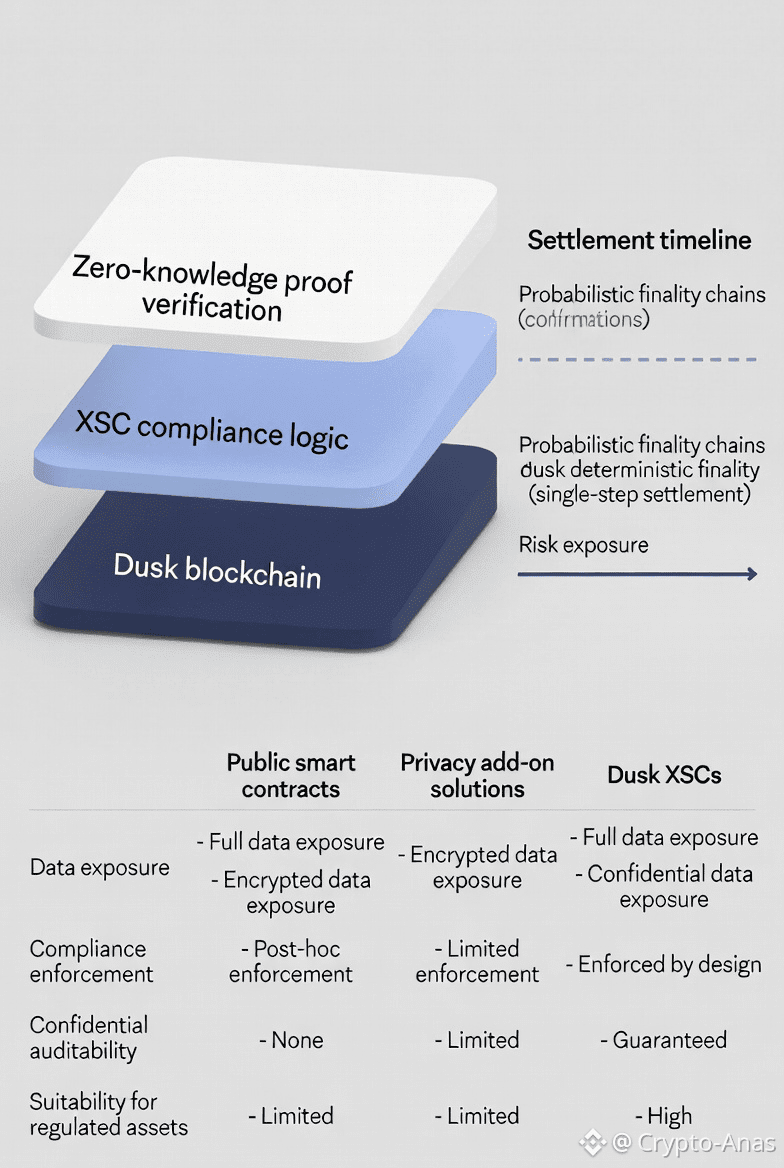
XSCs position Dusk not as a general-purpose blockchain, but as a specialized settlement layer for regulated digital assets. This focus reduces surface area for failure and increases relevance for asset managers, custodians, and issuers who require privacy, compliance, and certainty simultaneously.
Dusk is not trying to make regulation disappear. It is making regulation executable. In the long term, that is how tokenization moves from concept to infrastructure.
