
I’ve watched networks come and go on noise alone, and I’ve also watched the quieter ones survive by doing the unglamorous work. When I dig into Vanar Chain, what keeps pulling me back is that same infrastructure-first attitude, the sense that a chain can be designed to run routines, not just run hype. It feels like the builders care about repeatable execution, about systems that behave the same way at 3 a.m. as they do at noon. That is where automation stops being a feature and starts being a habit.
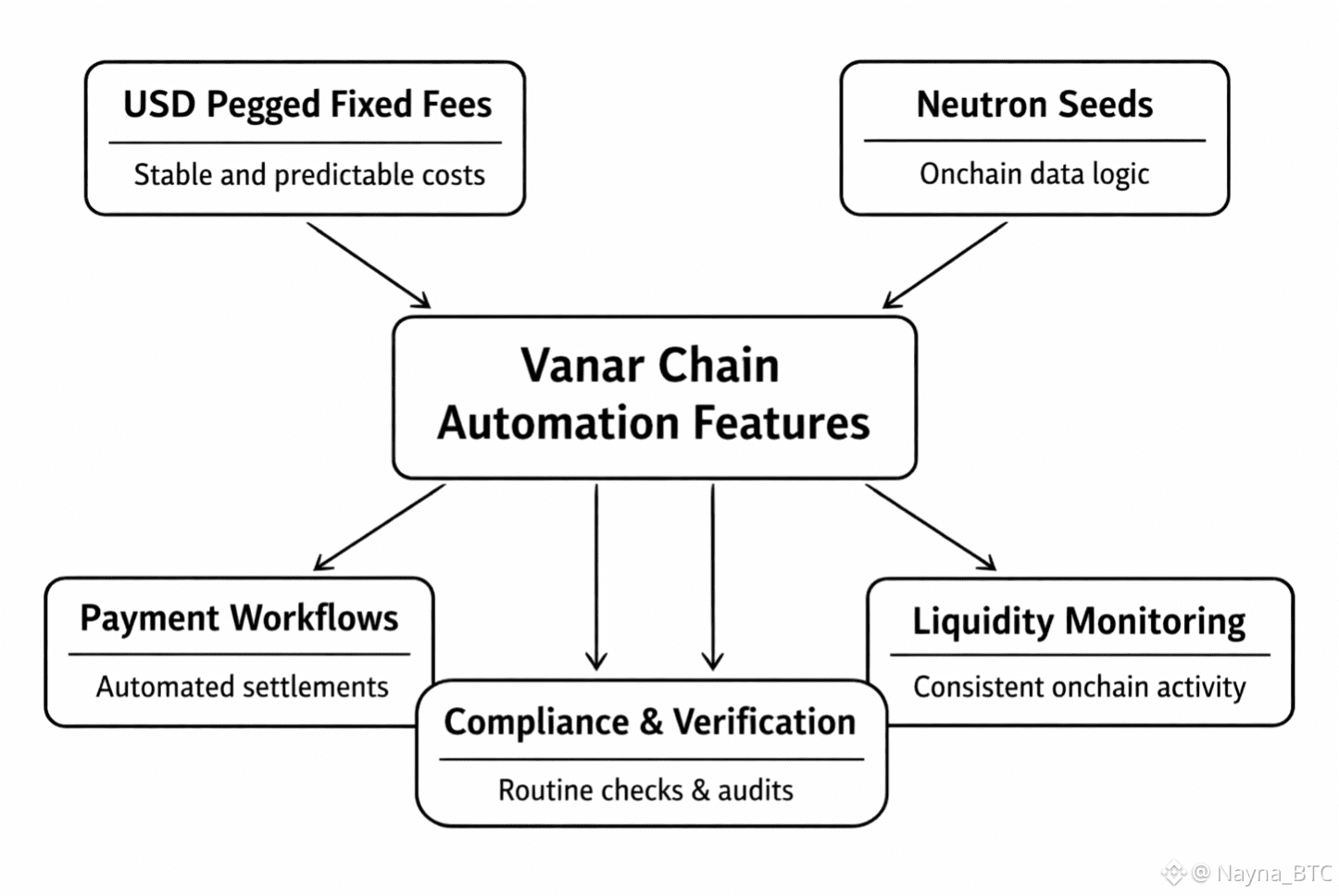
Automation only matters when it is boring. The kind that removes human timing from the loop, so apps can behave like services instead of experiments. Vanar positions itself as a stack built for payments, assets, and onchain agents, with a strong emphasis on structured data and logic layers that can react to it.
To me, that framing is the real automation story. The chain is not loud, it is trying to make state changes feel like standard operations. Quietly building, under the surface, depth over breadth. If you are building workflows that need predictable steps, that posture matters more than most people admit .
I remember the first time I shipped a product where users kept asking, “how much will it cost next week?” That question never really goes away. What I’ve noticed in Vanar’s approach is a clear attempt to treat fees like a managed system, where charges are tied to a stable value reference instead of floating wildly with demand.
The interesting part, from my vantage point, is not the headline claim, it is the automation implied behind it. If you want stable user experience, something has to constantly observe inputs, apply rules, and keep the fee model coherent. That is the kind of automation most chains ignore because it is not flashy, but it is what keeps products usable.
When I dig into Neutron, I keep coming back to the same impression, automation gets stronger when the chain can hold more context. Vanar describes Neutron as a way to compress and restructure data into programmable seeds that live fully onchain.
That quietly changes the shape of automation. Instead of a contract reacting to a single trigger, workflows can respond to richer proofs, files, or policy fragments. Not loud, but practical. Under the surface, it pushes the chain toward routines like verification, reconciliation, and compliance checks that can run without someone watching every step .
Automation becomes real when a network touches the messy edges of payments, refunds, disputes, and timing. Vanar’s work with global payment infrastructure signals an intention to connect onchain execution with systems that already handle scale. I’m not interested in slogans, but I do pay attention when a chain aims at operational flows instead of narratives. In practice, this is where automation looks like scheduled settlements, programmatic payouts, and machine-like handling of payment states. Quietly building means building the boring middle, the part where money movement becomes a routine, not an event.
In my experience, you can feel a chain’s automation culture by looking at how steady its activity is, not how loud it gets during attention cycles. When I checked Vanar’s onchain activity, I noticed a cumulative transaction count in the millions, the kind of number that only comes from repetitive use. Liquidity levels are still modest, sitting in the low seven figures across decentralized venues, but they move with consistency.
That is not a brag, it is a heartbeat. Automation thrives on steady beats, not spikes.
The best automation is the kind you stop noticing. Vanar Chain feels like it is aiming for that, quietly building systems where infrastructure first is more than a slogan, it is a design constraint. If I’m honest, I only glance at price at the end, and lately it has hovered around a cent, which tells me very little by itself. What matters more is whether the routines keep running when attention drifts.
Quiet chains endure by letting the machines do the waiting.
