
If you have been involved in cryptocurrency long enough, you are aware that it is not the tech launch that distinguishes "a promising chain" from "a real market winner." For the first time, regular people are attempting to utilize it and bounce.
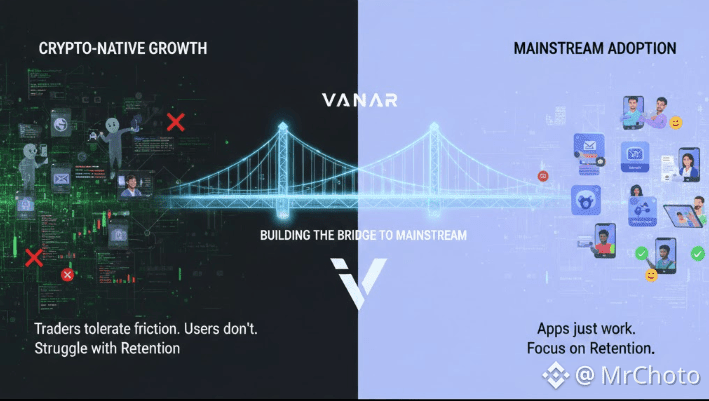
That is the fundamental issue Vanar is dealing with when attempting to get Web3 adoption into mainstream markets. It's not that Vanar lacks vision, but rather that the battlefield of mainstream adoption differs greatly from that of crypto-native growth. Traders are able to put up with friction. Regular users don't. Tokenomics is readable by investors. The typical user only wants the program to function.
Vanar Chain has embraced "AI native" messaging, which describes a multi-layer architecture created for AI workloads and "intelligent" Web3 apps, and portrays itself as infrastructure intended for mass-market adoption. On paper, that story makes sense given the direction the market is taking: AI, consumer apps, increased customisation, and improved user experience. However, the most difficult obstacles, particularly with regard to retention, arise when that promise is translated into widespread dissemination.
The majority of Web3 projects don't fail due of awareness. They struggle with retention.
People are going to click. They'll register. They may even make one wallet connection. They won't stay, though. Furthermore, repeat business is the foundation of mainstream success rather than new users.
After checking the price and volume, a trader may speculate for a week before moving on. A mainstream user needs an incentive to return every day without worrying about fees, chains, bridges, or custody. That's the gap.
VANRY is still a pretty small-cap asset as of right now. According to CoinMarketCap, Vanar Chain has a market cap of about $19 million and a circulating supply of about 2.2 billion tokens. The VANRY/USDT market page on Binance likewise displays a market valuation of about $19.6 million and trade volume of over $4 million. Similar market capitalization data and recent daily volatility are displayed by CoinGecko (declines and rebounds across days are usual at this magnitude).
That market profile is important to investors because it influences the adoption path. The mainstream doesn't adopt small-cap ecosystems "because the tech is better." Distribution, collaborations, or successful apps are how they obtain it. Furthermore, whether the chain is constructed on a five-layer architecture, AI-native, or compatible with EVMs is irrelevant to the general public. Results are important to them.
What, therefore, is preventing the bridge from entering mainstream markets?
Onboarding friction comes first.
The moment a new user sees wallet creation screens, seed phrases, and network settings, mainstream adoption ends. Many consumers who are fascinated about cryptocurrency never go past that point. Vanar may benefit from viewing Web3 as a back-end detail rather than a front-end identity. You're already restricting your addressable market if the initial encounter seems like cryptocurrency.
Uncertain consumer value comes in second.
"Blockchain" is not adopted by mainstream markets. They embrace what they already know, such as entertainment, payments, identity, gaming, and loyalty benefits. In certain aspects of its ecological story, Vanar has pushed toward gaming and entertainment positioning. That's a good direction, but it needs to be executed brutally so that the user can profit without having to learn new ideas. The finest apps from Vanar are still niche and seem like Web3 goods.
Third: dependability and trust.
Mainstream customers anticipate dependable app performance, recovery options, and customer support. Often, Web3 doesn't provide any of that. The chain's security is insufficient. The entire product experience needs to feel secure. If someone makes one mistake, loses access, or forgets their password, they are gone forever. This is not merely a support issue; it is a retention killer.
The fourth is the imbalance between liquidity and utility.
Like most tokens, VANRY is now traded as an asset. However, tokens must be unseen, or at least secondary, in order to be widely used. Speculators are drawn to ecosystems that feel more "token-first" than users. Although it alters incentives, that isn't always a bad thing. Volatility is caused by speculators. Mainstream partners are afraid about volatility.
Let's make it real now.
Imagine Vanar being considered by a major gaming studio. "Does your chain have AI workloads?" is not a question they pose. "Can you help us reduce fraud, improve retention, and monetize better than Web2 tools?" they inquire. They won't ship there if the response isn't quick, quantifiable, and verifiable. Traditional infrastructure may already be expanded upon with predictable prices and fewer legal complications.
And for Vanar, this is the reason "The Retention Problem" is so important.
Getting users in the door is only one aspect of adoption. Getting them to come back tomorrow is the goal. Network effects begin with retention. Revenue stabilizes at retention. Mainstream reputation is developed through retention.
What does bridging actually look like?
It appears to be apps where consumers sign in using email addresses rather than seed words.
It appears to be sponsored or abstracted fees.
greater ownership, greater rewards, and better portability appear to be advantages that don't require schooling.
It appears to be collaborations in which Vanar is subtly integrated as infrastructure rather than prominently advertised as a product.
The story changes from "interesting chain" to "real distribution" if Vanar can create even one or two consumer-grade applications that maintain users at Web2-level standards with daily or weekly active usage, seamless onboarding, and high repeat engagement.
If it can't, it runs the risk of suffering the most typical destiny in cryptocurrency: a compelling narrative, a devoted following, respectable market activity, but no widespread adoption.
Don't merely follow price candles if you're a trader or investor following VANRY. Monitor retention indicators such as active users, actual app usage, recurring interaction, and collaborations that attract audiences outside of the cryptocurrency space. Long-term value is produced there.
Treating Vanar as a business adoption thesis rather than a chart thesis is the straightforward call to action. Real usage growth and retention, as opposed to hype, indicate that the bridge to mainstream markets is being constructed in real time. #vanar $VANRY


