
High read and write performance is intended to be a default feature of Walrus rather than a unique improvement. From the client's point of view, engaging with Walrus feels more like working with contemporary cloud storage than with early decentralized systems; it is quick, parallel, and predictable while maintaining decentralization and robust security assurances.
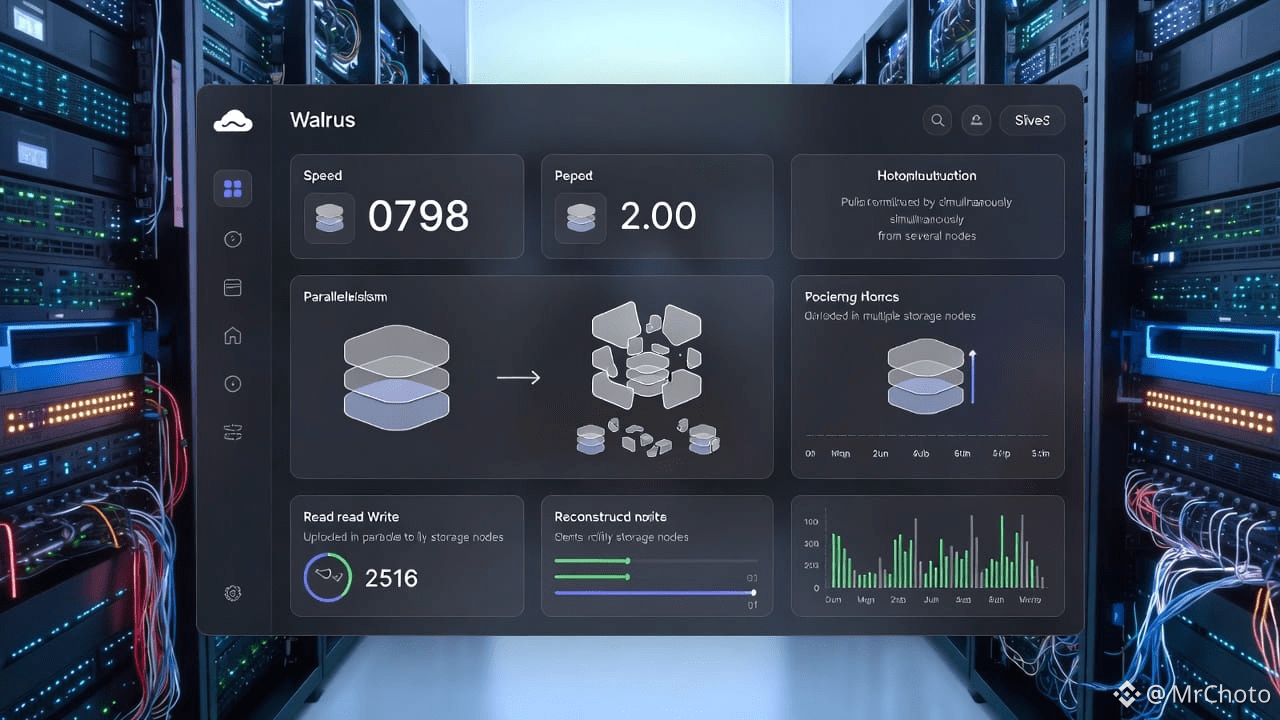
Walrus's high write throughput is a result of the way data is spread and packaged. The data is divided and erasure-coded into numerous smaller slivers when a client writes a blob.

Then, instead of being sent sequentially to a small number of replicas, these slivers are uploaded in parallel to several storage nodes. No single node becomes a bottleneck since each node only gets a portion of the data. The system can continue even if some nodes are sluggish or momentarily unavailable because the client just needs acknowledgements from a quorum of nodes to finish the write.
Walrus uses parallelism once more. By simultaneously retrieving slivers from several nodes, a client reconstructs data. The client can disregard slow or unavailable nodes and finish reading as soon as responses are received because any sufficiently big subset of slivers can recover the original blob. Because of this, read performance is resistant to node turnover, network variation, and partial failures—all of which are frequent in decentralized settings.
Walrus keeps data transport and availability proofs apart. Clients do not have to wait for lengthy verification procedures in order to read or write data because storage nodes constantly demonstrate that they contain valid data. The delay penalties associated with systems where each operation is closely linked to costly decoding or on-chain verification are avoided by this approach.
Walrus provides clients with consistently excellent throughput for both reads and writes by combining erasure coding, quorum-based completion, and aggressive parallelism. The end product is a decentralized storage network that is fast enough to serve real-world applications, such as long-lived public datasets and data-intensive Web3 services, while scaling with the number of nodes.@Walrus 🦭/acc $WAL

