
$DUSK Most blockchains compete for attention by promising speed, composability, or user growth. A smaller and more consequential group competes on something less visible but far more durable: credibility with institutions that operate under law, supervision, and audit. In the current market cycle, this distinction matters more than price action suggests. As regulatory clarity advances unevenly across jurisdictions, the infrastructure layer is being repriced not on narrative appeal but on its ability to support compliant financial activity at scale. Dusk Network sits precisely at this intersection, and understanding it requires stepping away from retail crypto framing and into the logic that governs real financial systems.
Dusk was founded in 2018, long before “regulated DeFi” became a phrase repeated in conference panels and policy briefings. That timing is not incidental. The network was conceived in an environment where privacy was already recognized as essential to financial markets, but where most public blockchains treated privacy as either an optional add-on or an ideological stance. Dusk’s premise was different. Financial institutions do not choose between privacy and compliance; they require both simultaneously. Markets function because sensitive positions remain confidential while accountability remains enforceable. Any blockchain aspiring to host real financial activity must replicate this balance natively rather than retrofit it later.
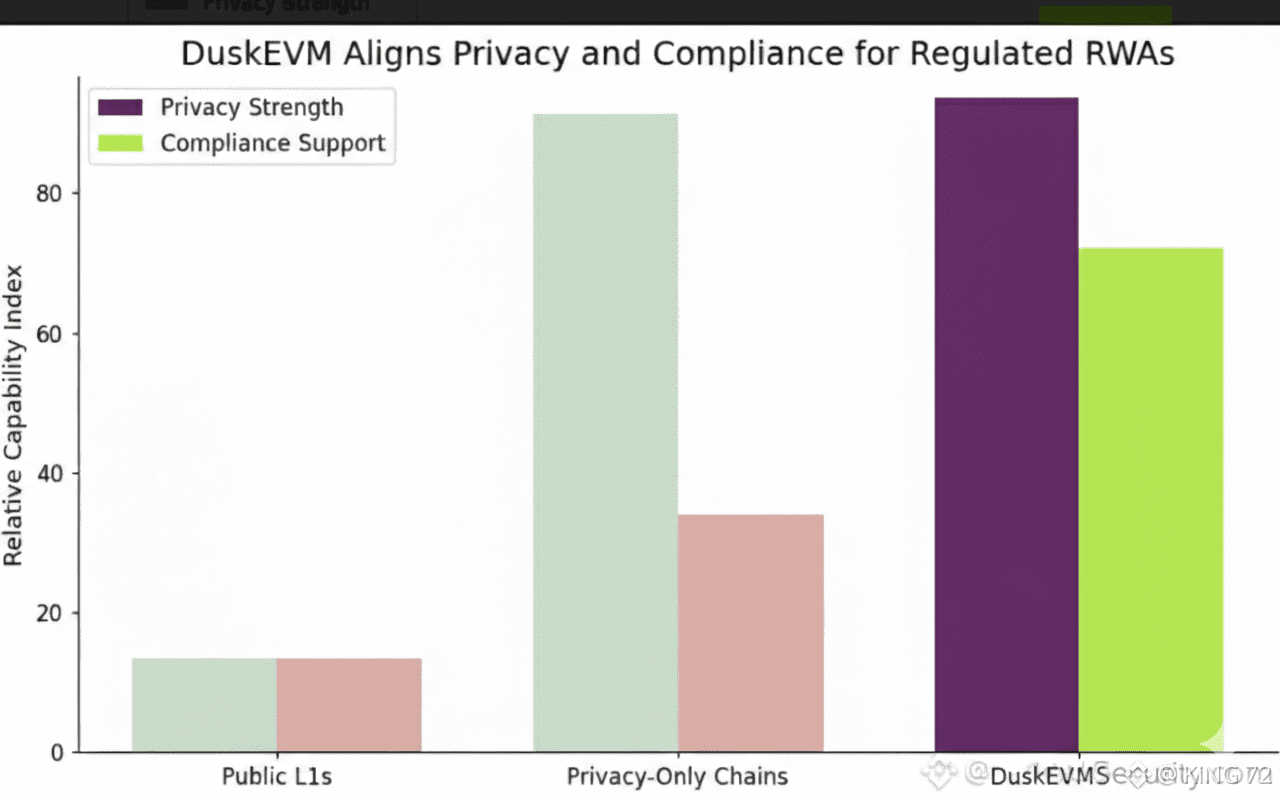
This foundational assumption shapes everything about Dusk’s architecture. As a layer 1 blockchain, it does not attempt to be all things to all users. Instead, it focuses narrowly on financial infrastructure that must operate under regulation without sacrificing the confidentiality that institutions and counterparties expect. Privacy on Dusk is not a cosmetic feature designed to obfuscate activity from oversight. It is a structural property designed to allow selective disclosure, auditability, and compliance without exposing market-sensitive information to the public domain. This distinction is subtle, but it is precisely where many blockchain narratives fail under scrutiny.
The market often treats privacy as a binary attribute: either transactions are public or they are hidden. Institutional finance does not operate on that axis. Positions, counterparties, and strategies are private by default, but regulators, auditors, and courts retain the ability to inspect activity when legally required. Dusk’s approach aligns with this reality. Its cryptographic design enables confidentiality while preserving provable correctness and audit trails. That alignment is what makes the network relevant to tokenized securities, regulated stable assets, and other real-world financial instruments that cannot exist on purely transparent or purely opaque ledgers.
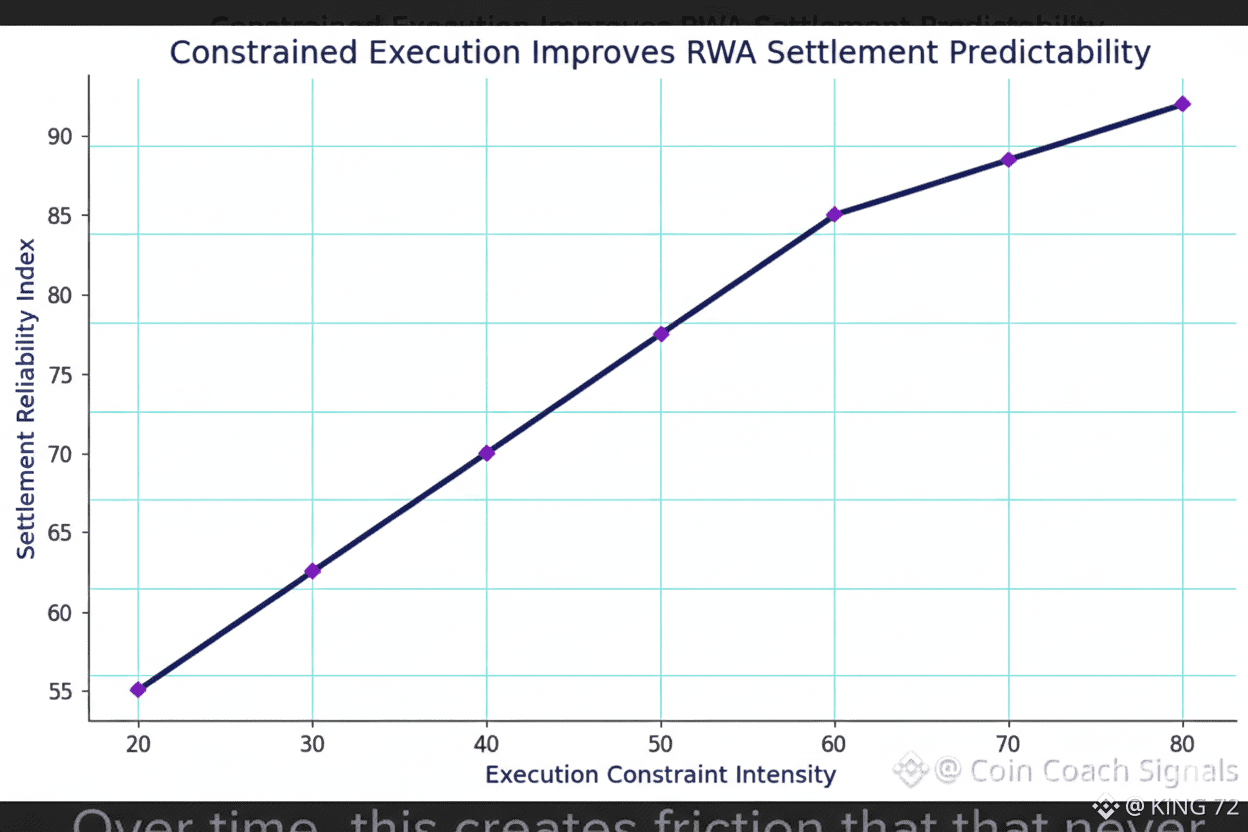
Modularity plays a central role here. Rather than forcing all applications into a single execution and privacy model, Dusk’s architecture allows financial primitives to be built with specific regulatory and confidentiality requirements in mind. This modularity mirrors how traditional financial infrastructure evolves. Clearing, settlement, custody, and issuance are distinct layers, each with its own controls and participants. A blockchain that collapses all these functions into a single, undifferentiated environment may be elegant from a developer’s perspective, but it is misaligned with institutional workflows. Dusk’s design choices suggest an understanding that adoption follows operational fit, not ideological purity.
Tokenization of real-world assets is often discussed as a future catalyst for blockchain adoption, yet most conversations remain superficial. Tokenization is not simply about representing assets on-chain; it is about ensuring that legal rights, transfer restrictions, and compliance obligations are enforceable in a digital environment. For equities, bonds, and structured products, confidentiality around ownership and trading activity is not optional. Dusk’s privacy-preserving smart contracts address this directly, enabling issuance and secondary market activity without broadcasting sensitive information to the entire network. This is less exciting than meme-driven DeFi innovation, but it is far closer to how capital actually moves.
What makes this especially relevant now is the shifting regulatory landscape. Jurisdictions are no longer debating whether blockchain-based finance will exist; they are defining the conditions under which it can operate. Networks that cannot support identity frameworks, compliance checks, and auditable privacy will increasingly be excluded from institutional use cases. Dusk’s early focus positions it not as a reaction to regulation but as an infrastructure aligned with it. That difference matters to institutions evaluating long-term platform risk rather than short-term experimentation.
Market perception often lags architectural reality. Tokens trade on liquidity, narrative, and macro sentiment long before infrastructure value is fully priced in. This creates a familiar pattern for those with an institutional mindset: assets that appear quiet or under-discussed during speculative cycles often represent deeper optionality when market structure shifts. Dusk does not dominate headlines because its value proposition is not retail-facing. It is oriented toward issuers, regulators, and financial intermediaries whose timelines are measured in quarters and years, not social media cycles.
This brings us to the question of visibility and authority within crypto discourse. Platforms like Binance Square reward early engagement, coherent narratives, and analytical consistency. Articles that resonate tend to do so not because they promote projects aggressively, but because they frame market realities that readers recognize intuitively but have not articulated. In that sense, writing about Dusk effectively requires adopting the same disciplined reasoning its architecture embodies. The argument must unfold logically, from the nature of regulated finance to the requirements of blockchain infrastructure, and finally to the implications for networks built with those constraints in mind.
A key mistake in many project analyses is treating adoption as a popularity contest. Institutional adoption is closer to counterparty selection. Banks, asset managers, and issuers care less about daily active users and more about legal certainty, operational resilience, and reputational risk. A blockchain that can demonstrably support regulated financial products without data leakage or compliance gaps offers a different kind of value. That value is slow-moving but sticky. Once integrated into issuance or settlement processes, infrastructure tends to persist because switching costs are high and trust is cumulative.
Consistency matters more than momentary attention in both markets and media. Just as a trader’s credibility is built through repeatable decision-making rather than one exceptional trade, a blockchain’s credibility is built through sustained alignment with its target users. Dusk’s development trajectory reflects this. Rather than pivoting with each narrative cycle, it has continued refining privacy-preserving mechanisms, compliance-friendly features, and institutional tooling. This steady approach rarely generates explosive short-term hype, but it does generate something more durable: confidence among stakeholders who cannot afford experimental risk.
Early interaction and discussion around analytical content extends its lifespan in much the same way liquidity sustains a market. When knowledgeable readers engage with an argument, testing assumptions or adding nuance, the content gains depth and relevance. Dusk, as a topic, tends to attract this kind of engagement precisely because it sits at the intersection of cryptography, regulation, and finance. These are domains where practitioners have strong views shaped by experience, and where thoughtful disagreement signals seriousness rather than fragmentation. Over time, this kind of discourse contributes to a project’s perceived legitimacy.
Developing a recognizable analytical voice around such projects is an underappreciated asset. Readers return not for updates alone, but for a particular way of interpreting events. An institutional voice avoids extremes. It acknowledges uncertainty, avoids promises, and frames progress in terms of incentives and constraints. Writing about Dusk through this lens positions it not as a speculative bet, but as a case study in how blockchain infrastructure is evolving to meet real financial requirements. That positioning resonates with readers who are already thinking beyond retail cycles.
The broader implication is that the market for financial blockchains is fragmenting along functional lines. General-purpose platforms will continue to serve open experimentation, while specialized networks will absorb regulated activity. Dusk belongs to the latter category. Its success does not depend on capturing mass user attention but on embedding itself into workflows where privacy, compliance, and auditability are non-negotiable. If tokenized securities, regulated DeFi, and institutional settlement migrate on-chain, they will do so on infrastructure that respects the logic of existing financial systems. Dusk’s architecture suggests it was built with that destination in mind.
In closing, Dusk Network represents a quieter but more structurally significant thesis in blockchain markets. It challenges the assumption that transparency alone is virtuous and replaces it with a more mature understanding of how finance actually functions. By integrating privacy and auditability at the protocol level, it offers a foundation for financial applications that must operate under regulation without compromising confidentiality. For observers willing to look past short-term narratives, Dusk provides insight into where blockchain infrastructure is converging with institutional reality. That convergence may not trend on any given day, but it is where durable value is ultimately formed.
