
The article frames Walrus as a storage layer built with Sui’s execution model in mind, rather than a generic decentralized file system. The core design choice is to treat data availability as an engineering constraint rather than a purely economic problem. Files are broken into segments and further into smaller fragments, with additional encoded fragments generated to create redundancy. This allows reconstruction of data even if several storage providers become unavailable, reducing dependence on any single operator.
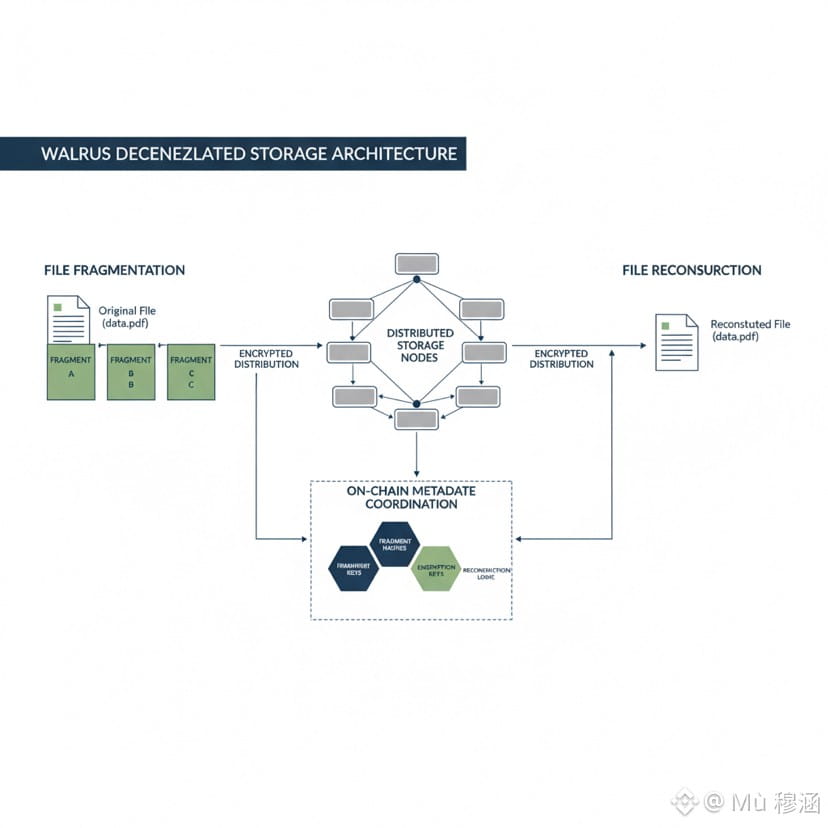
Storage fragments are distributed across multiple providers, and their relationships to the original file are recorded as metadata on-chain. This separation between physical storage and on-chain indexing means the network can restore files without querying a central coordinator. In practice, the blockchain acts as a reference layer, while storage providers act as execution infrastructure.
Walrus introduces a Proof-of-Authority sealer layer to oversee storage integrity. Sealers are selected dynamically and are responsible for auditing providers, verifying uploads, and coordinating recovery when fragments are missing. This adds an explicit verification layer above raw storage, prioritizing predictable behavior over full permissionless participation. The sealer set is not static, which is intended to reduce the risk of coordinated censorship.
The WAL token is positioned as a coordination and accountability mechanism rather than a purely speculative asset. Users pay for storage in WAL, while providers stake tokens to signal commitment. Misbehavior, such as failing to store fragments, can trigger penalties through token burning. Governance decisions related to protocol upgrades and system parameters are also mediated through token voting. The supply is structured across community reserves, early users, development incentives, core contributors, and investors, with long vesting schedules to smooth distribution over time.
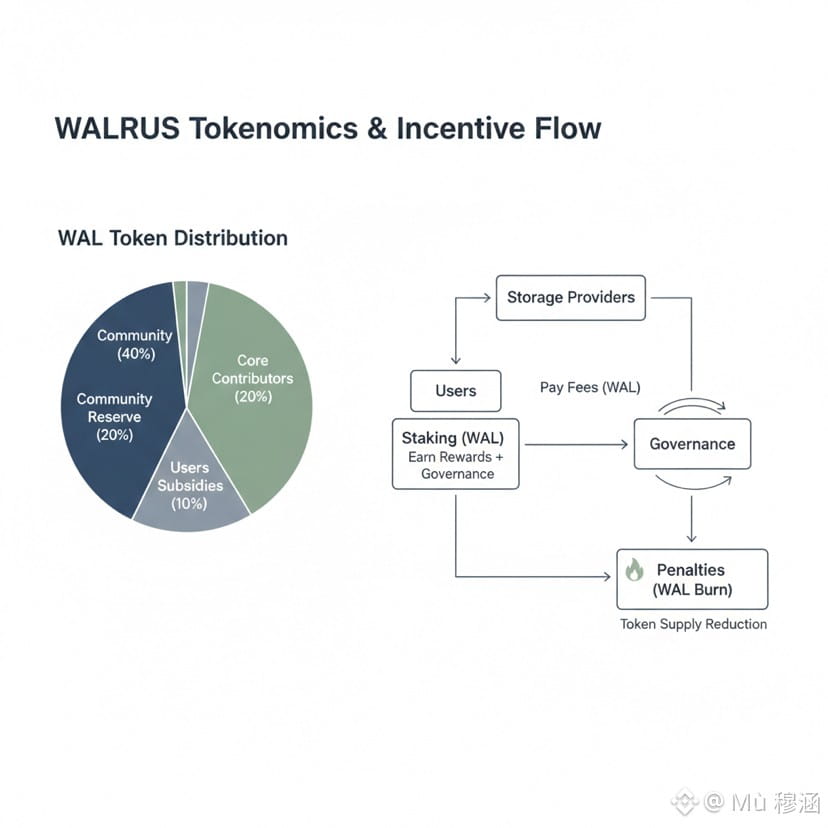
The article also acknowledges structural dependencies. Walrus requires sufficient provider participation to maintain redundancy, and the sealer network must remain diverse enough to avoid concentrated control. Token incentives are designed to encourage uptime and penalize data loss, but long-term effectiveness depends on sustained economic activity rather than initial distribution alone.
Overall, Walrus is presented as a storage architecture optimized for Sui’s environment, emphasizing recoverability, verifiability, and controlled decentralization rather than maximal openness at any cost.

