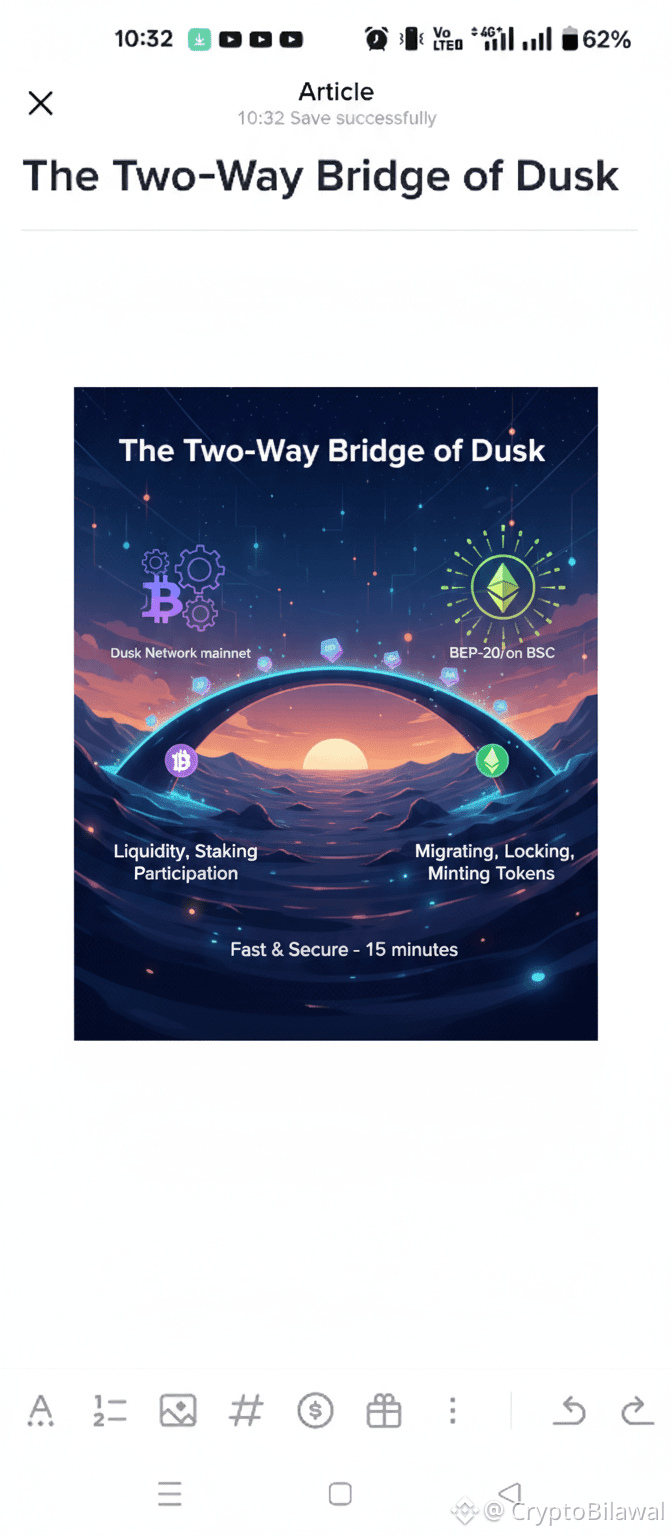
The DUSK Bridge is a two-way, native bridge designed to move DUSK tokens between the Dusk Network mainnet and other chains (specifically BEP-20/BSC and ERC-20), enabling liquidity, staking, and participation in the DuskEVM/DuskVM environments. The bridge is accessed via the Dusk Web Wallet, typically takes 15 minutes, and supports migrating, locking, and minting tokens to expand asset utility without changing the total supply.
Details of the DUSK Bridge
Two-Way Functionality: Users can transfer DUSK between the native network and external chains (e.g., BEP-20 on BSC).
Token Migration & Utility: The bridge supports the migration of ERC-20/BEP-20 DUSK into the native environment, while also allowing users to utilize DUSK for gas, staking, and privacy-preserving computations on different layers.
Process: The process involves locking native tokens on the Dusk mainnet to release an equivalent amount on the target chain (e.g., BSC).
Time & Cost: Transactions typically complete within 15 minutes, with a small fee (e.g., 1 DUSK) applied to cover gas costs.
Management: The bridge is designed to be seamless for users, managing complexity internally within the protocol rather than on the user side.
Status: As of mid-January 2026, the bridge service experienced a temporary closure for review, with plans to resume operations.
The bridge is a crucial component for the Dusk Network, which acts as a privacy-focused blockchain for financial applications, allowing for compliance, control, and secure, confidential transactions.
Until now, DUSK could only be bridged from ERC20 or BEP20 into native DUSK on the Dusk mainnet. With this update, users can now go in both directions; bridging native DUSK out to BSC, and using it across BSC-compatible platforms.
Bridging takes place via the Dusk Web Wallet, and instructions can be found here.
What This Means
Users now have the option to move between chains based on convenience, platform compatibility, or DeFi access.
Importantly, this update improves interoperability without compromising on security or transparency.
With mainnet now 5 months old and running without issues, work for DuskEVM (the EVM-compatible L2) well underway, now is the right time to begin opening up the Dusk ecosystem.
We know our blockchain works, and this is the first of many steps to connect Dusk not only to TradFi, but to the broader crypto ecosystem.
We expect there to be more updates in the future focused on interoperability, DeFi, and increased connectivity to the wider crypto-sphere allowing for a blending between on-chain DeFi, RWAs, regulated assets, and chains.
How It Works
When users want to bridge native DUSK from Dusk mainnet to BSC:
Send native DUSK to the BSC bridge wallet on Dusk mainnet.
Provide a BSC wallet address to receive the BEP20 DUSK.
On-chain validation occurs: the Dusk protocol locks the mainnet tokens, and triggers a mint on BSC.
This is possible because BEP20 DUSK on BSC is treated as a wrapped asset; the minting on BSC is only allowed after proof of a lock on the mainnet side. This makes native DUSK on Dusk mainnet the source of truth, strengthening our position as the most secure issuance layer for DUSK.#DUSK $DUSK @Dusk