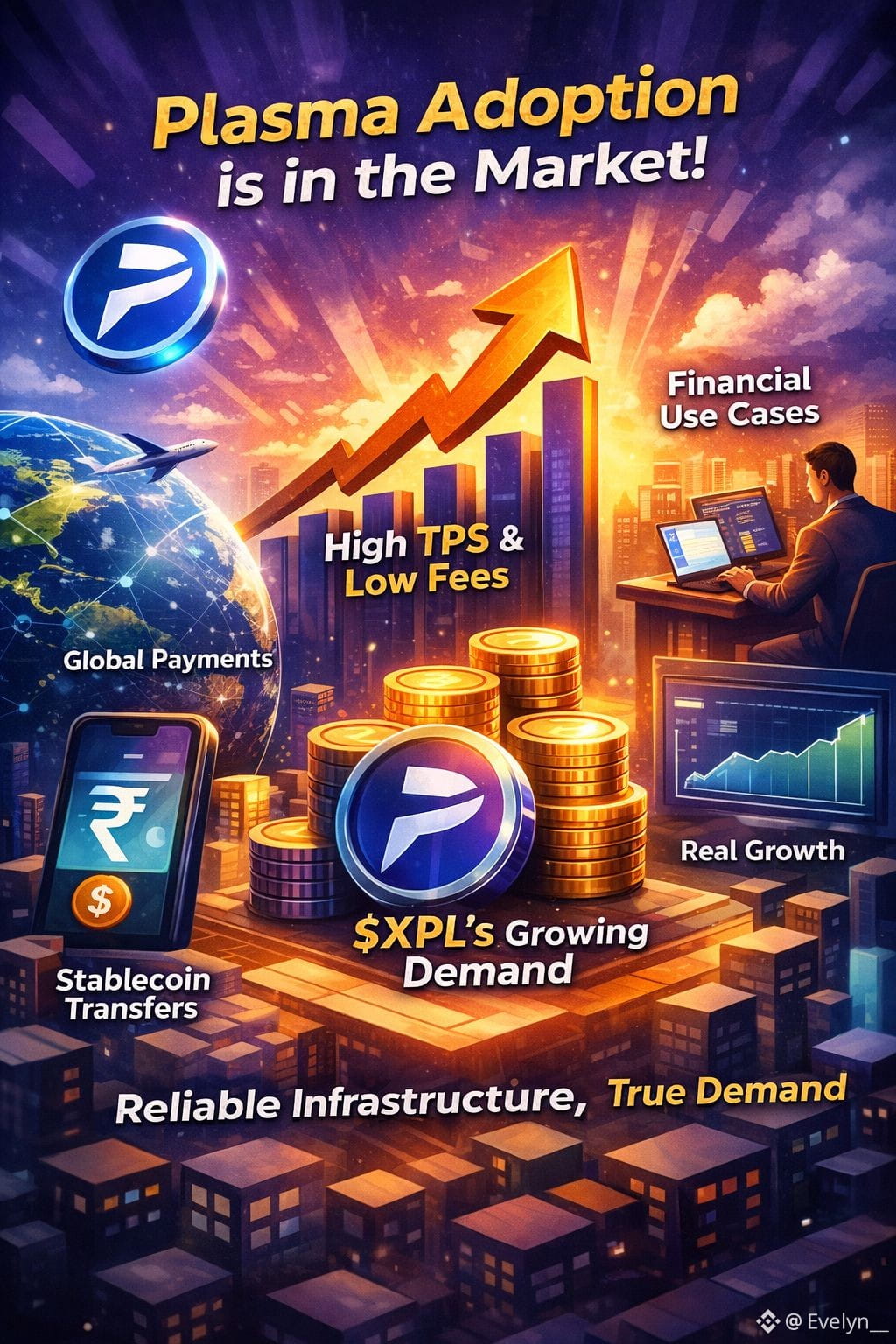
Most blockchain projects aim to be many things at once. Smart contract hub. DeFi platform. NFT ecosystem. Gaming layer. Plasma doesn’t read like it’s following that playbook. Its direction feels more deliberate, and arguably more difficult: focusing on financial throughput where failure isn’t tolerated.
Payments expose weaknesses quickly. If fees spike unpredictably, users leave. If throughput degrades, businesses look elsewhere. Plasma’s emphasis on stable performance suggests the team understands that financial adoption isn’t about novelty. It’s about trust built through repetition.
Instead of promising endless composability, Plasma prioritizes predictable execution. That makes sense in environments where transactions aren’t experiments, but obligations. Salaries, settlements, and value transfers don’t care about narratives. They care about arriving on time and in full.
This strategy reshapes how the ecosystem can grow. Plasma doesn’t need thousands of dormant applications to look successful. A handful of active, high-frequency use cases can create deeper network effects. Over time, that kind of activity tends to be stickier than incentive-driven growth.
The $XPL token fits naturally into this model. Its relevance increases as network usage increases. When transactions represent real-world financial movement, token demand becomes linked to actual behavior rather than speculation. That alignment doesn’t guarantee price appreciation, but it does create a clearer relationship between usage and value.
Still, Plasma has something left to prove. Vision alone isn’t enough. Adoption must show up in data. Users must keep returning without incentives. Businesses must trust the infrastructure enough to build on it long-term. These are higher standards than chasing short-term attention, but they’re also more meaningful.
In a market crowded with generalists, Plasma’s decision to specialize may look conservative. Over time, it might turn out to be the most durable choice of all.$XPL