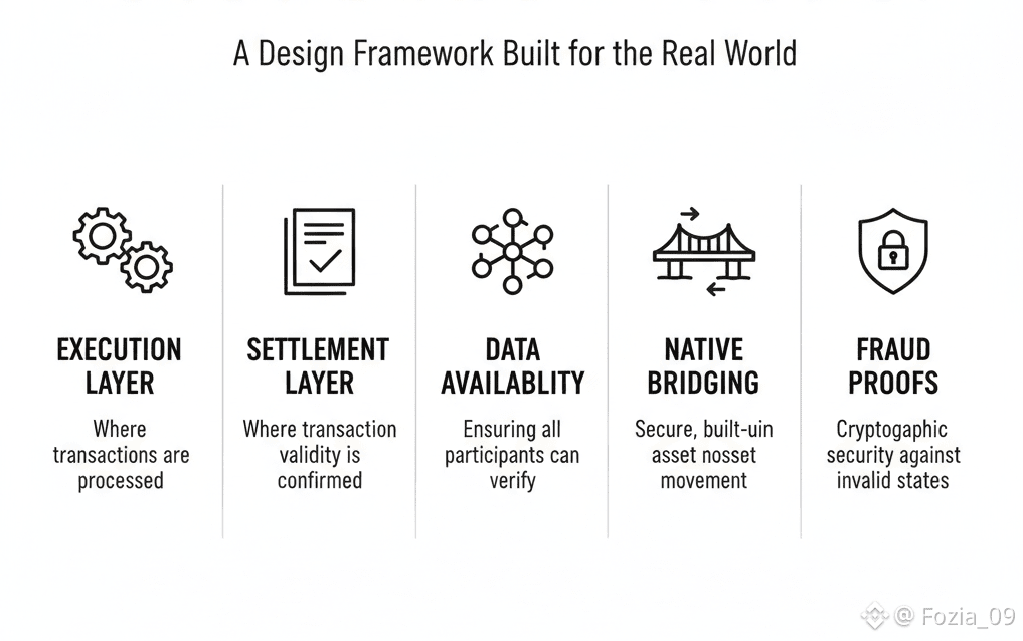
The weakest point of today’s multi chain world is rarely the blockchain itself it is the bridge that connects them.Over the past few years,the largest financial losses in crypto have come from bridge failures rather than consensus failures.Most bridges were designed as independent add ons:assets get locked on one chain,represented elsewhere, and users are forced to trust external operators,relayers,or multisig setups that exist outside the core protocol.From my point of view,this shows that the industry rushed into interoperability before truly solving how value should move securely between layers.
This problem becomes much sharper when applied to Plasma.Plasma was originally built around a clear idea:even if everything goes wrong on the secondary chain,users must always retain the right to exit back to Ethereum.That promise is the backbone of Plasma’s security model.However,if asset movement depends on an external bridge, that promise becomes fragile.A Plasma chain could function exactly as intended,yet users might still be trapped or drained because the bridge failed.To me,this means that in Plasma,security cannot be limited to transaction processing it must extend to how assets enter and leave the system.
Native bridging changes this dynamic completely.Instead of treating cross layer movement as something built on top of Plasma,native bridging integrates it into the core design;it becomes part of the protocol’s cryptographic and economic structure.I see this as a shift from“patched connectivity”to “designed connectivity,”which aligns far better with Plasma’s original philosophy of trust minimization.
A practical way to think about this is through logistics.Traditional bridging is like relying on an external courier that operates independently of your supply chain you have little control over how they handle your goods.Native bridging in Plasma is more like designing transportation,storage,and delivery as one unified system.In my view, this makes Plasma feel less like an isolated chain and more like a coordinated financial infrastructure.
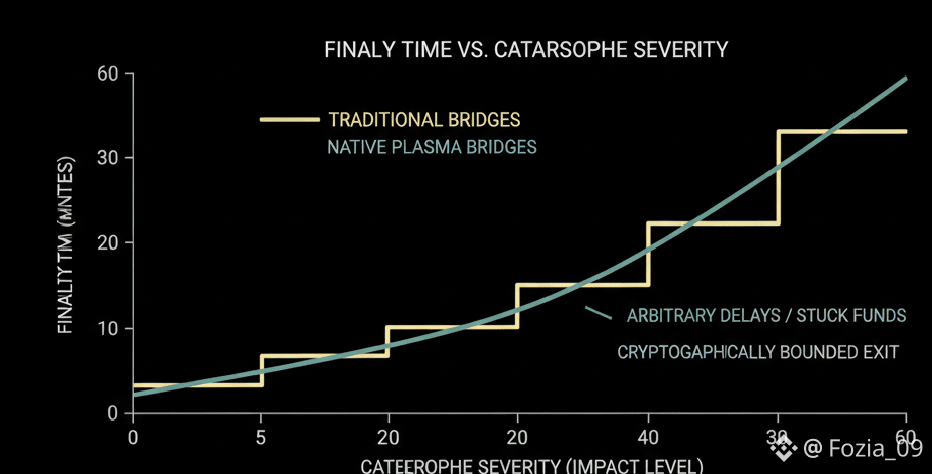
With native bridging,Plasma aligns how assets are represented with how they are exited.When assets are deposited,their structure is mapped in a way that corresponds cleanly to the base layer.If something goes wrong,the same proofs that validate Plasma activity can justify withdrawals.This removes the need for separate“bridge verification”mechanisms that often become attack vectors.Personally,I see this as one of the strongest advantages of native bridging less complexity,more security.
Equally important is the economic side. External bridges usually rely on separate validator groups or relayers with their own incentive systems,creating misalignment. Native Plasma bridging ties asset movement directly to the Plasma operator’s stake, penalties,and fraud proof mechanisms.From my perspective,aligning incentives is just as critical as cryptography many past exploits were failures of incentives,not just code.
Another advantage is systemic simplicity. Every additional layer relayers,message routers,custody contracts adds new points of failure.Native bridging collapses these components into a single coherent framework.I believe this reduction in complexity is deeply underrated in crypto, where overly elaborate designs often introduce hidden risks.
This approach also fits well with broader trends in modular blockchain design.Rollups, validiums,and other scaling models are increasingly trying to minimize trust in external intermediaries by relying more on base layer settlement and standardized messaging.Native bridging in Plasma aligns naturally with this direction,reinforcing my view that Plasma is not outdated but evolving alongside modern modular systems.
User behavior in high value environments supports this model.When large amounts of capital are involved,people tend to prefer certainty over speed.Even if Plasma exits take longer, their cryptographic guarantees build more trust than fast but opaque bridge mechanisms.From my perspective,this positions Plasma as better suited for long term capital rather than short term speculative trading.
That said,native bridging comes with trade offs.Plasma exits are intentionally slow to allow time for fraud challenges,and a tightly integrated native bridge inherits this delay. This makes it less attractive for high frequency traders or rapid arbitrage strategies.In my view,this does not make Plasma worse it simply defines what it is optimized for.
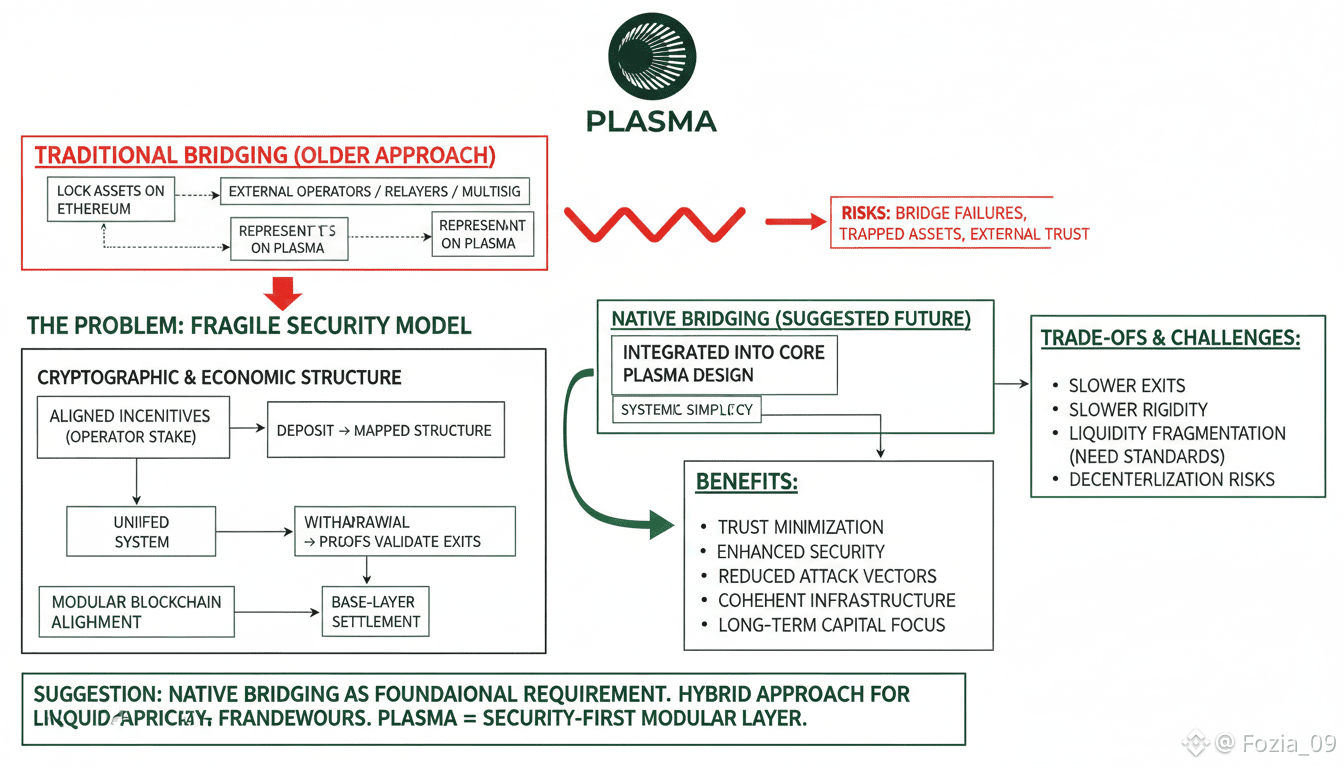
There is also the risk of design rigidity. Because native bridging is embedded in the protocol,upgrading it can be harder than modifying an external bridge.If the initial architecture is flawed,it could become a long term limitation.This reinforces my belief that Plasma requires careful,first principles design from the start.
Liquidity fragmentation is another challenge. If different Plasma implementations build their own native bridge standards,liquidity could become scattered across separate systems rather than unified.From my perspective,strong common standards will be essential if Plasma is to scale meaningfully.
Centralization is a further concern.If Plasma operators gain too much influence over both execution and bridging,the system could drift toward de facto centralization unless fraud proof mechanisms remain strong and credible.To me,preserving decentralization is crucial without it,Plasma loses much of its original purpose.
Ultimately,native bridging forces a shift in how we think about security.Instead of asking,“Is this bridge safe?”,the more important question becomes,“Does the entire layered system make sense as one coherent structure?”When bridging is treated as a core part of the protocol,Plasma’s original promise of trust minimized exits becomes far more convincing.
My Suggestion on the Article and on Plasma
Based on this analysis,my suggestion is that future Plasma designs should treat native bridging as a foundational requirement rather than an optional feature.Developers should work toward standardized native bridge frameworks so different Plasma implementations can interoperate without fragmenting liquidity.I also believe a hybrid approach could be valuable native bridges handling high value,long term capital,while faster liquidity layers serve traders who need speed.Additionally,Plasma interfaces should clearly communicate exit timelines and risk trade offs so users understand what they are choosing.More broadly,I suggest that the ecosystem stop framing Plasma as“old scaling tech”and instead recognize it as a security first modular execution layer that complements rollups rather than competes with them.If Plasma evolves along these lines,I believe it can play a meaningful role in the next generation of modular blockchain infrastructure.