
For years,the crypto world has tried to bolt AI onto blockchains that just weren’t built for it. Most chains out there run on strict rules: deterministic execution,minimal state,tight replication.That works fine for basic money stuff, but it doesn’t fit at all with how AI really works.AI needs to make guesses,adapt as it goes, and remember a ton of context. Cramming that into a rigid system? You end up with a mess.
Honestly, this isn’t just a growing pain.It’s a deep,structural mismatch.I see a lot of projects trying to work around it they keep AI off chain,wrap it up in middleware,and then try to glue it back onto the blockchain with oracles or relayers.That sort of works,for now.But it quietly brings back trust and moves the real“smarts”outside the blockchain.At that point,the chain isn’t where things actually happen it’s just a record keeper.
Vanar flips that logic.They start at the root: not“how do we stick AI onto a blockchain?” but“what does a blockchain need to look like if AI is baked in from the start?”It’s a subtle shift,but it matters.AI stops being a tacked on feature and becomes part of the foundation. That alone puts Vanar in a different league from most AIcrypto efforts.
A big part of this is how Vanar thinks about “state.”On most blockchains,state is just a dumb key value store.You can write or read, but that’s it no real structure,no depth.Vanar introduces“semantic memory.”Basically:state you can index,compress,search,and actually reason about.That matters because AI doesn’t just eat raw data.It looks for patterns and meaning that stretch across time.
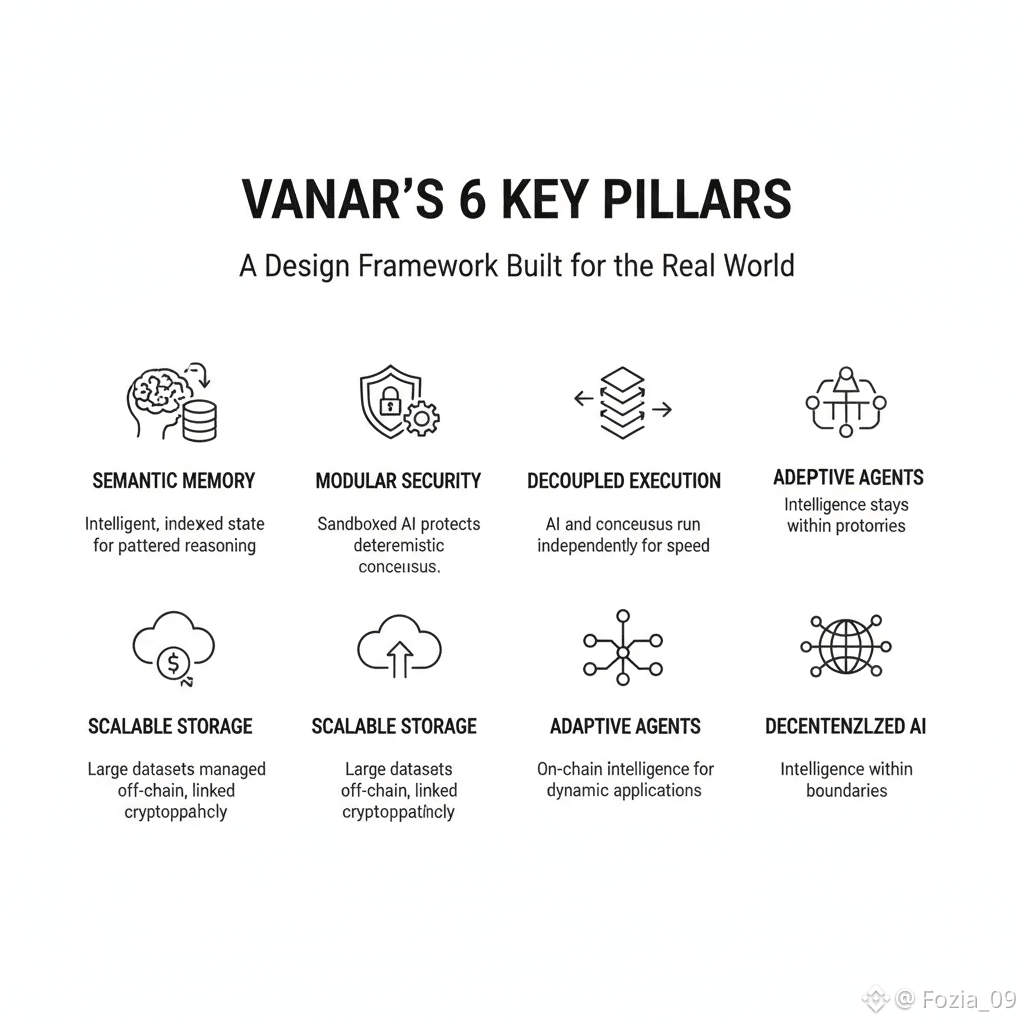
This is where Vanar starts to feel less like a regular blockchain and more like AI infrastructure.When you build around semantic memory,you get intelligent agents and adaptive apps right on chain.No more shoving everything off chain into some black box.The intelligence stays inside the protocol’s boundaries, not draining away to some centralized AI service.
Another thing Vanar gets right:they don’t jam AI directly into the consensus process.If you do that,you slow everything down and open up security holes.Instead,they keep things modular.Consensus stays clean,fast,and deterministic.AI execution and memory? They’re separate,optimized for their own jobs.Storage can scale up on its own,so you can keep big datasets without bogging down the core chain.
To me,this modular approach shows real maturity.It’s a lot like modern cloud architecture splitting up compute,memory, and storage but here,you get cryptographic guarantees instead of just trusting a company.Chains that don’t separate these pieces almost always end up pushing AI off chain anyway.Vanar’s design actually faces the hard problems,instead of pretending they don’t exist.
This modular setup also fits with where the market’s going.Crypto is moving toward modular chains,specialized execution,and new ways to buy and sell compute.As AI workloads grow,chains that can’t handle them natively will end up relying more and more on middlemen,which chips away at decentralization.From my perspective,Vanar is leaning into this shift at exactly the right time.
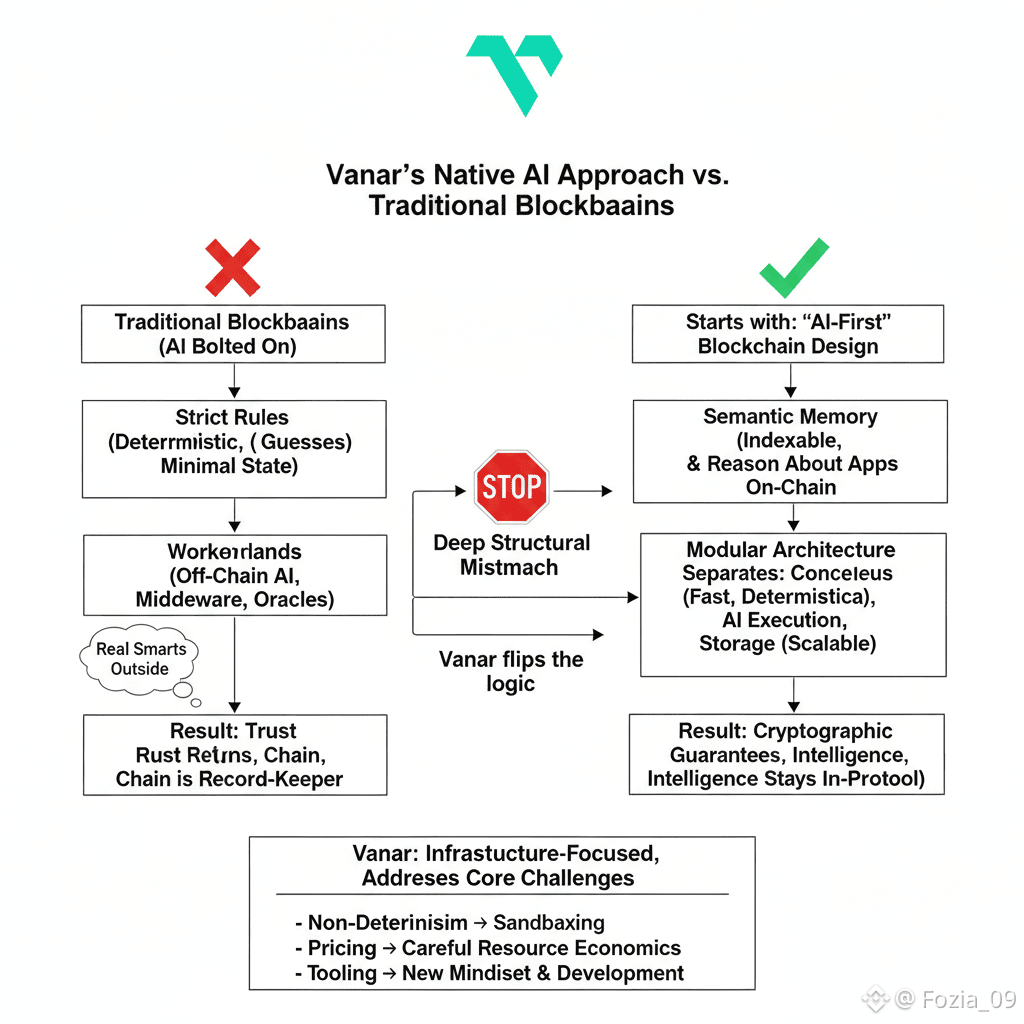
Of course, there are risks.Running AI on chain brings in non determinism,so you need to sandbox it to protect consensus.Pricing is tricky,too.If AI resources are too cheap,spam and abuse pile up.Too expensive,and developers bail for off chain solutions.And honestly,building for AI first chains takes a different mindset than old school smart contracts.The tooling’s got to catch up.
Still,I see those as the real price of building infrastructure that actually matters.If you dodge these challenges completely,you’re not really doing AI on chain you’re just avoiding the problem.
What stands out to me is Vanar isn’t chasing hype.They’re focused on infrastructure, where real,lasting value tends to build quietly.In a space full of projects shouting “AI!”at the top of their lungs,Vanar’s strength is in the core design.Even if people stopped caring about AI tomorrow,the architecture would make sense.
That,to me,is what separates the winners right now not who’s the loudest,but who’s building systems that actually move intelligence on chain without trust shortcuts, slowdowns,or wasted value.Vanar seems to get that, and that’s why I’m paying attention.