
Lately, while studying emerging technology and decentralized systems I have noticed that a lot of attention tends to gather around visible outcomes. People talk about yields token movement user growth or whatever metric happens to be moving quickly that week. The conversation often settles on what can be measured immediately. But I keep finding myself looking somewhere quieter the internal mechanics that sit underneath those numbers.
That has been especially true when I think about how Newton works inside a vault.
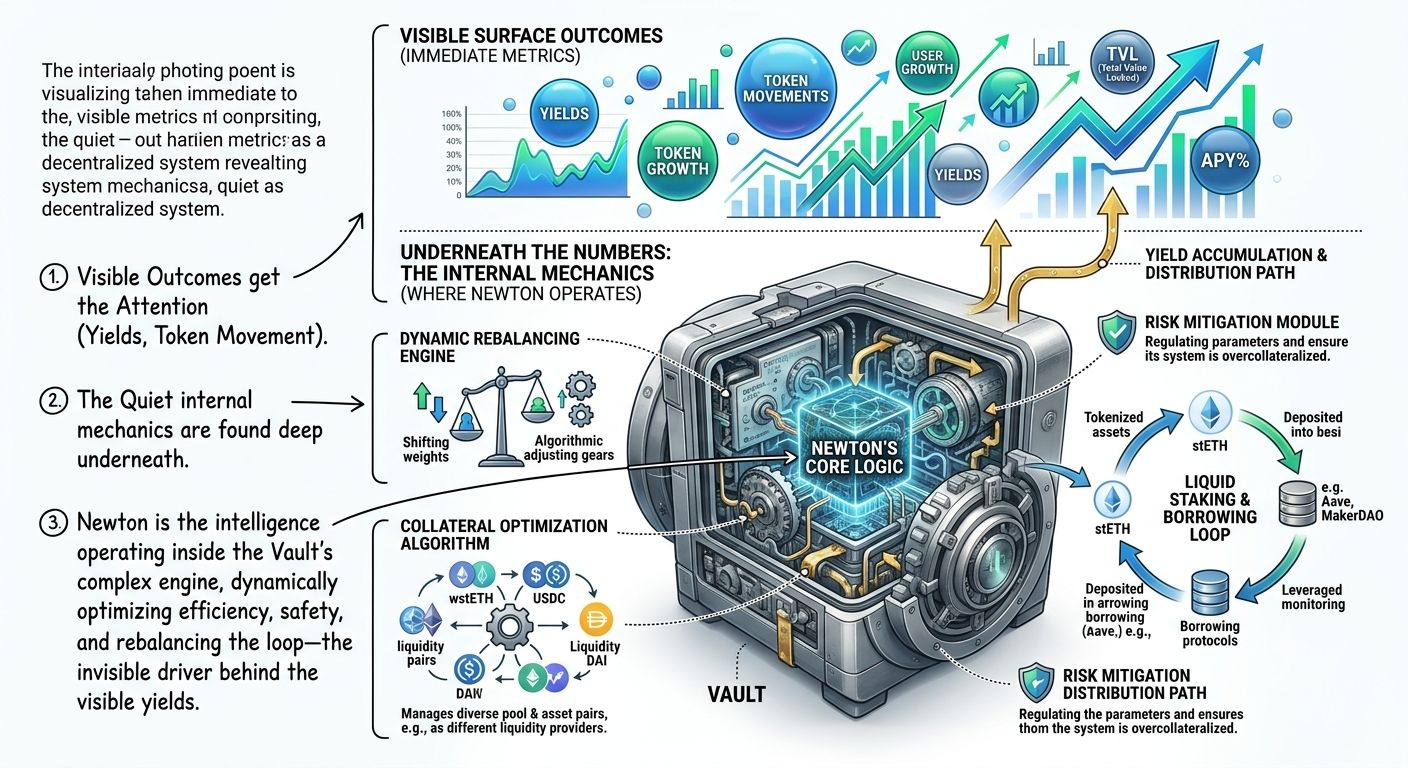
What stands out to me is that public discussion often emphasizes what comes out of a system rather than what the system is doing continuously behind the scenes. People naturally ask what returns look like how efficient a strategy appears or how quickly assets can move. Those questions matter. But I sometimes feel that the more important questions receive less attention. How does a vault actually decide where capital moves? What assumptions are embedded into its behavior? What happens when conditions become less predictable?
I do not think these questions are being intentionally avoided. I think they are simply harder to talk about.
When I look at Newton operating within a vault structure what interests me is less the outcome and more the process. A vault is not just a container holding assets. It becomes a system of choices. There are rules permissions thresholds timing decisions and assumptions about risk. Newton from that perspective feels less like a static tool and more like a layer of decision-making that exists inside a controlled environment.
I think people sometimes assume that automation naturally reduces uncertainty. I understand why that assumption exists. Automated systems remove certain forms of human inconsistency and they can react much faster than people can. But after spending time around decentralized systems I have become less convinced that automation eliminates complexity. In many cases it simply relocates complexity.
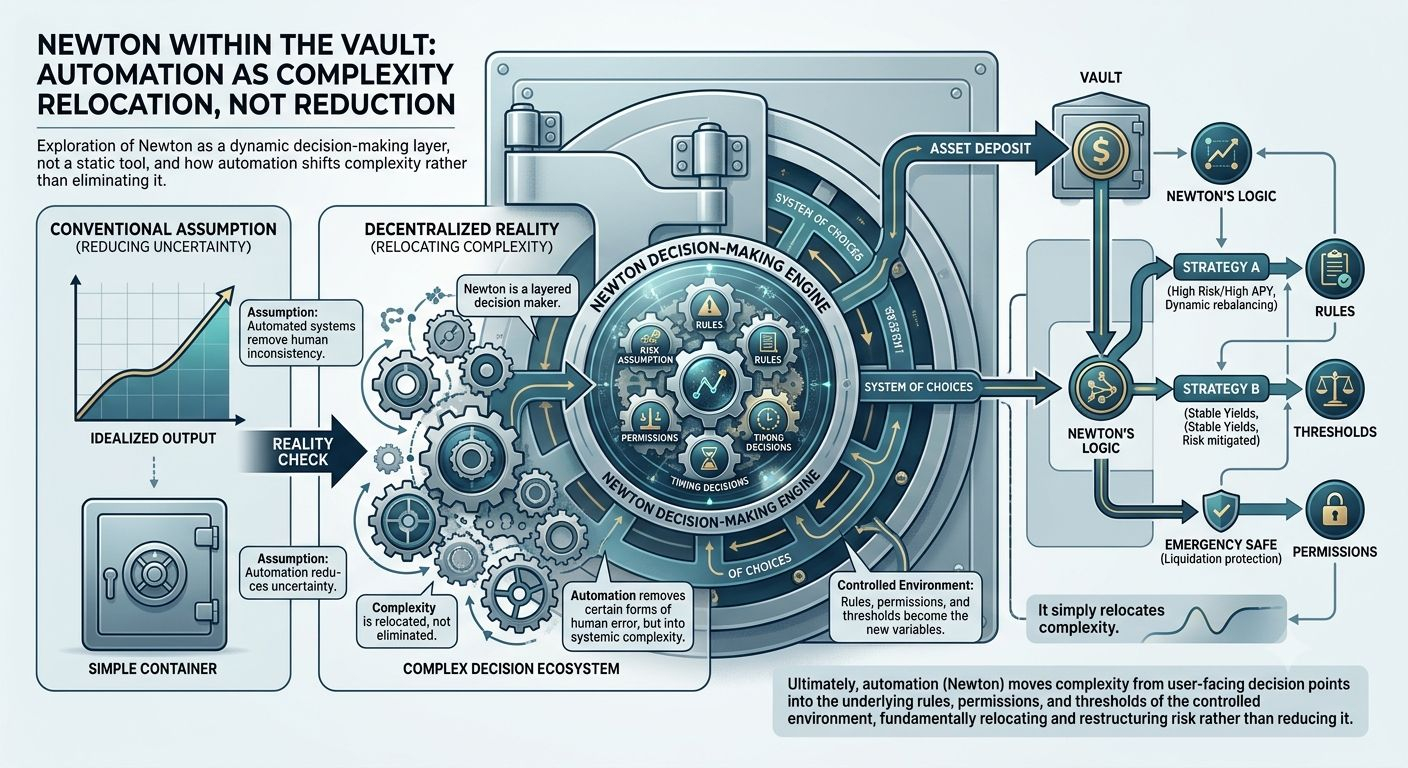
Instead of asking whether people make good decisions the question becomes whether the system guiding those decisions was designed carefully in the first place.
I have seen versions of this across different systems. Sometimes a vault can appear stable during normal conditions because its operating assumptions happen to align with the market around it. Then conditions shift slightly. Liquidity behaves differently. Network activity changes. Risk that seemed abstract suddenly becomes practical. In those moments what matters is often not how impressive a system looked during ideal periods but how it behaves during imperfect ones.
That feels important because every design introduces tradeoffs.
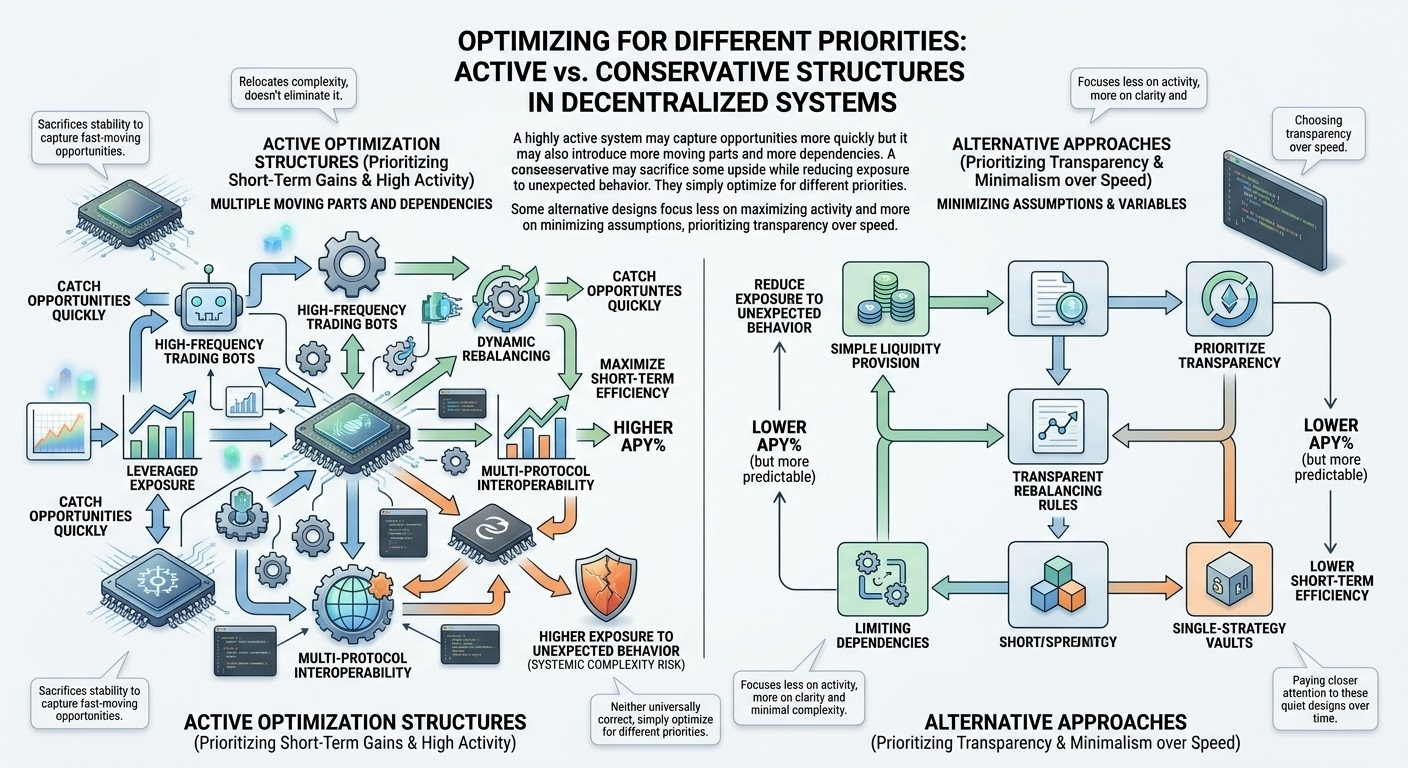
A highly active system may capture opportunities more quickly but it may also introduce more moving parts and more dependencies. A more conservative structure may sacrifice some upside while reducing exposure to unexpected behavior. Neither approach feels universally correct to me. They simply optimize for different priorities.
During my own research I have also noticed alternative approaches that focus less on maximizing activity and more on minimizing assumptions. Some designs are prioritize transparency over speed. Others limit the number of variables involved even if that means accepting lower short-term efficiency. Initially those choices can look less exciting. But over time I have started paying closer attention to them.
I think long-term qualities are easy to underestimate because they rarely create immediate signals. Reliability is difficult to notice when everything works. Predictability feels unremarkable until conditions become unstable. Resilience often looks slow until something breaks.
The longer I spend studying these systems the less interested I become in temporary narratives around performance alone. I find myself paying more attention to whether a system behaves in understandable ways and whether responsibility is visible rather than hidden behind layers of abstraction.
Because eventually trust does not come from speed or novelty. It forms gradually through repeated behavior. Confidence builds when people understand not only what a system produces but also how it acts when nobody is paying attention. And over time I think that may be where real value quietly accumulates.