
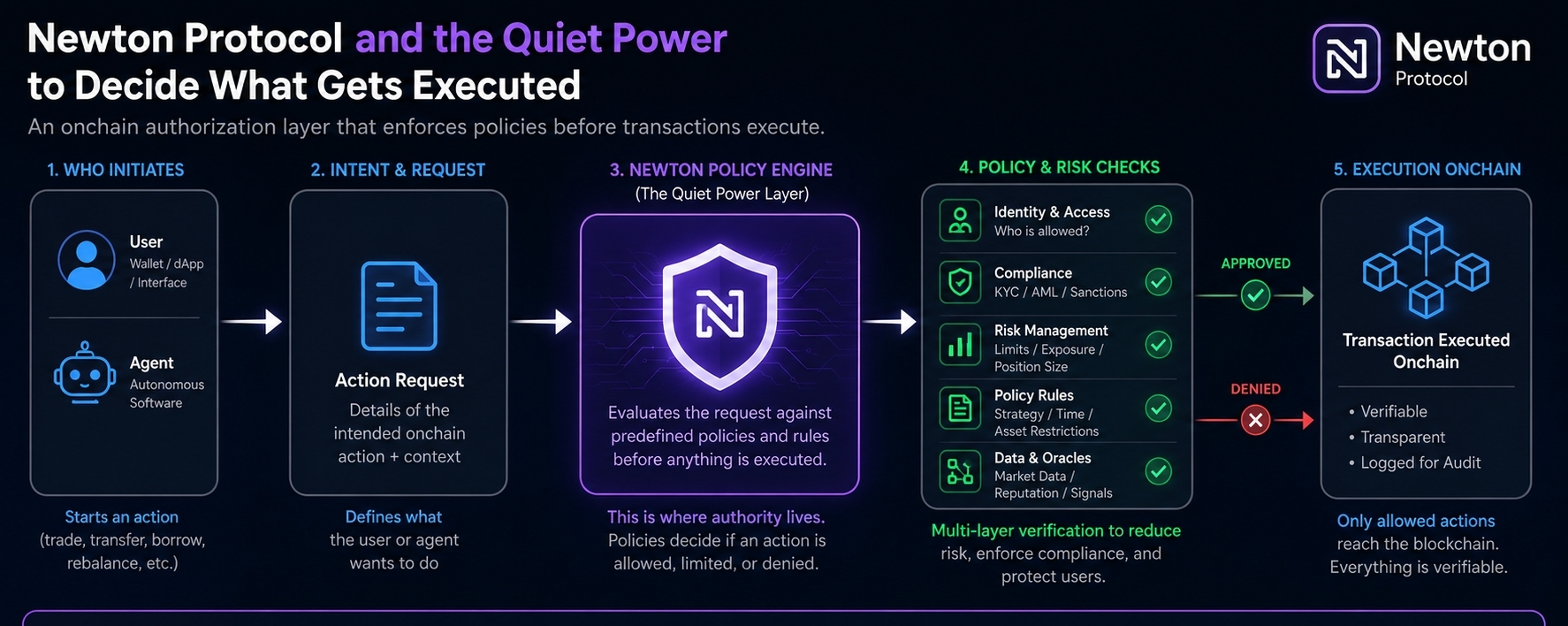
I keep looking at Newton Protocol with mixed feelings, and that is probably the most honest place to start. Part of me understands why a project like this needs to exist. Crypto is becoming too fast, too fragmented, and too tiring for users to manage every action by hand. Another part of me does not want to trust the story too quickly, because this market has turned too many real problems into clean narratives before the hard work was ever proven.
Newton Protocol is trying to solve a very specific kind of problem. It is not just about making onchain activity faster. It is about allowing agents, apps, and systems to act on behalf of users while staying inside defined limits. That sounds simple from a distance, but it is one of the hardest problems in crypto. Once a user gives something permission to act, the real question becomes how much control has actually been given away.
That is where Newton becomes interesting.
Most crypto products talk about automation like it is automatically good. Faster execution. Less manual work. More efficient workflows. But automation without boundaries is dangerous. Anyone who has spent enough time in crypto has seen what happens when users approve too much, trust the wrong interface, or let a system move faster than their understanding. Newton is trying to build around that weakness by making authorization more structured.
The project is focused on controlled delegation. That is the part I keep coming back to. It wants users and institutions to define what can happen before anything actually happens. An agent may be allowed to trade, but only within certain rules. A transaction may be allowed to move forward, but only after checks. A wallet may delegate some activity, but not become completely exposed. In theory, this is a healthier direction than the usual crypto habit of asking users to either trust everything or manually approve everything.
But theory is always the easy part.
The difficult part is execution. Newton Protocol has to prove that its rules are not just clean in documentation, but useful in real market conditions. Real users do not behave like diagrams. Real liquidity is thin in the wrong moments. Real strategies break. Real institutions bring compliance needs that are slow, heavy, and sometimes contradictory. Real agents can follow instructions and still make poor decisions.
That is where things usually break.
What makes Newton different from many projects is that it is not only building for attention. It is building around friction. Permissions are friction. Compliance is friction. Risk checks are friction. User safety is friction. Most crypto narratives try to remove friction completely. Newton seems to be saying that some friction should stay, but it should become programmable, visible, and easier to manage.
That is a more realistic idea than the usual promise of smoothness.
Still, friction does not disappear just because a protocol organizes it better. Someone still defines the rules. Someone still decides what counts as acceptable risk. Someone still provides the data. Someone still benefits when a transaction passes or fails. This is the part that deserves more attention. Newton Protocol is not only creating a system for action. It is creating a system for deciding when action is allowed.
That power matters.
The phrase “hiding the authority of definition” fits Newton because the project sits close to a quiet but important layer of control. In crypto, people like to talk about decentralization as if power always looks obvious. But power often hides in defaults, policies, integrations, provider choices, and risk settings. A user may think they are simply delegating an action. In reality, they may also be accepting a whole set of definitions they never fully read.
Most users will not study that deeply.
They will trust the interface. They will trust the permission screen. They will trust the fact that the system feels safer than doing everything manually. That does not make them careless. It makes them human. Crypto asks too much from users, then acts surprised when users choose convenience. Newton Protocol is building into that exhaustion. That may be one of its strongest opportunities, but also one of its biggest risks.
Because when automation works, users stop thinking about it.
That is useful until something goes wrong.
If Newton can make delegation safer, it has a real place in the market. DeFi needs better permission systems. Agent-based activity needs limits. Institutions need clearer compliance paths before they can use onchain rails seriously. Even normal users need a way to let apps act without giving them open-ended control. These are not imaginary needs. They are already visible in how people use wallets, trading tools, bots, bridges, and automated strategies.
The question is whether Newton can turn that need into actual adoption.
Crypto has a habit of treating a strong idea as if it is already a strong network. That is dangerous. A protocol can identify the right problem and still fail to become the place where the market solves it. Developers need to integrate it. Users need to understand enough to trust it. Institutions need to believe it reduces risk rather than adds another layer to review. The token needs a role that goes beyond speculation. The system needs usage that does not depend on the market being excited for a few weeks.
That is where the project has to earn its seriousness.
Newton Protocol should not be judged only by its concept. The concept is good enough to deserve attention, but not enough to deserve blind confidence. The real test is whether its authorization layer becomes something people use because it solves a painful problem, not because the narrative around AI agents and onchain automation is active. Narratives bring attention. Usage brings pressure. Pressure reveals design quality.
Execution is where narratives go to die.
I also think Newton’s biggest challenge may be communication. The project sits in a space that is not naturally exciting to retail users. Authorization, compliance, policies, and risk controls do not create the same instant reaction as a new chain, a new yield product, or a loud consumer app. But that does not mean they are less important. Often, the least exciting infrastructure becomes important only after the market has already depended on it.
That creates a strange timing problem.
If Newton is early, the market may ignore it because the need still feels abstract. If it is right on time, the market may simplify it into another “agent” narrative and miss the deeper role of the protocol. If it is late, larger platforms may already control the policy and automation layers users rely on. The project has to find a narrow path between being too complex to understand and too easy to copy at the surface level.
That is not an easy place to build.
What I like about Newton is that it seems to accept that automation needs constraints. That alone makes it more grounded than projects that talk as if agents should just run freely across DeFi. Money does not need more careless speed. It needs better decision boundaries. It needs systems that can say no, or at least slow things down when the action does not match the user’s intent.
But I do not fully trust any project that sits near the permission layer.
Not because permission is always bad. Sometimes permission is what protects users. The problem is that permission creates authority, and authority creates incentives. Over time, every system that decides what is allowed becomes attractive to the people who want to influence those decisions. Institutions may want stricter controls. Apps may want smoother approvals. Users may want convenience. Token holders may want more activity. Providers may want more dependence on their checks. Those incentives will not always point in the same direction.
Good theory does not survive bad incentives.
That is why Newton Protocol needs to be watched through behavior, not just language. How does it grow? Who uses it first? Which integrations matter? Does it become a real standard or just another branded layer? Does the token gain demand from actual system usage, or does it mostly move with the broader agent narrative? Does the project improve user control, or does it simply make control feel easier while shifting power somewhere less visible?
These are the questions that matter more than the clean version of the story.
The market will probably try to simplify Newton. It always does. It may call it an AI agent project, or a compliance project, or an automation project, depending on which narrative is strongest that week. But Newton is more interesting than those labels. It is really about trust after delegation. It is about what happens when users no longer want to approve every action, but also cannot afford to give systems unlimited freedom.
That problem is not going away.
If anything, it is becoming more important.
The more crypto grows, the more users will rely on software to make decisions around them. Not because they are careless, but because the environment is too complex. The market moves faster than human attention. That creates room for Newton Protocol, but it also raises the stakes. A bad automation layer is not just inconvenient. It can become a machine for repeating mistakes at scale.
That is the quiet risk.
Newton could help make onchain activity safer and more usable. It could become part of the infrastructure that lets agents, institutions, and users interact with better boundaries. But it could also inherit the same old crypto problem in a cleaner form: users trusting systems they do not fully understand because the alternative is too much work.
I am not ready to trust the project completely. I am also not ready to ignore it.
Newton Protocol sits close to one of the most important questions in crypto now. Not just who can move capital faster, or who can automate more actions, or who can make the user experience smoother. The deeper question is who defines the limits before action happens.
And if Newton becomes good at hiding that definition inside the system, will users notice the power they have delegated before the market forces them to?