
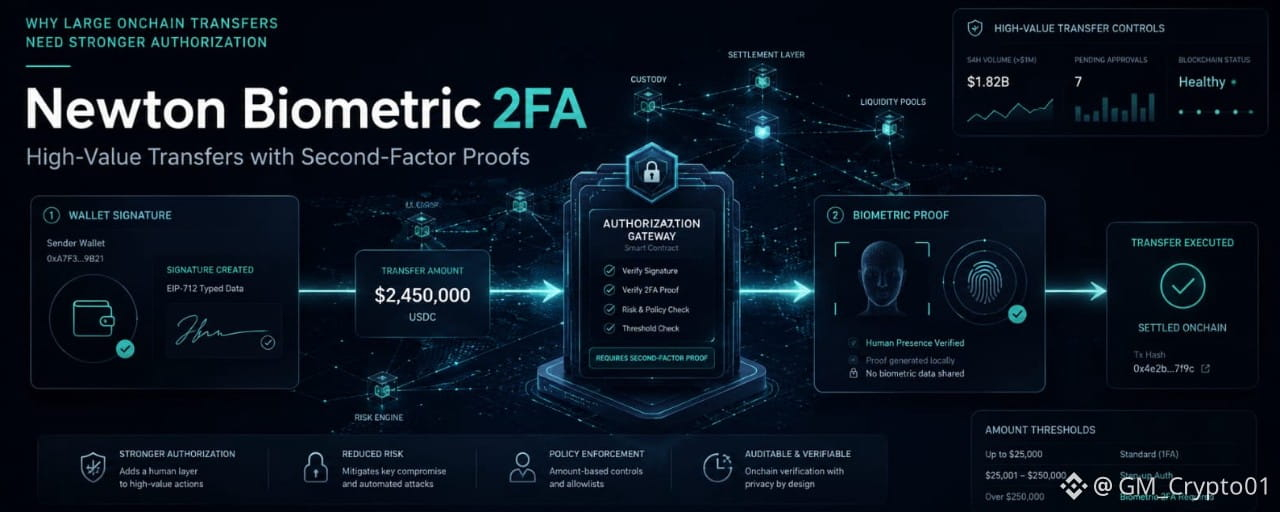

I used to think biometric 2FA in crypto was a wallet comfort feature, borrowed from banking to make users feel less exposed. That became harder to believe as onchain money movement started looking less like app usage and more like settlement under stress. When stablecoins sit above $272 billion in supply and show $10.2 trillion in adjusted volume over the last 12 months, the fragile point is not only speed. It is whether the right person is present when serious value moves.
The common misreading of Newton biometric 2FA is that it adds friction. The sharper claim is that Newton is trying to make custody conditional. Custody means control over assets; conditional custody means that control changes with risk. A small transfer can pass with a wallet signature, while a large transfer can require a second-factor proof, meaning evidence that another verification step passed before execution.
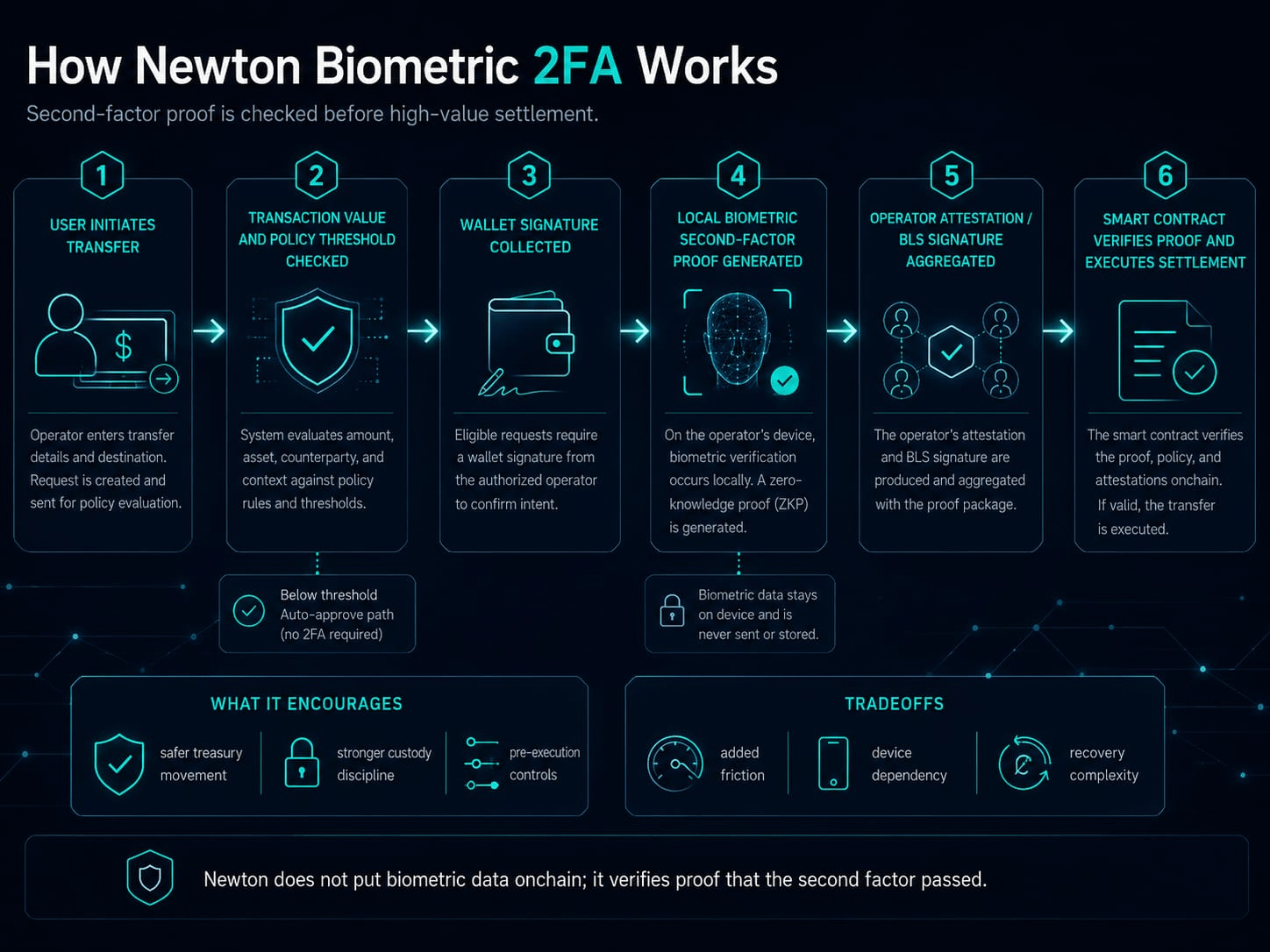
On the surface, this looks like a face or fingerprint check. Underneath, the important object is not biometric data but proof that the check happened. Newton’s design already follows that logic: transaction intents are checked by operators against policies, then signed with BLS signatures, a cryptographic method that compresses many approvals into one result a smart contract can verify.
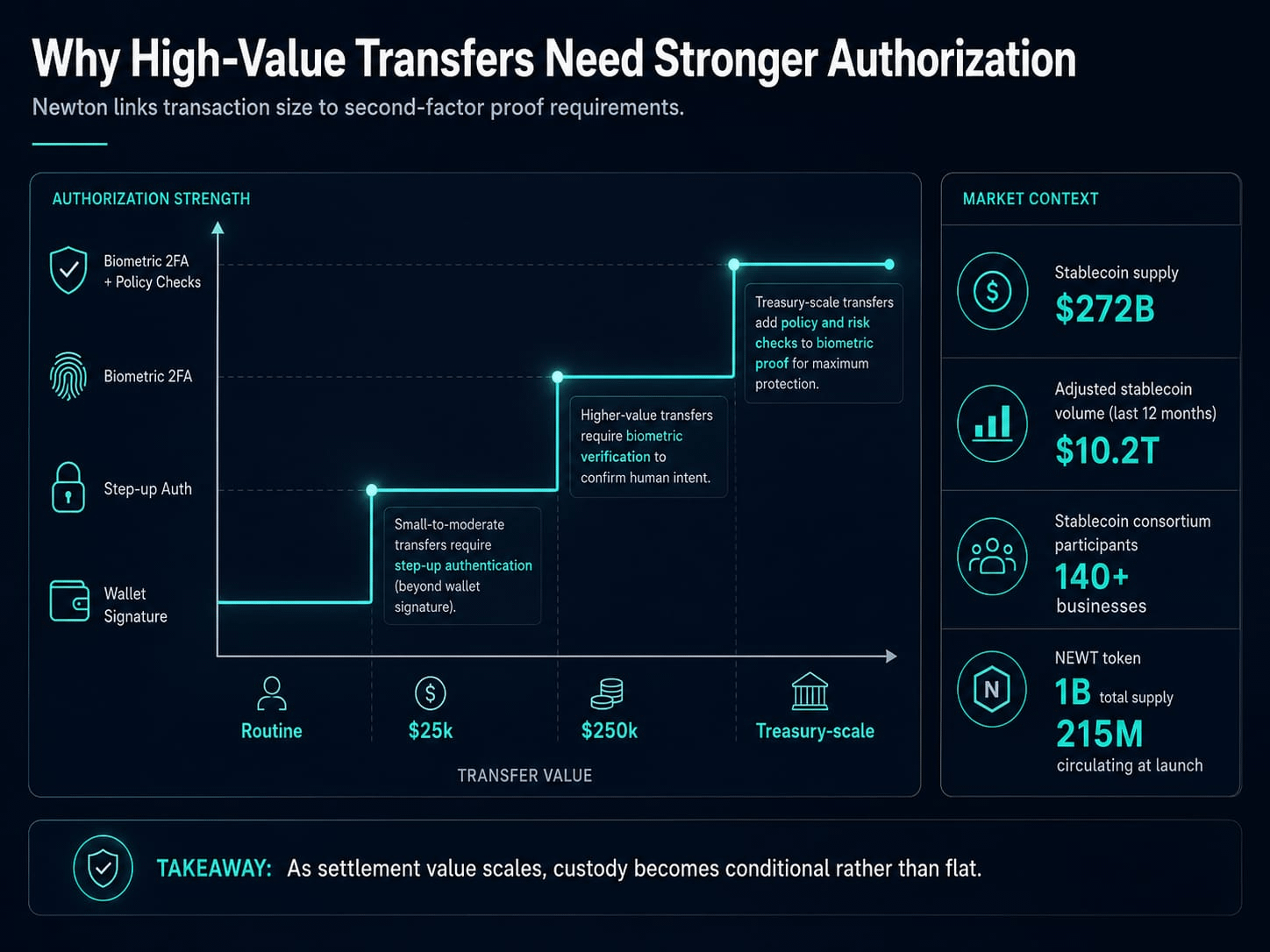
That structure encourages a different business model from ordinary wallet security. Instead of warning users after a loss, applications can block execution before settlement. A treasury transfer, bridge movement, or large stablecoin withdrawal can wait for stronger proof. The cost is real: more dependency on devices, recovery flows, vendors, and user patience.
The market makes this less theoretical. Reuters reported that a Visa, Mastercard, and Coinbase-linked stablecoin consortium now includes more than 140 businesses, while also noting stablecoins are still used mostly for trading rather than everyday payments. If public rails become business infrastructure, authorization quality becomes part of liquidity, not a side setting.
Newt Token belongs in this discussion only if it supports that discipline. Binance Research described NEWT as tied to staking, gas or fees, model-operator collateral, and governance, with 1 billion total supply and 215 million circulating at launch. Those figures do not prove demand. They show the coordination surface: who pays, who secures, and who bears consequences when proofs enter execution.
The counterargument is fair. High-value users may still prefer multisigs, hardware keys, or institutional custody, and extra checks can break at the worst moment. For now, the stronger interpretation is modest: Newton biometric 2FA is not about making crypto feel safer. It is about making large transfers harder to perform accidentally, remotely, or under compromise. Digital trust will not be built by faster settlement alone. It will be built by systems that know when speed should stop.