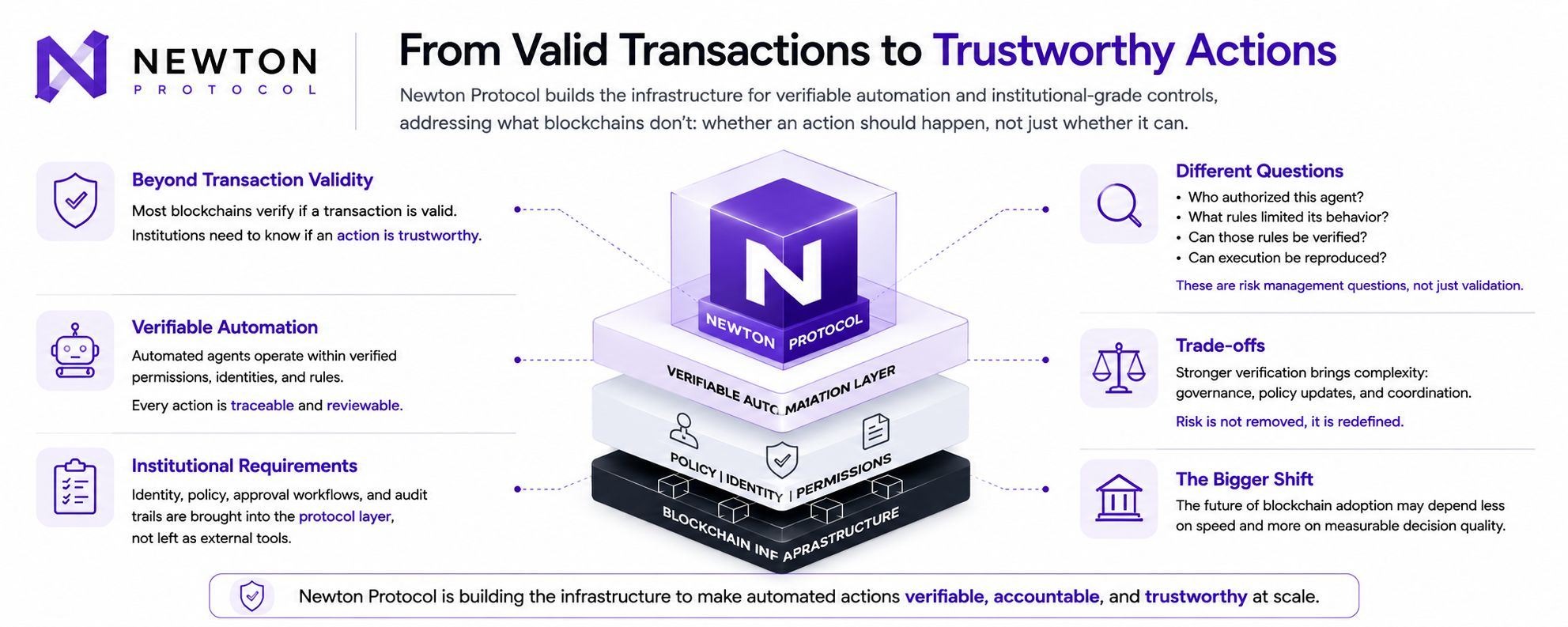
When I first started reading Newton Protocol I expected another attempt to improve execution or reduce transaction costs. Instead I kept coming back to a different thought. Most blockchains measure whether transactions are valid. Institutions often need to measure whether actions are trustworthy. Those are not always the same thing.
That distinction feels small at first but it becomes harder to ignore once blockchains move beyond simple token transfers. Large organizations usually care less about whether a transaction can execute and more about whether it should. Risk teams spend years building approval processes identity checks and audit trails because mistakes often matter more than speed.
Newton appears to be exploring that gap instead of assuming existing blockchain security is enough.
Most public networks were designed around minimizing trust between participants. The network verifies signatures reaches consensus and records state changes. That model works well for open financial systems where anyone should be able to participate without asking permission.
Institutional environments often introduce different requirements. Companies need to know which systems initiated actions. They need confidence that automated agents follow predefined policies. They also need evidence that every important decision can be reviewed later. Traditional blockchains leave much of that responsibility outside the protocol itself.
Newton seems to ask whether some of those controls belong inside the infrastructure rather than being added through separate software.
One part that kept my attention was its focus on verifiable automation. Instead of treating automated agents as external tools the protocol appears to provide a framework where their permissions identities and actions can be verified within a broader execution model. That changes how risk can be evaluated.
Instead of asking whether an address signed a transaction an institution might ask different questions.
Who authorized this agent
What rules limited its behavior
Can those rules be independently verified
Can another organization reproduce the same execution path
Those questions resemble operational risk management more than traditional blockchain validation.
That does not automatically make the model better. It simply shifts attention toward a different layer of trust.
The interesting trade off is that stronger verification often creates additional coordination. Identity systems require governance. Permission frameworks require policy updates. Verification standards require agreement between different participants. Complexity does not disappear. It simply moves into another part of the architecture.
That raises an important question.
Does Newton reduce institutional risk or redefine what institutions consider acceptable risk
Those are not identical outcomes.
Another observation is that Newton does not appear to reject permissionless infrastructure entirely. Instead it seems to acknowledge that some participants especially regulated organizations may require stronger guarantees before allowing autonomous software to control valuable assets or sensitive operations.
That feels closer to how financial infrastructure has evolved historically. Open access exists alongside carefully managed operational controls rather than replacing them completely.
I also found myself wondering how this model behaves at larger scale.
If thousands of organizations create different policy frameworks will interoperability remain simple
Could verification standards become fragmented across ecosystems
Would developers need to maintain multiple compliance models for the same application
Those questions become more important as adoption increases.
There is also the question of governance.
Whenever identity frameworks permissions or policy engines become part of protocol design someone eventually decides how those standards evolve. Even decentralized governance introduces coordination costs. Upgrading security rules across a distributed ecosystem is rarely straightforward especially when different stakeholders have different definitions of acceptable risk.
That uncertainty deserves more attention than protocol performance metrics.
Another detail that stands out is developer incentives.
Many blockchain ecosystems encourage developers to optimize for openness because fewer restrictions often mean faster adoption. Newton appears to encourage thinking about predictable behavior instead. That could attract applications where reliability matters more than unrestricted flexibility.
The trade off is obvious.
Developers who value complete freedom may see additional policy layers as unnecessary friction. Organizations responsible for legal liability may see the same mechanisms as essential infrastructure.
Neither perspective is automatically wrong.
Perhaps the most interesting implication is that Newton quietly challenges how blockchain security is usually measured. Networks often compare decentralization validator counts throughput or finality times. Those metrics describe network performance but they say less about operational confidence once autonomous systems begin making increasingly important decisions.
That makes me wonder whether future institutional adoption will depend less on faster consensus and more on measurable decision quality.
If that shift happens then protocols may eventually compete not only on how securely they process transactions but also on how convincingly they help organizations understand the risks behind every automated action. That feels like a different conversation than blockchain has traditionally been trying to solve