
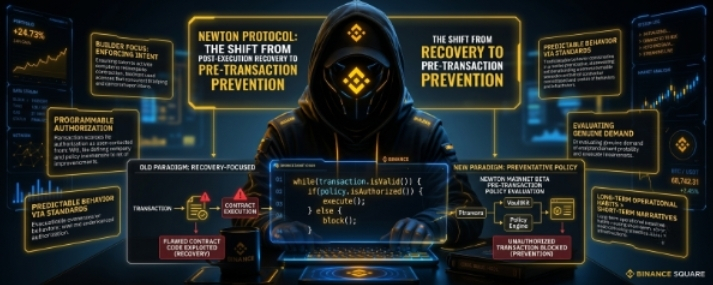
I used to think the largest source of on-chain risk came from flawed contract code. After following enough exploit reports, I realized many losses originated from transactions that technically behaved as designed but should never have been authorized. That changed the way I interpret security. Instead of focusing only on execution quality, I started paying closer attention to the logic that decides whether execution should happen at all. Prevention gradually became more interesting to me than recovery.
That mindset led me to examine @NewtonProtocol and its Newton Mainnet Beta. What stood out was not another security dashboard but an execution framework built around pre-transaction policy evaluation. Rather than assuming every valid transaction deserves to proceed, the system introduces programmable authorization before settlement. I find that distinction meaningful because it moves decision-making earlier in the lifecycle instead of treating risk as something to monitor after activity has already occurred.
A common assumption is that policy layers mainly satisfy regulatory or enterprise requirements. My interpretation is different. If developers can define reusable execution conditions through the Policy Engine and VaultKit integrations, security practices become more standardized across applications instead of being recreated independently every time. The second-order impact could be fewer inconsistencies between protocols, making operational behavior more predictable without forcing every team to reinvent the same protective framework.
Even so, I think $NEWT should be evaluated with realistic expectations. Infrastructure adoption rarely follows a straight path because every integration introduces engineering overhead and operational complexity. External data dependencies may affect policy reliability, while additional validation layers could increase execution latency under certain conditions. I also question whether ecosystem participation will remain consistent once early incentives become less influential and long-term utility carries more weight.
The metrics I care about are fairly different from what usually dominates market discussions. I want to observe repeat usage by operators, sustained policy evaluation activity, and how deeply authorization logic becomes embedded across independent dApps. Those indicators tell me more about genuine infrastructure demand than bursts of transaction volume driven by temporary narratives. Durable ecosystems usually expand through recurring operational habits rather than isolated periods of attention.
For me, #Newt remains an evolving observation instead of a conclusion. I expect the market to determine whether programmable execution policies create enough practical value to justify the additional coordination they require. The real question is not whether more security is desirable, but whether stronger execution rules can coexist with the efficiency that decentralized networks have always tried to preserve.
