
I spent last week actually trying to use Newton Protocol. Not just reading the docs. I wanted to see if this "verifiable automation" thing actually works or if it's another crypto solution looking for a problem.
Here's what I found.
The thing that actually clicked
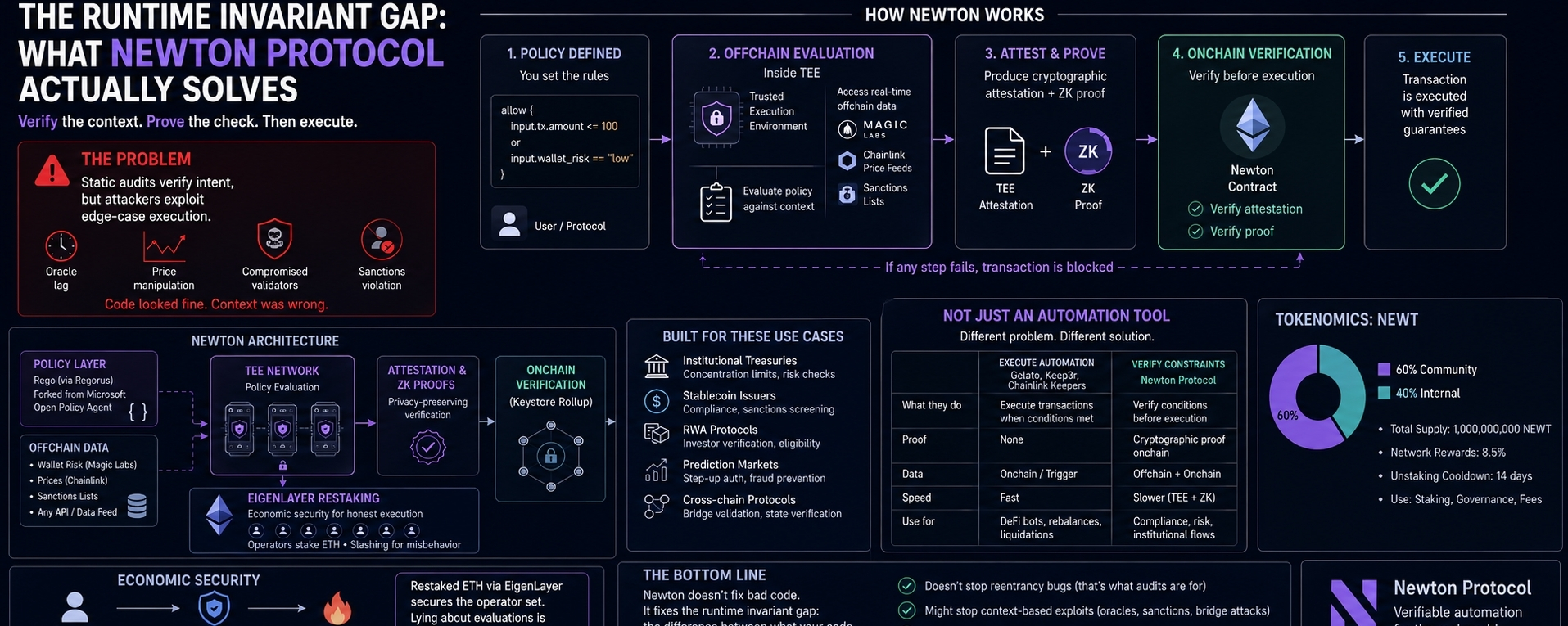
I started with their demo. Connected my wallet, set up a simple policy: block any transaction over $100 if the wallet risk score is high. Then I tried to simulate a transfer.
It failed. Not because the code was wrong. Because the offchain check actually ran. The policy evaluated my wallet against Magic Labs' risk data, decided it was fine, but then I realized something.
Most "automation" in crypto is just... execution. You set a limit order, a bot executes it. You set a rebalance, it happens. But you have no proof it followed your rules. You just trust the executor.
Newton does something different. It proves the check happened before the transaction.
Why this matters more than the AI hype
Everyone talks about Newton's "AI agent marketplace." That's coming in Q4 2025 apparently. But that's not what's live now. What's actually working is the policy layer.
I dug into their GitHub. They forked Microsoft's Regorus. That's a Rust implementation of Open Policy Agent's Rego language. Enterprise infrastructure teams use this stuff. It's battle tested.
The insight hit me when I read their README: "Static audits verify intent, but attackers exploit edge-case execution."
Think about that. Every major DeFi hack passed audit. Euler. Curve. Nomad. The code wasn't obviously broken. But the execution context was wrong. Prices moved too fast. Oracles lagged. Validators got compromised.
Newton doesn't prevent all of this. But it changes where the check happens. From "hope the code handles it" to "verify the context before executing."
The architecture that actually makes sense
I spent time understanding why they built it this way.
TEEs run the policy evaluation. Not because TEEs are perfect. They're not. Intel or AWS could theoretically compromise them. But TEEs let you do something pure cryptography can't: access real-time offchain data privately, then prove you evaluated it correctly.
The zero-knowledge part comes after. The TEE produces an attestation. That's verified onchain. So you get privacy for the data check, but public verifiability that the check happened.
Their Keystore Rollup isn't trying to be a general purpose L2. It's specifically for permission management. zkPermissions they call them. Granular, revocable, cross-chain.
I kept asking: why EigenLayer? Why restake ETH to secure a policy engine?
The answer is economic security. If operators lie about policy evaluations, they get slashed. Real money at stake. It's expensive to attack because you'd need to compromise both the TEE infrastructure AND the economic stake.
The tokenomics I actually checked
NEWT has a 1 billion fixed supply. Nothing fancy there. But the distribution is interesting: 60% to community, 40% to internal. That's a heavier community tilt than most projects.
The 14-day unstaking cooldown is annoying if you're trying to exit fast. But I get why they did it. Prevents flash attacks on the operator set.
8.5% of supply goes to "Network Rewards." That's subsidizing validators now, before the protocol generates enough fees to sustain them. Classic bootstrap problem.
What actually works vs. what's marketing
Here's where I got skeptical.
The AI agent marketplace? Not live. The docs talk about it. The roadmap has it for Q4 2025. But right now, you're building policy infrastructure for a future that doesn't exist yet.
I looked for real integrations. Magic Labs uses it for wallet risk scoring. Polymarket apparently has some step-up 2FA framework built on Newton. But I couldn't find a long list of DeFi protocols actually enforcing policies through Newton in production.
That's the risk. You're betting that institutional DeFi actually wants cryptographic proof of compliance. Not just frontend checks and legal agreements. Real proof that can be audited onchain.
Will they pay for that? Will they accept the latency? I don't know yet.
The competitors nobody compares correctly
Gelato, Keep3r, Chainlink Keepers. People lump Newton with these. Wrong category.
Those execute automation. Newton verifies constraints. Different problem.
Gelato will run your rebalance at 2am. It won't prove the rebalance respected your volatility limits, your sanctions screening, your concentration caps. It just executes.
Newton evaluates first. Then proves. Then executes.
The tradeoff is speed. TEE evaluation + ZK proof generation + onchain verification takes time. Not for high frequency trading. For institutional treasuries that need receipts. For stablecoin issuers that need compliance proofs. For RWA protocols that need investor verification.
What I actually think now
After using the demo, reading the contracts, understanding the architecture, I think Newton is solving a real problem. But it's a specific problem. Not "make DeFi safer" in some vague way.
It's: how do you enforce rules when the rule depends on offchain context?
Sanctions lists. Oracle prices. Wallet risk scores. These change. You can't hardcode them. But you also can't trust a centralized API to tell your contract what to do.
Newton's answer: evaluate in TEEs, attest cryptographically, verify onchain. It's not perfect. TEEs have trust assumptions. The latency is real. The learning curve for Rego policy language exists.
But it's the first approach I've seen that doesn't force you to choose between "trust a centralized service" and "only use onchain data."
The honest bottom line
Newton won't stop the next reentrancy hack. That's a code problem. Audits catch those.
It might stop the next bridge exploit where someone tricks validators into signing invalid states. Or the next protocol that processes transactions during an oracle freeze. Or the next treasury that accidentally violates concentration limits during volatile markets.
The question is whether enough protocols care about runtime verification to justify the infrastructure. The tech is interesting. The use case is real. The adoption is early.
I'm watching to see who actually integrates this for production use cases. Not demos. Real volume. That's when I'll know if the runtime invariant problem was worth solving this way
