
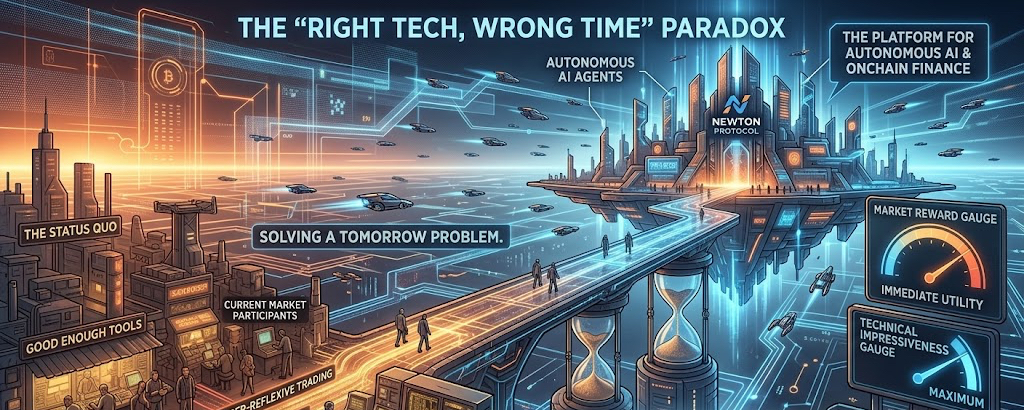

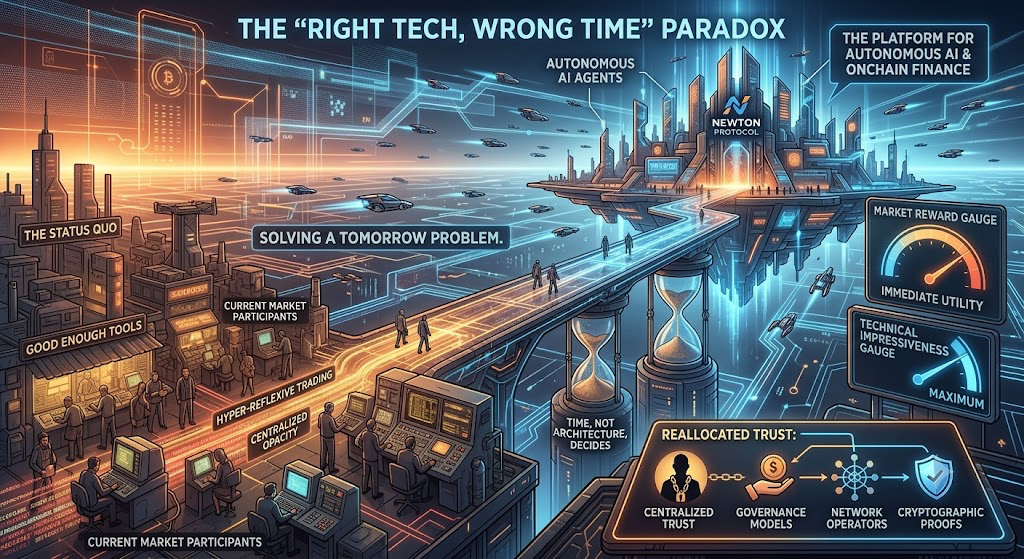
The @NewtonProtocol ($NEWT ) represents one of the most fascinating dilemmas in modern Web3: the friction between visionary engineering and current market realities. While its architecture provides a highly sophisticated, secure layer for autonomous AI agents and programmable policies, it confronts a massive hurdle it is solving a tomorrow problem for a today market.
 The Adoption Hurdle: "Good Enough" is the Enemy
Great tech rarely wins on merit alone. To get users to switch from their current setups, the pain of staying must outweigh the friction of moving.
The Status Quo: Most participants still rely on centralized tools. They might be opaque black boxes, but they are fast, familiar, and "good enough" for current demands.
The Friction: Forcing a migration to a complex, cryptographically verified decentralized layer requires an urgent, painful catalyst that simply hasn't hit the mainstream retail or institutional market yet.
Moving the Trust Goalposts
It's also crucial to recognize that Newton doesn't eliminate the need for trust it reallocates it. Instead of trusting a centralized corporation, users are asked to place their faith in:
Protocol governance models
Independent network operators
Underlying cryptographic proofs
While this is undeniably a massive structural upgrade for systemic safety, it still requires a fundamental paradigm shift in user behavior and a collective leap of faith.
The Bottom Line: Surviving the Clock
Ultimately, the market doesn't hand out trophies for technical elegance; it rewards immediate utility. If the agentic economy takes off tomorrow, Newton positions itself as indispensable infrastructure. If widespread adoption is still years away, the protocol’s true challenge isn't debugging its codebase it's surviving the wait. Time, not architecture, will always have the final say. #Newt