
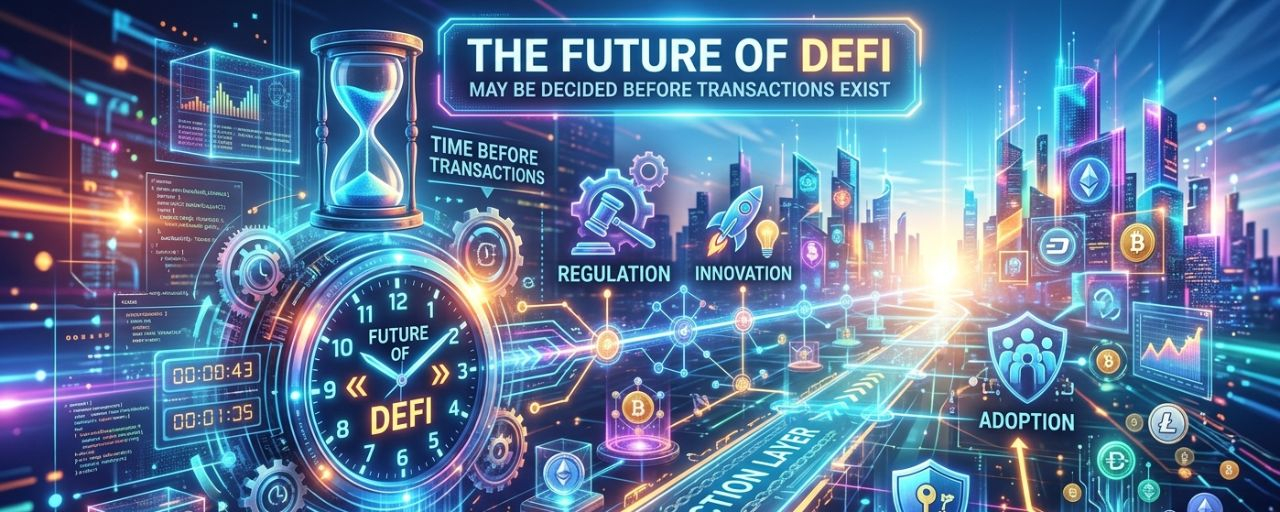
Most conversations about decentralized finance still revolve around speed, efficiency, and transparency. Yet the more time I spend watching protocols evolve, the more I wonder whether we have been optimizing the wrong part of the system. We built extraordinary tools to explain the past, but relatively few to shape the future before it unfolds. That imbalance feels increasingly important as digital assets move beyond experimentation toward infrastructure that may eventually support institutions, businesses, and even governments.
Risk management across DeFi has largely become an exercise in historical interpretation. Dashboards become richer every year. Analytics grow more sophisticated. Machine learning models identify suspicious behavior faster than ever. But every one of these systems shares a common limitation: they observe events after execution. By the time an alert appears, capital has already moved, incentives have already changed, and any damage has already entered the ledger.
What makes this interesting is that the next phase of blockchain infrastructure may not depend on producing better explanations of completed transactions. Instead, it may depend on determining whether certain transactions should proceed at all. That distinction matters because prevention and observation solve fundamentally different coordination problems.
The market tends to assume that decentralization requires minimizing constraints. Yet history suggests that mature financial systems do not simply remove rules; they automate rule enforcement in ways participants can predict. Credit card networks, payment processors, and institutional settlement systems all evaluate conditions before assets move. They reduce uncertainty not by analyzing yesterday's mistakes but by narrowing tomorrow's possibilities.
Viewed through that lens, @NewtonProtocol appears less like another execution layer and more like an attempt to introduce policy enforcement into decentralized finance itself. Rather than relying exclusively on post-settlement monitoring, the protocol evaluates predefined policy rules before settlement and records the signed authorization result onchain. At least in theory, this shifts security from reactive investigation toward proactive verification.
The deeper issue may be that blockchains have become exceptionally good at guaranteeing execution while remaining comparatively neutral about whether execution aligns with agreed intentions. Code faithfully performs instructions, but intent often exists outside the transaction itself. That disconnect creates room for operational mistakes, governance failures, compromised keys, and increasingly sophisticated automation risks.
Of course, introducing policy layers also raises legitimate concerns. Every additional enforcement mechanism potentially increases complexity. Poorly designed policies could become bottlenecks, reduce composability, or unintentionally centralize decision-making if governance over those policies becomes concentrated. The challenge is ensuring that enforcement remains transparent, verifiable, and programmable rather than discretionary. Otherwise, the cure risks recreating the very trust assumptions decentralized systems sought to eliminate.
The question isn't whether analytics become obsolete. They remain indispensable for auditing, research, compliance, and continuous improvement. Instead, the question is whether analytics alone are sufficient in an environment increasingly dominated by autonomous agents, algorithmic capital allocation, and machine-driven execution. As transaction volume accelerates beyond human oversight, relying exclusively on after-the-fact visibility begins to resemble driving by looking only in the rearview mirror.
This is also where ecosystem incentives become relevant. If $NEWT ultimately aligns validators, policy authors, developers, and users around maintaining reliable enforcement without compromising openness, the protocol could encourage healthier coordination rather than merely adding another technical feature. Whether that balance proves sustainable remains an open question, but the direction itself reflects a broader historical shift. The future of DeFi may depend less on seeing everything that happened and more on reliably defining what is allowed to happen before value moves. #Newt