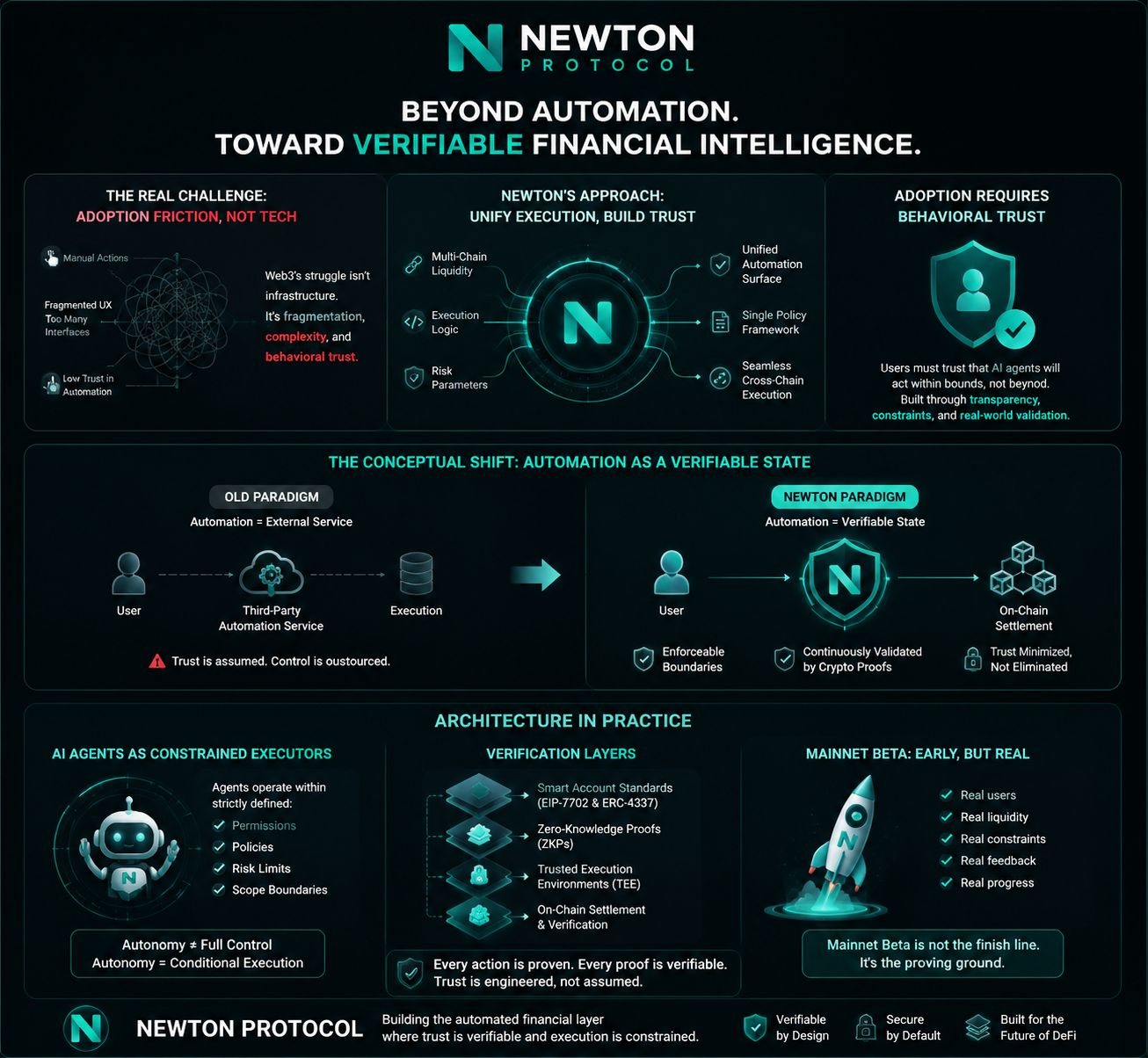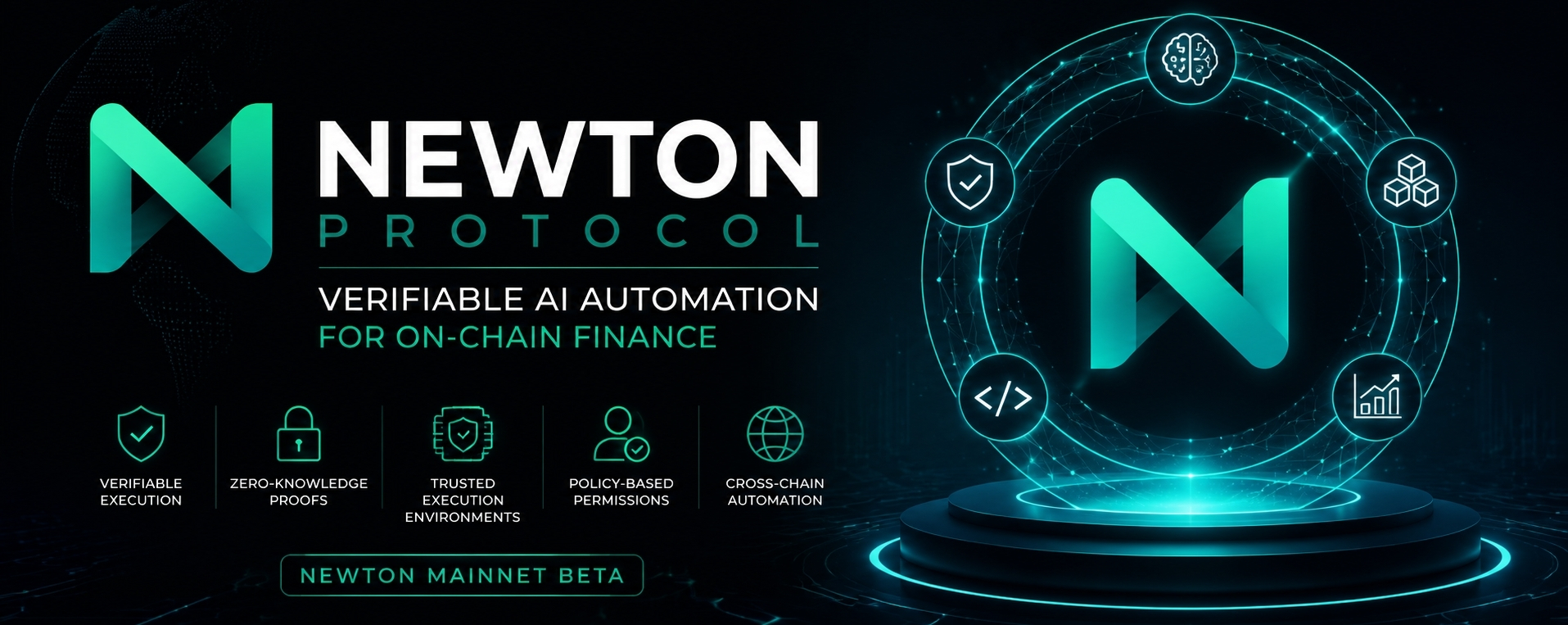
The introduction of @NewtonProtocol (NEWT) signals a structural shift in how on-chain finance is expected to operate under conditions of increasing automation. Rather than treating decentralized finance as a sequence of isolated applications requiring constant manual coordination, Newton reframes the environment as a verifiable execution layer where decisions, permissions, and outcomes are continuously enforceable through cryptographic guarantees. The Newton Mainnet Beta represents an early manifestation of this architecture, where the focus is not on expanding the number of DeFi tools but on redefining how those tools are safely operated by autonomous systems.
At its core, Newton Protocol functions as a verifiable automation system designed for AI-driven financial execution. The critical distinction lies in the introduction of accountability at the level of execution logic itself. Traditional automation in crypto has largely depended on opaque bots or centralized execution services, where users delegate control without meaningful transparency. Newton attempts to replace this trust-based model with a structure that combines zero-knowledge proofs and Trusted Execution Environments, ensuring that automated actions can be validated without exposing sensitive inputs or proprietary strategies. This creates a system where execution is not only automated but also provably constrained within predefined rules.
A notable interpretation of Newton’s design is that it does not position AI as an external actor interacting with DeFi, but rather as a bounded participant operating inside a cryptographically enforced perimeter. Smart Account standards based on EIP-7702 and ERC-4337 extend this idea by enabling policy-based delegation. In this model, private keys remain fully controlled by the user, while AI agents operate under strictly defined permission layers. The implication is that autonomy is not granted as full control, but as conditional execution capacity, continuously checked against verifiable constraints.
The Newton Mainnet Beta introduces early validation of this approach in a fragmented DeFi environment where liquidity, execution logic, and risk parameters are spread across multiple chains and interfaces. The protocol attempts to consolidate these layers into a unified automation surface. This consolidation is not merely infrastructural but behavioral, as it allows cross-chain operations to be executed through a single policy framework rather than a sequence of manual interactions. The effect is a reduction in cognitive overhead without a corresponding increase in custodial risk, which is a structural contradiction that most automation systems in DeFi fail to resolve.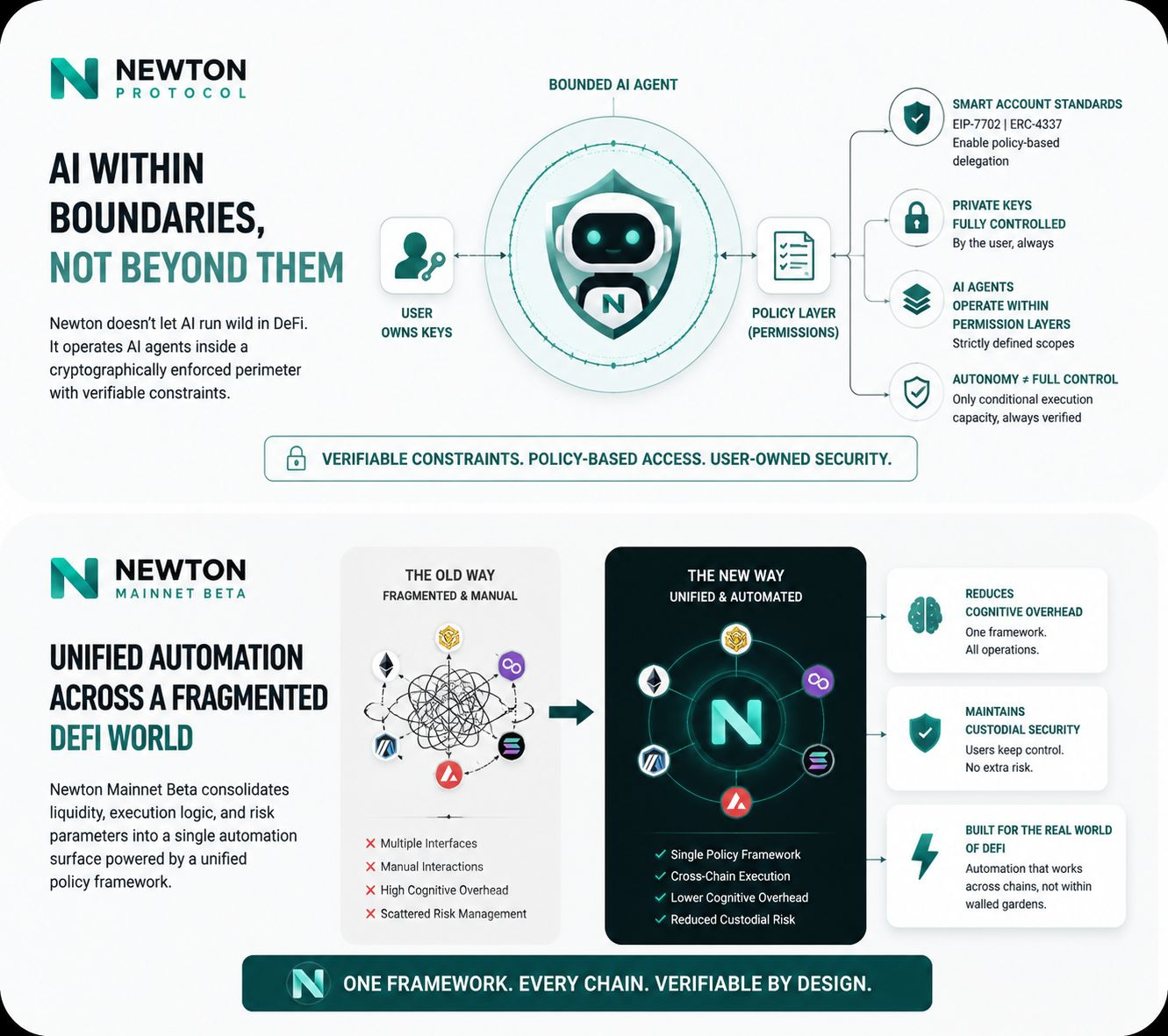
The role of zero-knowledge proofs in this system extends beyond privacy preservation. They function as a verification boundary between off-chain computation and on-chain settlement. Instead of broadcasting intermediate execution logic, Newton validates that actions conform to defined constraints before they are executed. Trusted Execution Environments complement this by providing hardware-level assurance that computation has not been altered during execution. The combination suggests an architecture where trust is not assumed in any single component but distributed across verifiable layers of computation and proof generation.
$NEWT , as the native token of the protocol, is positioned within this architecture as both a governance mechanism and a utility anchor. With a fixed total supply of one billion and a partial circulating allocation at launch, the token structure reflects an attempt to align early network participation with long-term protocol governance. Its inclusion in the Binance HODLer Airdrop program further indicates that early distribution strategies were designed to incentivize liquidity alignment rather than speculative fragmentation, although market behavior ultimately depends on execution adoption rather than distribution mechanics alone.
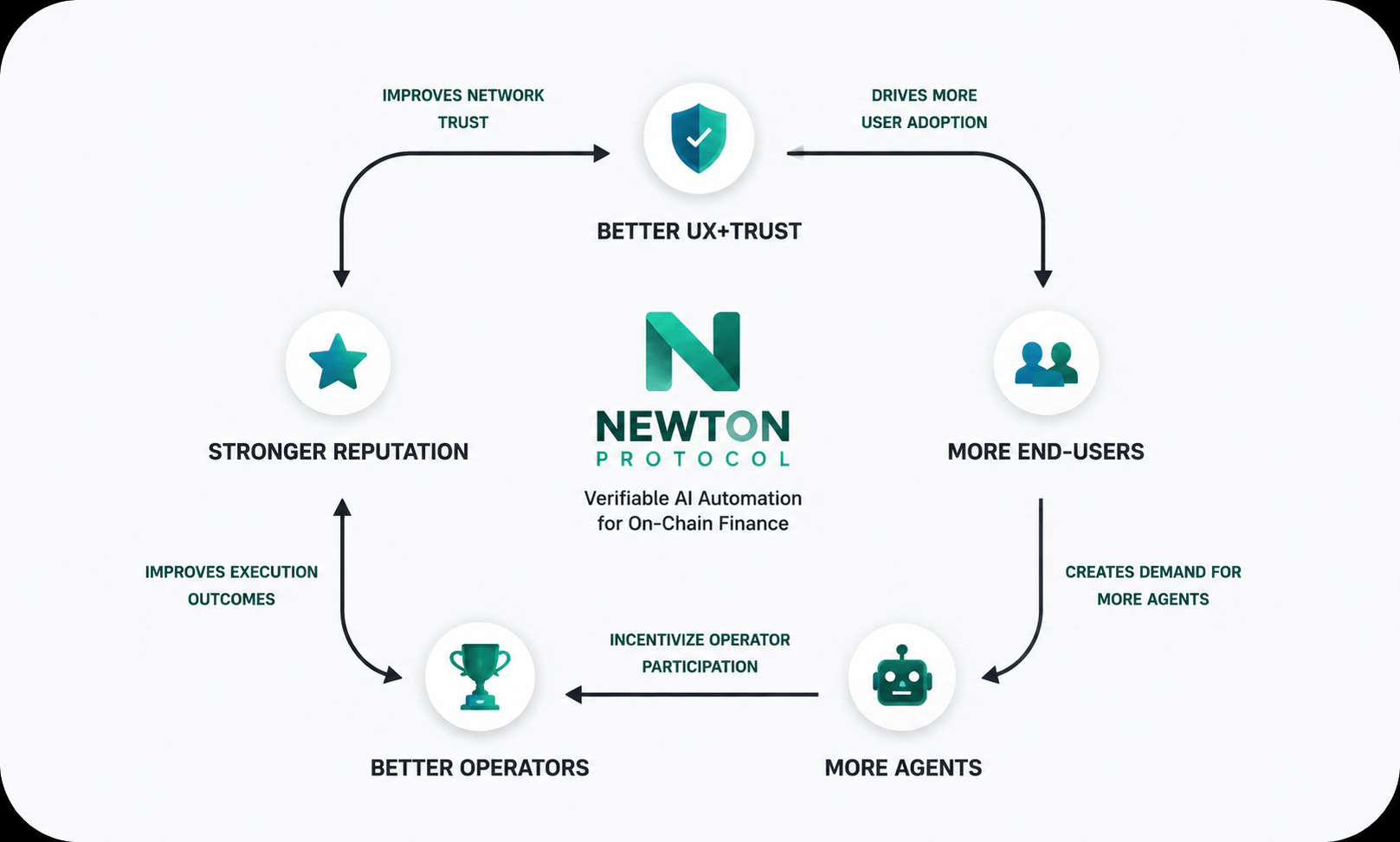
A more critical interpretation of Newton Protocol emerges when examining its proposed marketplace for automation agents. This introduces a competitive environment where AI strategies are not only executed but also evaluated through verifiable performance and compliance with execution rules. Unlike traditional bot ecosystems, where performance is often opaque and results are difficult to audit, Newton’s design implies a future where automation providers operate under observable constraints. This shifts the competitive axis from speed or secrecy toward verifiable correctness under policy-bound execution.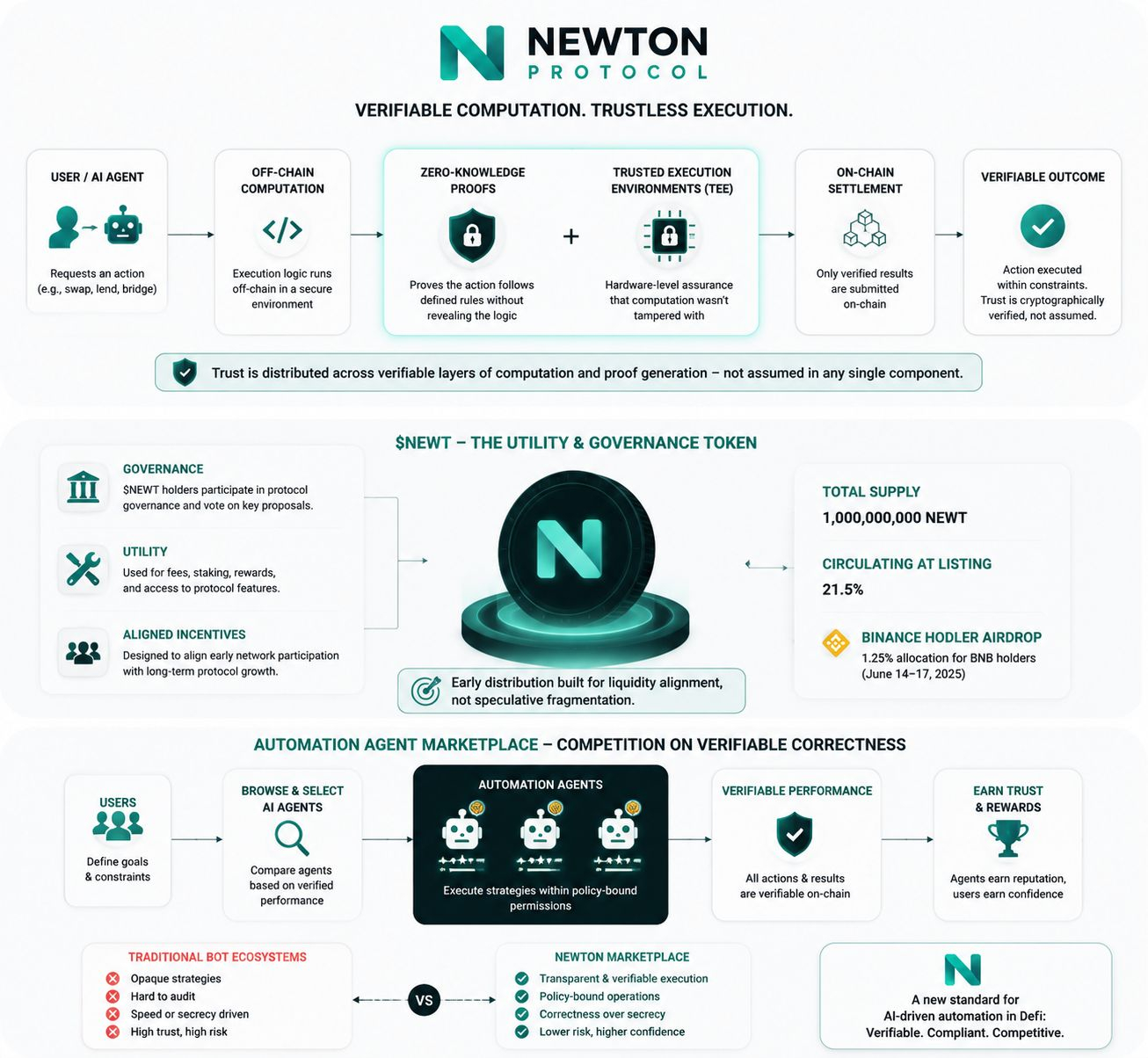
Despite these architectural advances, the underlying challenge remains centered on adoption friction rather than technical capability. Web3 has historically struggled not due to lack of infrastructure but due to fragmentation of user experience. Newton addresses this by attempting to unify execution logic, but unification at the protocol level does not automatically translate into usability at the application level. The transition from manual DeFi interaction to delegated AI execution requires behavioral trust in systems that are still emerging and partially validated in production environments such as the Mainnet Beta phase.
The most significant conceptual shift introduced by Newton Protocol is the redefinition of automation as a verifiable state rather than an external service. In conventional systems, automation is something users connect to. In Newton’s design, automation becomes something that exists within enforceable boundaries, continuously validated through cryptographic proofs. This reframing reduces reliance on subjective trust while increasing dependence on system-level correctness, which is a fundamentally different risk model.
Ultimately, Newton Protocol positions itself as infrastructure for an automated financial layer where AI agents operate not as uncontrolled actors but as constrained executors within a verifiable system. The success of the Newton Mainnet Beta will likely depend on whether these constraints remain lightweight enough to enable flexibility while still strict enough to ensure security. If balanced correctly, the result is not merely a new DeFi tool but a shift in how execution, trust, and automation coexist in decentralized systems.