
I’ve spent enough time around crypto to know that most projects become easier to understand once you ignore the big slogans and look at the problem they are quietly trying to solve. Newton feels like one of those projects. The more I look at it, the less I see it as another technical layer built for people already comfortable with crypto, and the more I see it as an attempt to deal with something the industry has avoided for years: the fact that moving money onchain is not always supposed to be final in the human sense.
Crypto has always been proud of finality. You send a transaction, it settles, and nobody can interfere. There is a certain appeal in that. No one can suddenly pause your money, question your decision, or make you wait for approval. But after watching this space mature, I have started to feel that finality is often treated like a complete answer when it is really only one side of the equation.
Real payments are rarely as clean as blockchain transactions make them look. People get tricked. A payment is sent to the wrong place. A buyer does not receive what was promised. Someone gains access to an account that was not theirs. A recurring payment continues longer than expected. In those situations, the question is not whether the transaction happened. The question is whether it should have happened in that way at all.
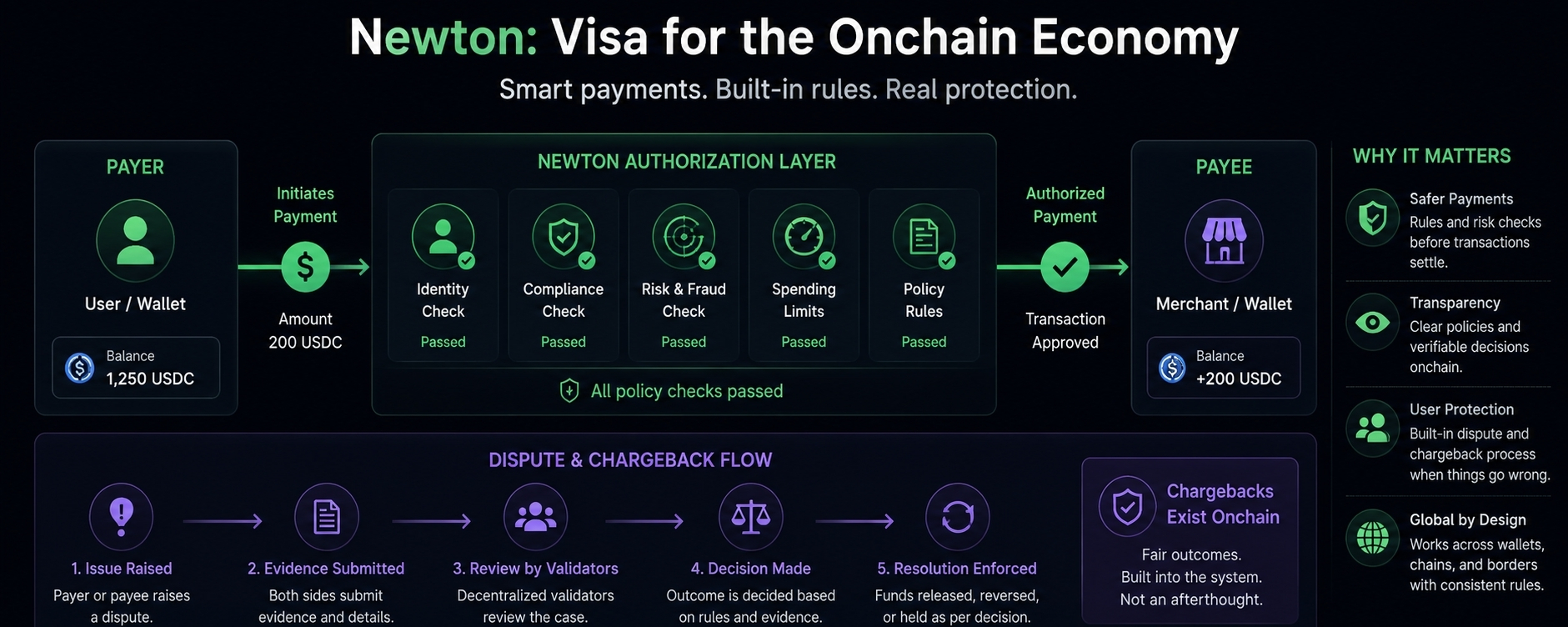
That is where Newton becomes more interesting. It seems to be built around the idea that onchain payments can include rules before they become permanent. Instead of treating every transfer as the same, Newton creates room for conditions around how money moves. A transaction can carry limits, permissions, checks, or restrictions that make the payment feel less like an irreversible command and more like part of a controlled process.
I think that matters because crypto has spent years proving that value can move quickly. That is no longer the difficult part. The harder issue is whether people can use that value in everyday situations without carrying the full burden of every mistake. Fast settlement is useful, but it does not automatically create trust. A payment system becomes more meaningful when it can account for the possibility that something goes wrong.
Newton’s approach seems to focus on that gap. It is not just about sending funds from one place to another. It is about giving the transaction some context. Who is allowed to send? How much can move? Under what conditions should a payment be approved? Should there be limits based on behavior, timing, or risk? These are questions that most people do not think about until they are the ones affected by a bad transaction.
The idea of chargebacks is especially important here, although I do not think it should be understood as simply reversing a payment. A chargeback is really a dispute. It is a process for questioning whether a transaction was legitimate, fair, or properly completed. Sometimes the buyer is right. Sometimes the seller is right. Sometimes the situation is unclear and neither side has a perfect case.
That is exactly why bringing this kind of protection onchain is difficult. A blockchain can show that funds moved, but it cannot naturally understand whether someone was misled, whether a service was delivered properly, or whether a claim is honest. Those are human questions. They involve judgment, evidence, and context. Newton may be able to make the rules around transactions more programmable, but it cannot remove the complexity that comes with real financial disputes.
Still, I think there is value in trying to build around that reality instead of ignoring it. Onchain payments often feel like digital cash. Once you hand it over, the interaction is over. That can be useful in some cases. But many payments are not really like cash. They involve trust between people who do not know each other, expectations around delivery, and the possibility that one side may need protection later.
Newton could make those interactions feel less exposed by allowing payments to carry clearer conditions from the beginning. Some transfers might be final immediately. Others could include a limited period for disputes. Some could require extra approval. Others might have restrictions based on who is receiving the funds or how the payment is being used. The important part is not that every transaction gets the same protection. It is that the rules are visible before the money leaves.
That kind of clarity could be more important than it first appears. In many financial systems, people only discover the rules after something goes wrong. They find out too late whether a payment can be challenged, whether they are protected, or who is responsible for fixing the problem. Newton has the potential to make those conditions more explicit. A user could understand what kind of transaction they are entering before they confirm it.
But that possibility also brings difficult questions. The moment a system can stop, restrict, or reverse a payment, someone has authority. Even when rules are open and visible, they still have to be written by someone. Someone has to decide what counts as suspicious behavior. Someone has to decide which disputes are valid. Someone has to decide how much control is too much.
That is where I remain cautious. The goal of making onchain payments safer can easily turn into building systems that are too restrictive, too complicated, or too difficult for ordinary users to challenge. A person may feel protected until a rule affects them unfairly. A merchant may appreciate fraud prevention until a valid payment is blocked. A user may want reversibility until they become the one waiting for funds to clear.
Newton is working in that uncomfortable space between complete freedom and structured protection. It is not an easy place to build, and it should not be treated as an easy problem. But I find the direction more thoughtful than the usual idea that people should simply accept the consequences of every transaction forever.
The industry has spent years celebrating the idea that users should control their own money. That principle still matters. But control also means responsibility, and responsibility becomes heavy when there is no room for error. Newton seems to be exploring whether onchain payments can remain direct while still allowing for more realistic safeguards around the way people actually use money.
I do not know whether that balance can be achieved cleanly. It may create new forms of control, new disputes, and new questions about who gets to define fairness. But I think Newton is at least looking at a problem that many projects prefer to ignore. Moving money is only one part of a payment system. The harder part is deciding what should happen when the transaction is not as simple as it first appeared.