 One of the strangest assumptions in technology is that more capability automatically creates more value.
Sometimes it does.
Sometimes it creates new problems.
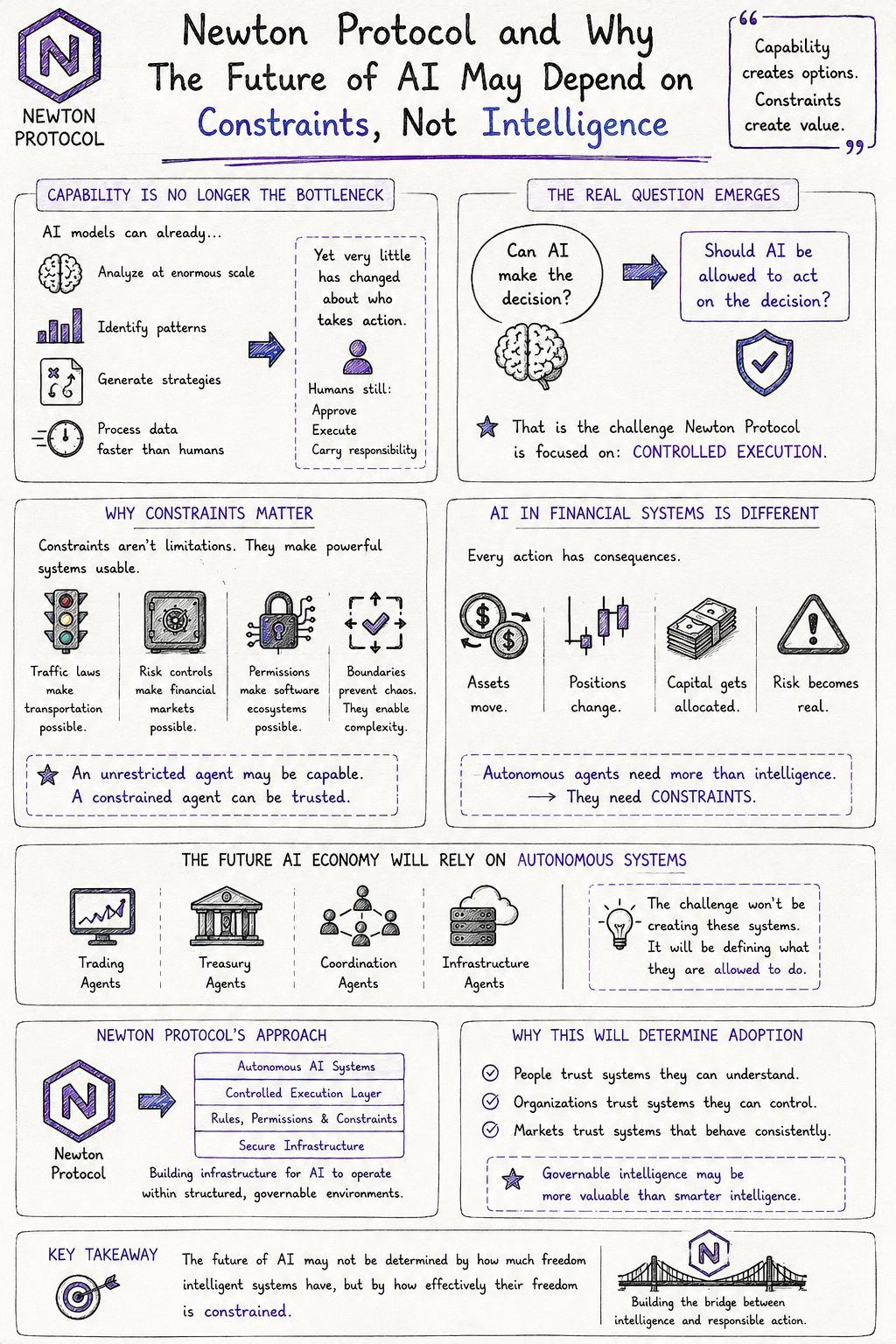
AI is reaching a point where capability is no longer the primary bottleneck.
Models can already analyze information at enormous scale.
They can identify patterns, generate strategies, and process data far faster than most humans.
Yet despite those advances, very little has changed about who ultimately takes action.
Humans still approve.
Humans still execute.
Humans still carry responsibility.
That gap is becoming increasingly important.
Because eventually the question stops being whether AI can make a decision.
The question becomes whether AI should be allowed to act on one.
That is the reason Newton Protocol caught my attention.
The project appears to be focused on a challenge that sits beyond intelligence itself.
Execution.
More specifically, controlled execution.
For years, AI systems have operated inside relatively safe environments. They generate outputs, and humans decide what happens next.
Financial systems work differently.
Every action has consequences.
Assets move.
Positions change.
Capital gets allocated.
Risk becomes real.
An autonomous agent entering that environment needs more than intelligence.
It needs constraints.
And I think constraints are one of the most underrated pieces of technology.
People often treat constraints as limitations.
In reality, constraints are what make powerful systems usable.
Traffic laws make transportation possible.
Risk controls make financial markets possible.
Security permissions make software ecosystems possible.
Without boundaries, complexity becomes chaos.
The same principle applies to AI.
An unrestricted agent may be capable.
A constrained agent can be trusted.
That distinction matters.
Because the future AI economy will likely be filled with systems making decisions continuously.
Trading agents.
Treasury agents.
Coordination agents.
Infrastructure agents.
The challenge won't be creating those systems.
The challenge will be defining what they are allowed to do.
This is where Newton's infrastructure approach becomes relevant.
Rather than focusing entirely on making AI smarter, the protocol appears to be exploring how autonomous systems can operate within structured environments.
That feels like a more mature problem.
Smarter intelligence is valuable.
Governable intelligence may be even more valuable.
History shows that technologies achieve widespread adoption when they become predictable.
People trust systems they can understand.
Organizations trust systems they can control.
Markets trust systems that behave consistently.
Autonomous AI will eventually face the same expectations.@NewtonProtocol
Which is why I keep returning to the same conclusion.
The future of AI may not be determined by how much freedom intelligent systems have.
It may be determined by how effectively their freedom is constrained.
And if that turns out to be true, infrastructure projects like Newton Protocol could end up playing a much larger role than many people currently expect.