
Artificial intelligence is becoming part of almost every industry, and finance is no exception. Many crypto projects are now developing AI agents that can trade, move assets across blockchains, and search for better investment opportunities without constant human input.
At first, this sounds exciting. But one important question often gets ignored.
Can people really trust AI to manage their money?
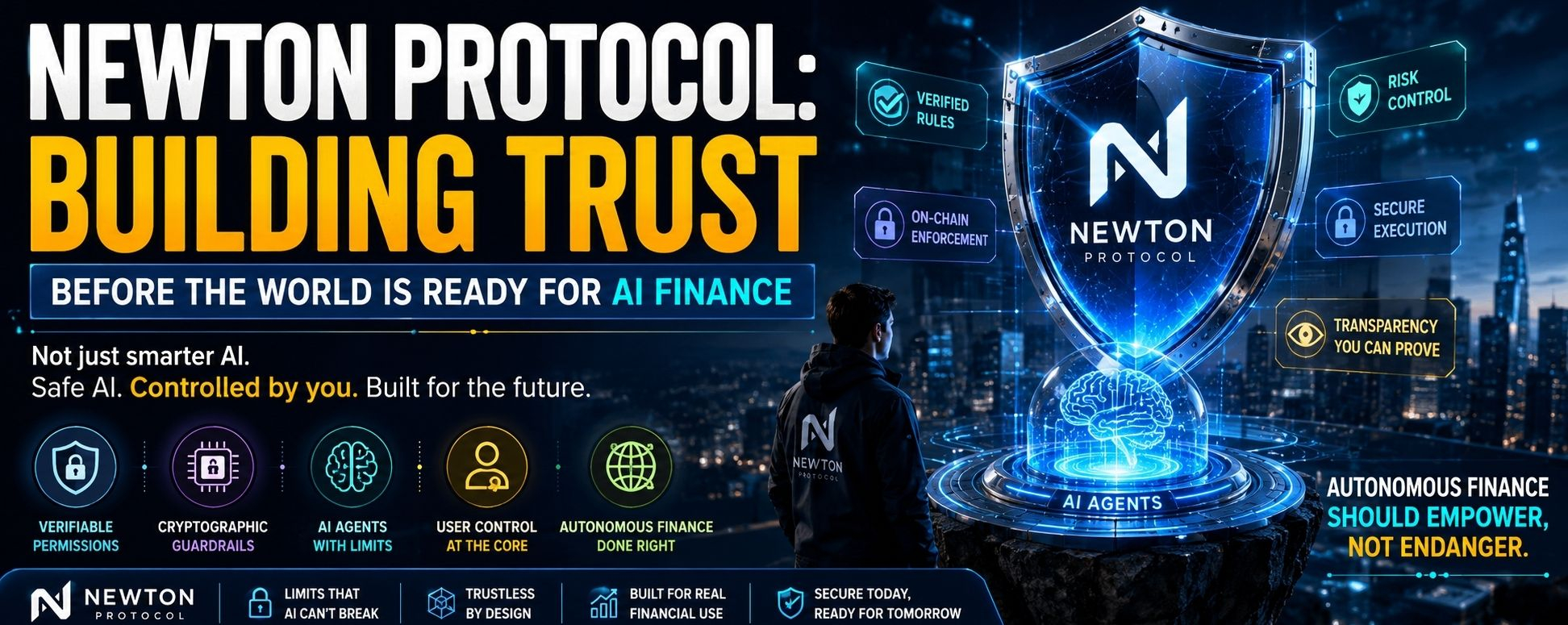
That is where Newton Protocol stands out. Instead of focusing only on making AI smarter, the project focuses on making AI safer. It recognizes that the biggest challenge in autonomous finance is not intelligence—it is trust.
Trust Comes Before Automation
Many projects promise a future where AI handles financial decisions automatically. The idea is attractive because it could save time and remove emotional decision-making.
However, most people are still uncomfortable giving complete control of their assets to software.
Money is personal. Even experienced investors hesitate before allowing an automated system to make important financial decisions without limits.
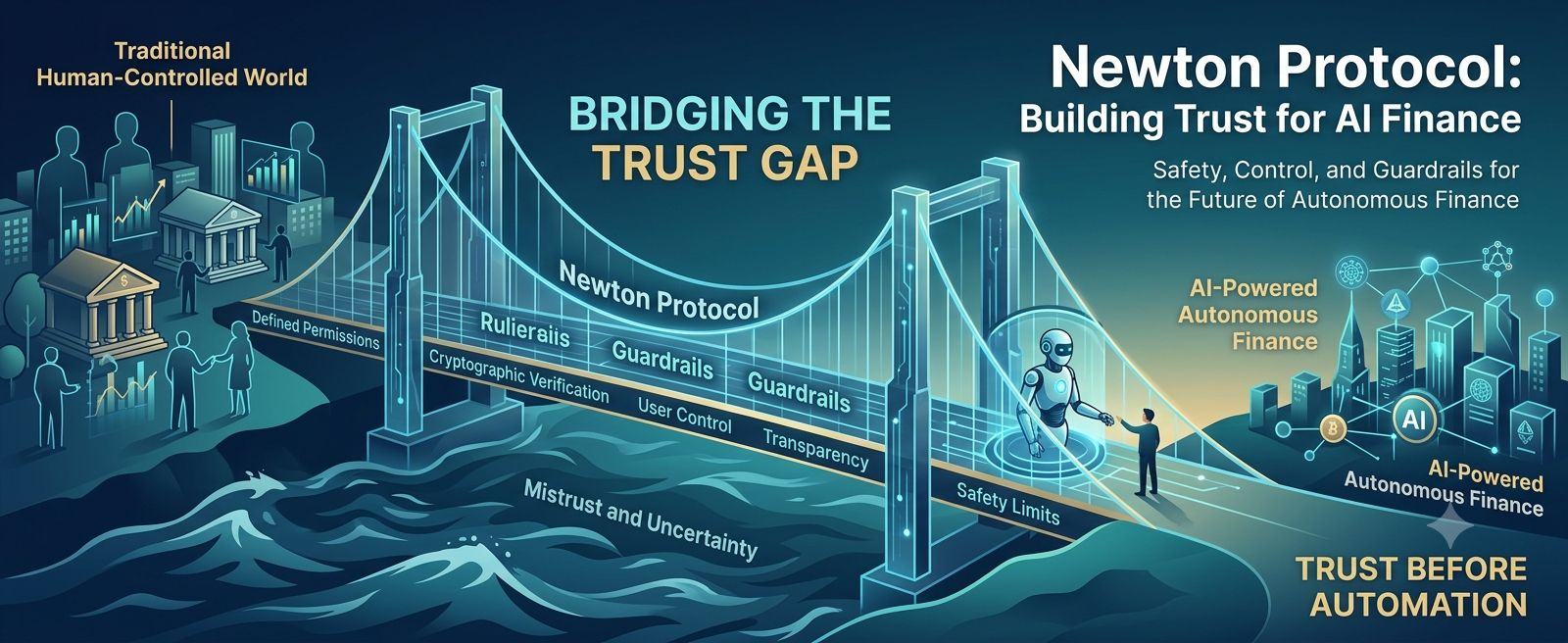
Newton Protocol seems to understand this concern. Rather than asking users to trust AI completely, it tries to create clear rules that the AI cannot break.
The goal is simple: let AI help with financial tasks while allowing users to stay in control.
Accepting That Mistakes Can Happen
One thing that makes Newton Protocol different is its realistic approach.
No technology is perfect. AI models can make poor decisions. Software can contain bugs. Security risks can appear at any time.
Instead of pretending these problems do not exist, Newton Protocol is designed with protective measures. Users can define permissions, while cryptographic verification helps ensure that AI operates within those boundaries.
This approach does not remove every risk, but it reduces the chance that AI acts outside the owner's intentions.
That may be one of the project's strongest ideas.
Great Technology Does Not Guarantee Success
History has shown many times that better technology does not always win.
People rarely choose products simply because they are technically superior. They usually choose what feels familiar, easy to use, and dependable.
This is true inside the crypto industry as well.
Millions of users already keep their funds on centralized exchanges because they are convenient. Others use existing DeFi platforms because they already understand how they work.
These services may not offer the most advanced technology, but they have earned user confidence over time.
Newton Protocol is not only competing with other blockchain projects.
It is competing with habits.
Changing user behavior is often harder than building new technology.
Finding the Right Audience
This raises another important question.
Who is Newton Protocol building for today?
Most retail investors are not actively searching for AI systems protected by cryptographic permissions. At the same time, large institutions already use professional trading tools and risk management systems built for their own needs.
The project's biggest opportunity may lie somewhere between these two groups.
But attracting that audience will require more than innovative technology.
People need a clear reason to leave products they already trust.
Trust Is Still Part of the System
Crypto has often promoted the idea of removing trust from finance.
In reality, trust never disappears.
It simply moves from one place to another.
Instead of trusting a company, users trust smart contracts, validators, governance systems, cryptographic proofs, and secure infrastructure.
For many people, this is an improvement because the rules become transparent and easier to verify.
Still, it remains a form of trust.
Whether everyday users see that difference as valuable will play an important role in the protocol's future.
Most Users Care About Results
Crypto enthusiasts often discuss decentralization, security, and protocol design.
Average users usually care about something much simpler.
Does it work?
If an application is reliable, easy to understand, and performs well, many people will continue using it without worrying about the technology behind it.
This has been true for many successful products across different industries.
Convenience often wins.
Timing May Be Newton's Biggest Challenge
AI is improving rapidly, but autonomous finance is still developing.
Many people are not ready to let software manage significant amounts of money without supervision.
Governments are still creating regulations.
Businesses are still testing AI-based financial tools.
Consumers are still learning where automation fits into their financial lives.
Newton Protocol may be solving a problem that becomes much more important several years from now instead of today.
That could become either its greatest advantage or its biggest obstacle.
Being early can be just as difficult as being late.
Real Adoption Will Decide Everything
Every blockchain project eventually faces the same question.
Are people using it because it offers real value, or only because rewards encourage temporary activity?
Token incentives can attract attention, but they cannot create lasting demand.
Long-term success depends on genuine users, real transactions, and meaningful economic activity.
Newton Protocol will eventually be judged by these factors.
If people continue using the network after the excitement fades, it will have built something valuable.
If not, even impressive technology may struggle to survive.
Human Confidence Matters More Than Artificial Intelligence
Technology changes quickly.
Human behavior changes much more slowly.
People do not trust new financial systems overnight. Confidence grows through consistent performance over time.
This may be the biggest challenge Newton Protocol faces.
The project is not only building infrastructure for AI-powered finance.
It is trying to earn human confidence in a future where software becomes an active financial partner.
That goal is far more difficult than writing better code.
Final Thoughts
Newton Protocol offers a thoughtful vision of how autonomous finance could develop in the years ahead. Rather than assuming people will automatically trust AI, it focuses on creating safeguards that allow automation without removing user control.
Whether that vision succeeds will depend on much more than technical design.
It will depend on timing, adoption, and the willingness of ordinary people to embrace a new way of managing money.
The crypto industry has seen many brilliant ideas arrive before the market was ready.
Newton Protocol now faces the same challenge.
If the world embraces autonomous finance, its approach to trust could become one of its greatest strengths.
If adoption takes longer than expected, the project may need patience as much as innovation.
In the end, the future will not be decided only by smarter AI.
It will be decided by whether people feel confident enough to let that AI work for them.