
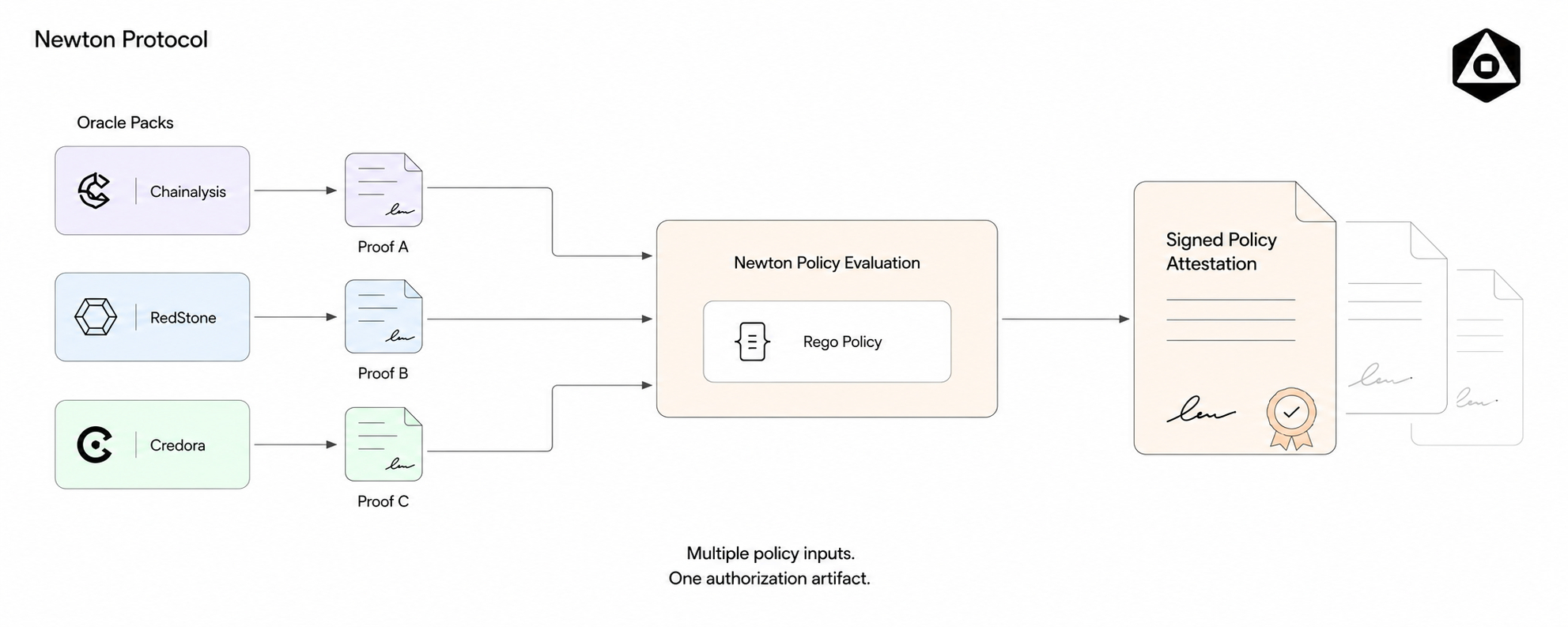

I went back through Newton's policy evaluation flow because I couldn't work out where the other receipts had gone.
I'd assumed every oracle pack would leave behind its own signed artifact.
One for sanctions.
One for price.
One for risk.
I wasn't trying to understand the Rego policy.
I was trying to find the receipts.
I read the evaluation flow once.
Then again.
Then a third time.
The oracle outputs arrived.
The Rego policy evaluated them.
One signed policy attestation appeared before settlement.
Nothing else.
I went back.
Read it again.
Still one.
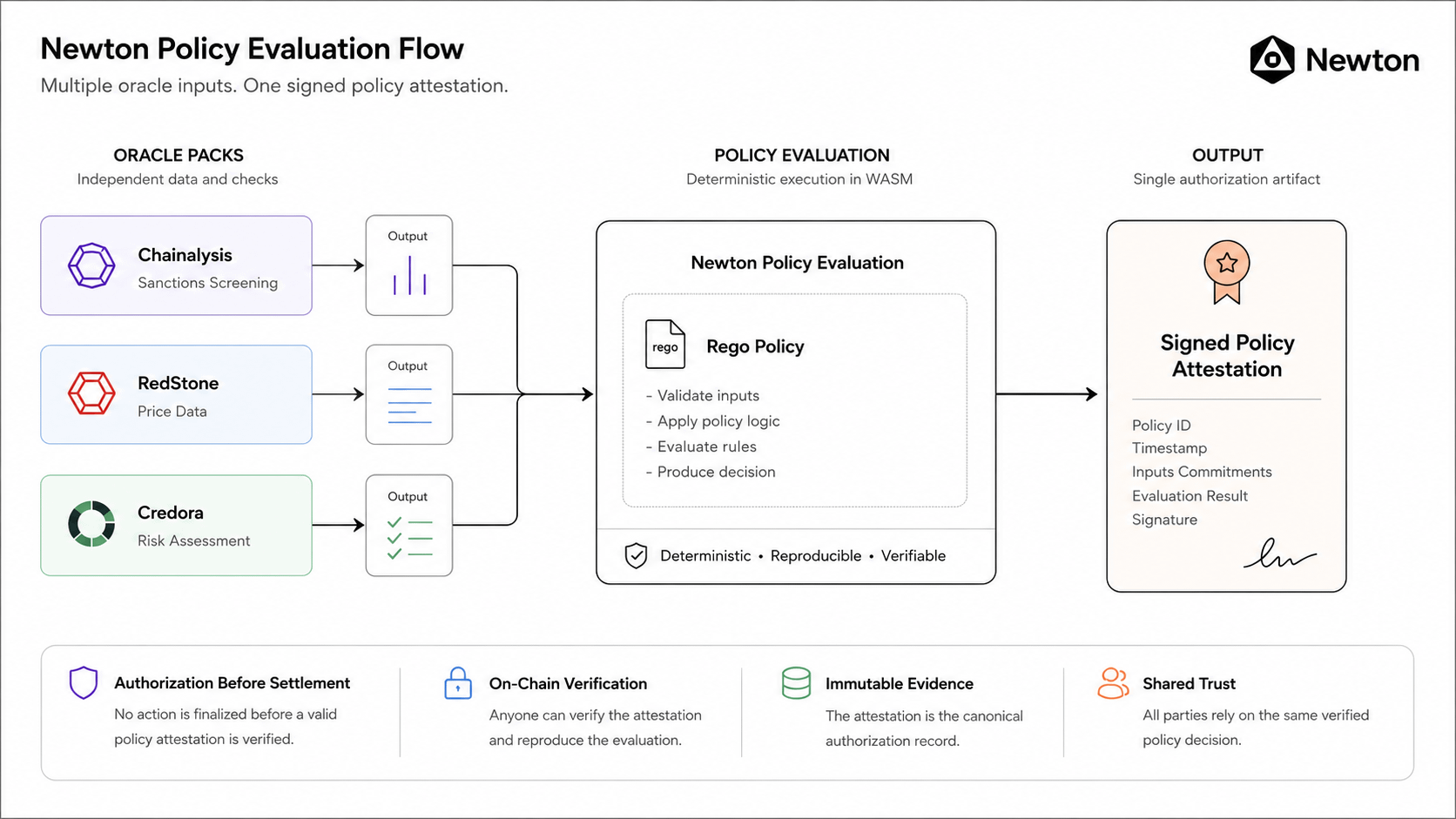
That was the moment I stopped trying to understand the implementation.
I started trying to understand why the other receipts never existed.
That became a much more interesting question.
At first I assumed Newton was simply merging several authorization checks into one decision.
The longer I sat with it, the less satisfying that explanation became.
The individual controls never disappear.
Sanctions screening still happens.
Price data still matters.
Risk still influences the authorization decision.
Nothing is missing.
Except the thing I expected the protocol to preserve.
None of those controls becomes the artifact that ultimately receives its own signature.
I couldn't get past that.
Not because it looked wrong.
Because I couldn't work out why Newton's engineers were comfortable giving something up that I'd always assumed was valuable.
I'd always imagined authorization evidence accumulating naturally.
One control.
One receipt.
Another control.
Another receipt.
Eventually the collection became the thing you trusted.
@NewtonProtocol doesn't seem to begin from that assumption.
Or maybe I'm still reading the architecture through assumptions I brought with me.
I honestly can't tell yet.
I kept looking for another explanation.
I never found one that felt more convincing.
Maybe once every required input has already been evaluated inside the same deterministic policy, preserving separate signed artifacts no longer adds confidence to the authorization itself.
Or maybe the trade-off runs even deeper.
Maybe Newton isn't trying to preserve individual controls at all.
Maybe it's preserving something larger.
I kept writing one phrase in my notes.
**Evidence collapse.**
Not because evidence disappears.
It doesn't.
Because the evidence stops existing as independent artifacts and survives only as a single authorization decision.
I'm still not convinced that's the perfect phrase.
It's simply the only one that kept making sense every time I went back through the evaluation flow.
And that creates another question.
If someone later asks whether a sanctions check happened, what are they actually asking for?
Proof that one control executed?
Or proof that the authorization policy evaluated every required control before settlement?
Those questions sound almost identical.
The more I think about them, the less convinced I am that they actually are.
And if they aren't, where does the burden move?
To replaying the policy?
To trusting the signed policy attestation?
To something else entirely?
I still haven't settled on an answer.
I closed the policy pack documentation with the same question I'd opened it with.
The signed policy attestation was still there.
The individual receipts still weren't.
Maybe that's exactly what Newton's engineers intended.
Or maybe I still haven't found the better explanation.
Mainnet Beta will probably decide which interpretation survives contact with real operators.
I'm watching to see whether operators eventually stop looking for the same receipts I couldn't stop looking for.
If they do, $NEWT only becomes interesting to me if this way of thinking survives real operators, real audits, and real production systems.