
Decentralized finance, often called DeFi, has introduced a new way to trade digital assets without relying on traditional financial institutions. Instead of using banks or centralized exchanges to match buyers and sellers, many DeFi platforms use liquidity pools. These pools allow people to trade at any time while keeping the system decentralized.
@NewtonProtocol ($NEWT) is building infrastructure designed for AI powered strategies, automated trading, and a marketplace where developers can create and share intelligent tools. For an ecosystem like this to function smoothly, users need a reliable way to exchange tokens. That is where liquidity pools become essential.
Understanding how these pools work can help new users better understand not only Newton Protocol but also many other DeFi applications.
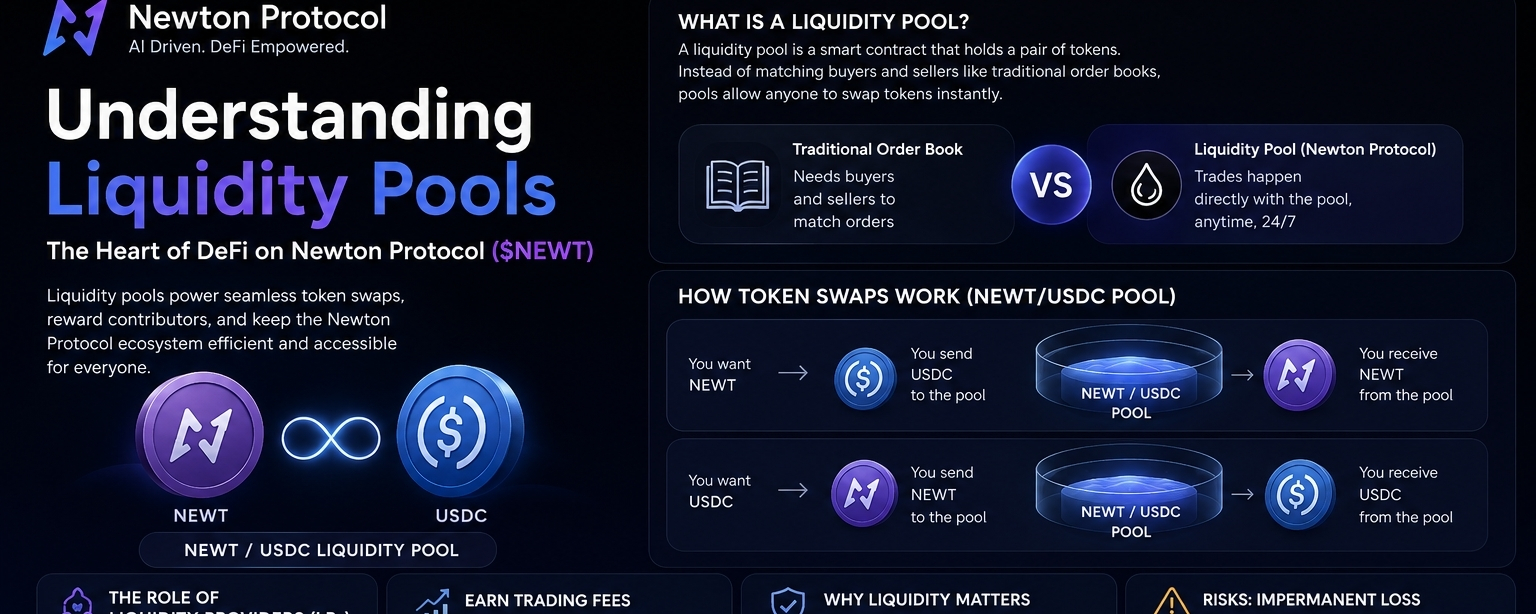
A liquidity pool is simply a collection of tokens locked inside a smart contract. Instead of waiting for another trader to take the opposite side of your trade, you interact directly with this pool.
Think of it like a shared digital vault that always holds two different tokens. Traders can swap one token for another whenever they want, as long as there is enough liquidity inside the pool.
This is very different from traditional financial markets.
In a traditional exchange, an order book records buy orders and sell orders. A trade only happens when someone is willing to buy at the same price another person wants to sell.
That system works well, but it depends on having enough active traders placing matching orders.
Liquidity pools remove that requirement.
Instead of matching two people together, the smart contract automatically handles the swap using the assets already stored inside the pool. This means trading can continue without waiting for another individual to appear on the other side of the transaction.
Let's imagine a NEWT/USDC liquidity pool.
The pool contains both NEWT tokens and USDC. If someone wants to exchange USDC for NEWT, they send USDC into the pool. In return, the smart contract automatically sends the correct amount of NEWT back to them.
If another trader wants to swap NEWT for USDC, the opposite happens.
The pool receives NEWT and sends out USDC.
Everything happens automatically according to the rules written into the smart contract.
This creates a smooth trading experience that is available around the clock.
One of the biggest advantages of this system is that users do not have to wait for another trader with matching intentions. The liquidity pool is always available to process swaps as long as it contains enough assets.
Of course, this raises an important question.
Where do the tokens inside the pool come from?
The answer is ordinary users known as Liquidity Providers, often called LPs.
Liquidity Providers deposit equal values of both tokens into the pool. In our example, they would contribute both NEWT and USDC.
By supplying these assets, LPs help create the liquidity that allows everyone else to trade.
Without these contributors, there would be no pool and no simple way for users to swap tokens whenever they want.
Providing liquidity is one of the ways people participate in decentralized finance beyond simply buying and holding tokens.
Since Liquidity Providers are helping the network, they usually receive rewards.
Whenever traders swap tokens through the liquidity pool, they pay a small trading fee.
Instead of going to a centralized company, these fees are typically shared among the Liquidity Providers based on how much liquidity each person has contributed.
For example, if an LP owns a larger percentage of the NEWT/USDC pool, they generally receive a larger share of the trading fees generated by that pool.
As trading activity increases, more fees may be collected.
This creates an incentive for people to keep their assets inside the pool and support the overall health of the ecosystem.
Liquidity itself plays a very important role in making trading efficient.
Imagine trying to exchange a large amount of NEWT in a pool that contains only a small number of tokens.
The trade could significantly change the price before it finishes.
This difference between the expected price and the actual execution price is called slippage.
High slippage usually means traders receive fewer tokens than they expected.
Nobody enjoys paying more or receiving less during a trade.
Larger liquidity pools help reduce this problem.
Because there are more assets available, even larger trades have a smaller impact on the overall price.
This creates a smoother trading experience and helps prices remain more stable.
Healthy liquidity also makes markets more efficient.
When plenty of liquidity is available, users can enter and leave positions more easily.
Prices tend to adjust more smoothly because the market can absorb buying and selling activity without dramatic price swings.
For a growing ecosystem like Newton Protocol, strong liquidity helps improve the overall user experience.
Developers building AI powered applications, traders using automated strategies, and everyday users all benefit when token swaps happen quickly with minimal slippage.
Although providing liquidity can generate trading fees, it is important to understand that it is not completely risk free.
One of the most common risks is called impermanent loss.
The name sounds complicated, but the basic idea is actually quite simple.
Imagine you deposit NEWT and USDC into a liquidity pool.
After some time, the market price of NEWT rises significantly compared to USDC.
As traders continue swapping tokens, the balance inside the pool automatically changes.
When you eventually withdraw your assets, you may end up with a different amount of NEWT and USDC than you originally deposited.
Sometimes the total value of those assets can be lower than if you had simply held the two tokens separately in your wallet without providing liquidity.
This difference is known as impermanent loss.
It is called "impermanent" because if token prices later return to similar levels, the loss may decrease or even disappear.
However, if you withdraw your funds while prices remain far apart, the loss becomes real.
Trading fees earned while providing liquidity may help offset some or even all of this loss, but there is no guarantee.
That is why every Liquidity Provider should understand both the potential rewards and the possible risks before participating.
Learning how liquidity pools respond to changing prices is just as important as learning how trading fees are earned.
Another useful habit for beginners is starting with education instead of rushing into participation.
Take time to understand how token prices move, how liquidity pools rebalance assets, and how trading activity affects returns.
The better you understand these ideas, the more confident you will feel when exploring DeFi.
Newton Protocol aims to support an ecosystem focused on AI innovation, automated strategies, and decentralized applications. As this ecosystem grows, liquidity pools can play an important role by making token trading accessible, efficient, and available at any time.
For users, understanding these pools is one of the first building blocks for understanding decentralized finance as a whole.
Whether you eventually become a trader, a Liquidity Provider, or simply someone interested in blockchain technology, learning how liquidity pools work will give you a stronger foundation.
Liquidity pools are one of the most important ideas in decentralized finance, and Newton Protocol provides an easy way to understand why they matter. They replace traditional order books with smart contracts, allow users to swap NEWT and USDC directly from shared pools, reward Liquidity Providers with trading fees, and help reduce slippage through deeper liquidity. At the same time, providing liquidity carries risks such as impermanent loss, so it is important to understand both the benefits and the challenges. Before participating in the Newton Protocol ecosystem, spend time learning the basics of liquidity pools. A little knowledge today can help you make more informed decisions as you continue exploring the world of DeFi.
