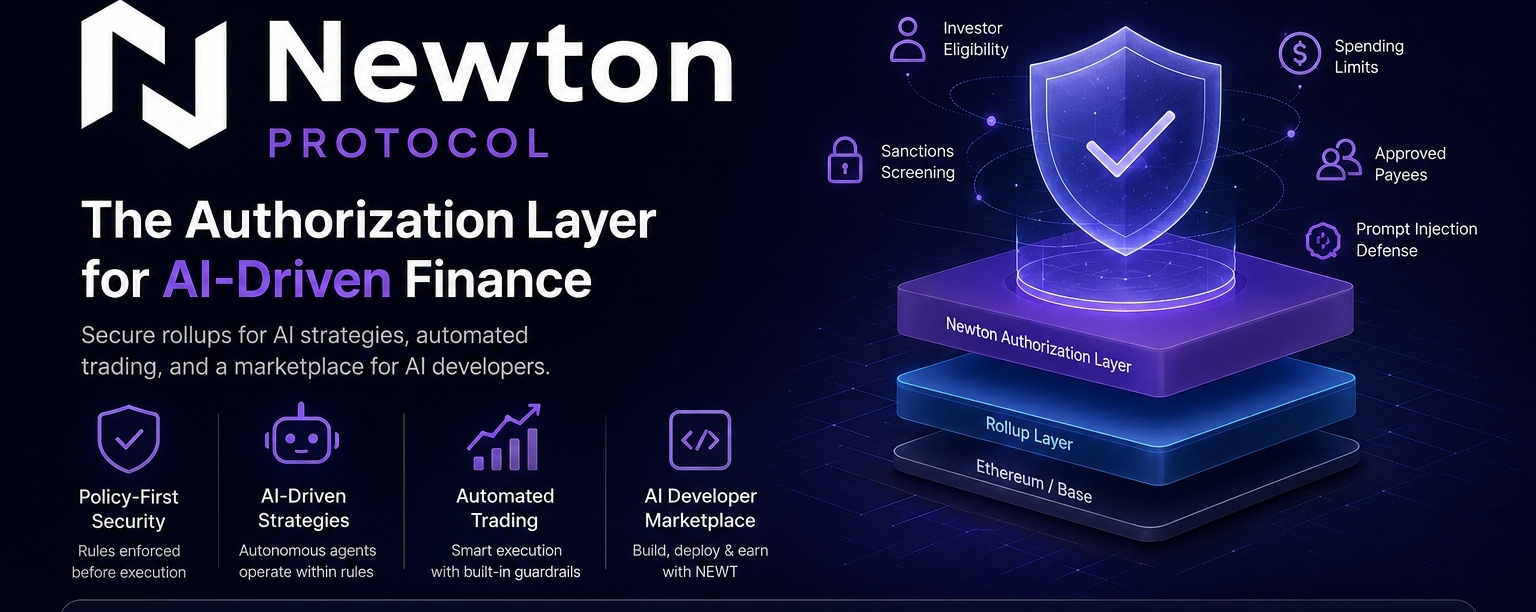
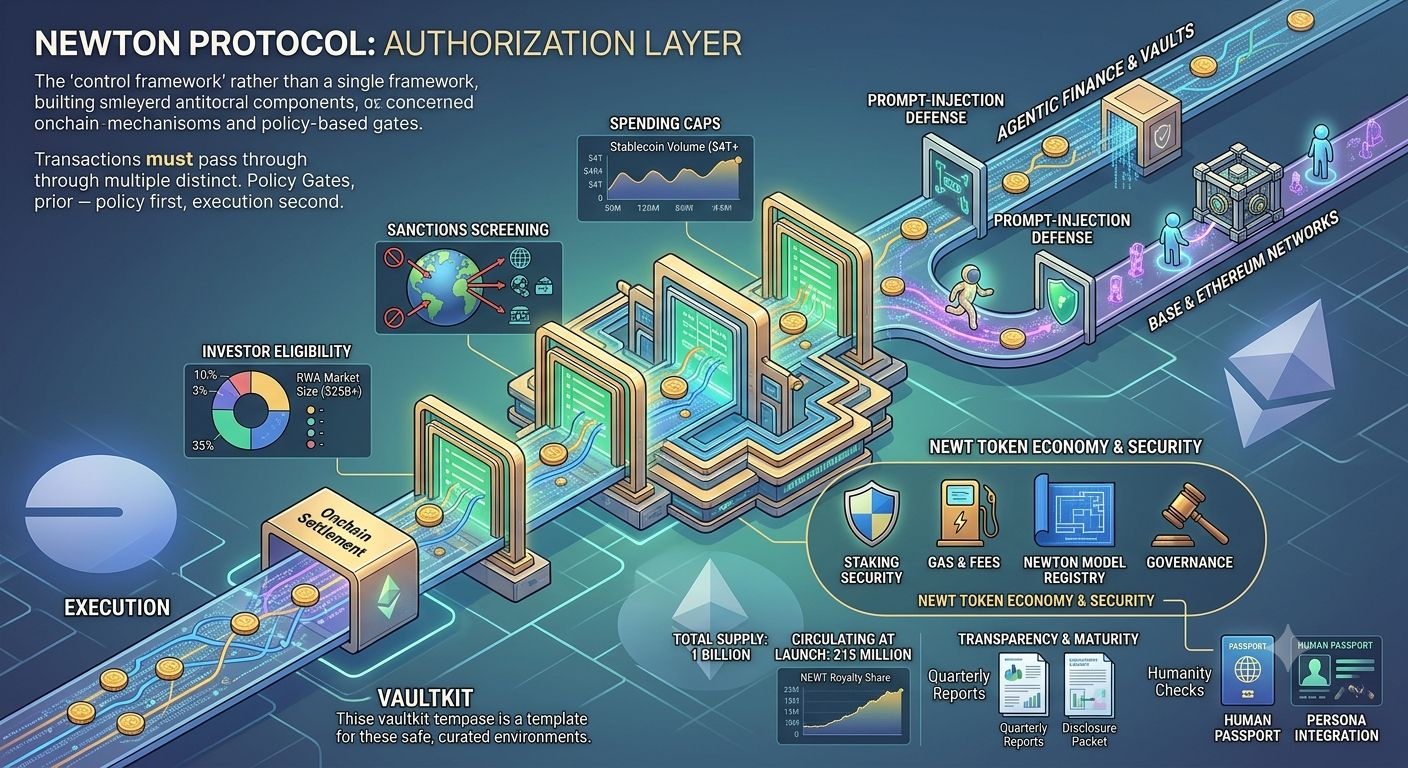
 Newton is not trying to be another loud crypto project with a flashy launch and a vague promise. It is positioning itself as an authorization layer for onchain transactions, which sounds technical because it is, but the idea is simple enough: rules should be checked before money moves, not after. That matters more than it sounds. The project says its mainnet beta went live on June 23, 2026, and the protocol is now live on Base and Ethereum. The newest official posts from July 1 and June 24 push that same message even harder: policy first, execution second.
That is the part worth paying attention to. A lot of crypto infrastructure still treats compliance like a wrapper around the real system. Newton is taking the opposite route. It is trying to make authorization native, so the transaction itself can carry the rules that govern it. On the public site, the protocol describes use cases across RWAs, stablecoins, and agentic finance, with examples like investor eligibility, sanctions screening, spending caps, approved payees, and prompt-injection defense for autonomous agents. That is not marketing fluff. It is a direct answer to a market that keeps asking for speed and trust at the same time.
The timing is not random. Newton’s own homepage points to the size of the problem: a $313B+ stablecoin market cap, $4T+ in monthly stablecoin transfer volume, $25B+ in tokenized real-world assets, and $206B+ in annual global compliance costs. Whether every number is the point or not, the direction is obvious. More value is moving onchain, and the old guardrails are not keeping up. That is why the project’s pitch feels more practical than ideological. It is not asking whether rules should exist. It is asking where they should live.
The newest Newton writing also makes the use case feel less abstract. VaultKit, announced on June 24, is framed as compliance and risk controls for onchain vault management, turning a curator’s promise into something the vault itself enforces before execution. Then on July 1, Newton published a deeper explanation of how the authorization layer works, which suggests the team is now moving from announcement mode into explanation mode. That usually happens when a project wants builders, not just spectators. It also usually means the hard part is no longer the slogan. It is the implementation.
And that is where Newton gets interesting. The March updates show the protocol widening beyond policy enforcement into identity and humanity checks. Persona integration is meant to support real-time identity and jurisdictional compliance, while Human Passport is being used to verify that wallets map to real, unique humans. Those are different problems, but they point in the same direction: if value is going to flow through agents, vaults, airdrops, and governance systems, then the network needs a cleaner sense of who or what is acting. Bluntly, a lot of onchain systems are still too easy to game.
The NEWT token sits inside that design rather than beside it. According to the foundation’s token announcement, NEWT is meant to function as staking security, gas and fees, a registration token for the Newton Model Registry, and a governance asset over time. The same disclosure says total supply is fixed at 1 billion, with 215 million circulating at launch. That is a fairly standard token structure on paper, but the interesting part is the registry angle: model developers can list AI models or agents, operators can serve them, and developers can receive a royalty share of NEWT fees. That makes the token feel less like decoration and more like plumbing.
There is also a quiet maturity in how the foundation talks about transparency. The token post says the foundation will hold NEWT in publicly tagged onchain wallets, publish quarterly transparency reports, and use a disclosure packet that covers governance, tokenomics, allocations, and vesting. Not every project does that, and not every project can sustain it. But Newton seems to understand something basic: if you are building a system around trust, you do not get to be vague about your own structure. That would be awkward at best. At worst, it would kill the whole thesis.
What stands out, in the end, is that Newton is not selling a future where AI runs free. It is selling a future where AI is fenced in just enough to be usable. That is the real story here. Not autonomy without brakes. Not compliance without motion. Something more ordinary, and probably more valuable: systems that can act quickly, but only inside rules people can see, verify, and enforce before the loss happens. You can already feel why that would matter to treasury teams, protocol teams, and the builders trying to ship agent-based finance without creating a mess they cannot clean up later.
@NewtonProtocol $NEWT #Newt $ESPORTS $OPG