
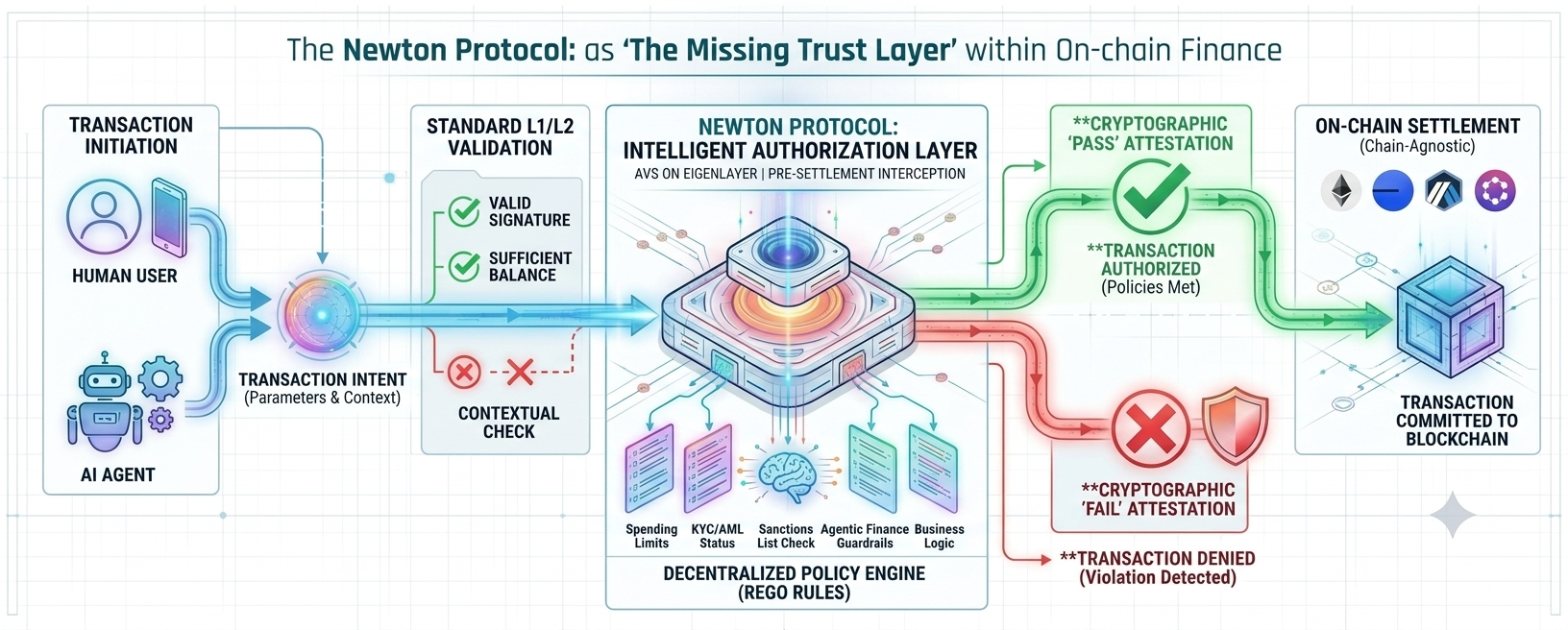

For years, blockchain has excelled at one thing: settlement. Once a transaction is approved, decentralized networks can move value quickly, transparently, and without relying on traditional intermediaries. Yet the journey leading up to that final settlement has remained one of crypto's biggest blind spots.
Traditional finance doesn't simply process transactions. Every payment, loan, or investment passes through multiple layers of verification, including compliance checks, fraud detection, sanctions screening, identity verification, collateral analysis, and risk assessment. These controls determine whether a transaction should happen before funds ever move.
Blockchain has largely focused on the last step while leaving the decision-making process off-chain.
Newton Protocol introduces a fundamentally different approach by bringing programmable authorization directly onto the blockchain. Rather than treating compliance and risk management as external services, Newton transforms them into verifiable on-chain policies that can be enforced automatically and transparently.
This shift has the potential to become one of the most important infrastructure upgrades for decentralized finance.
Settlement Alone Is Not Enough
Crypto has successfully built an open financial settlement network, but settlement represents only the final stage of a financial transaction.
Institutional capital requires confidence that transactions satisfy regulatory requirements, internal risk policies, asset restrictions, and operational safeguards before execution.
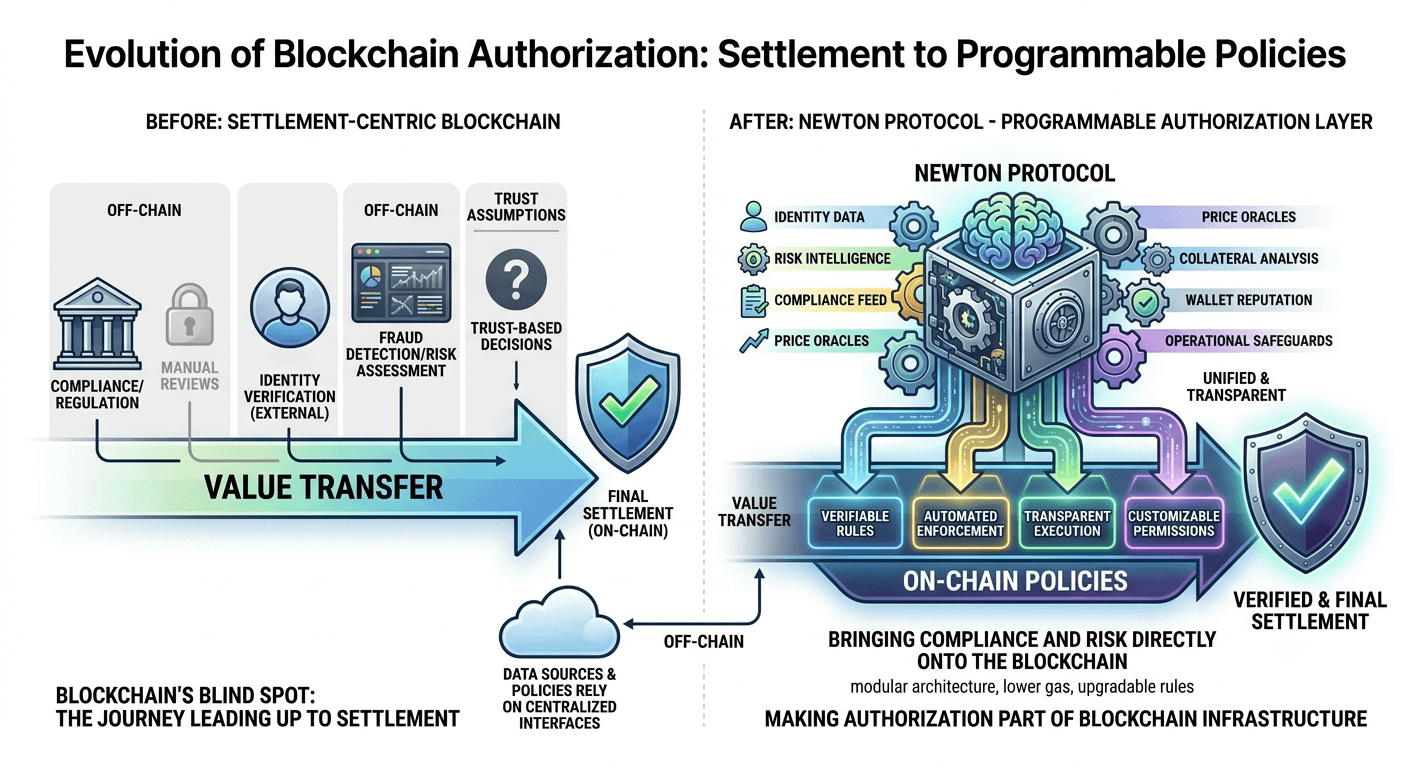
Without this layer, protocols often depend on centralized interfaces or manual reviews that users cannot independently verify. These systems may work, but they reduce transparency and introduce trust assumptions that blockchain was originally designed to eliminate.
Newton addresses this challenge by making authorization itself part of blockchain infrastructure.
Instead of asking users to trust external processes, every authorization rule becomes programmable, transparent, and verifiable.
A Purpose-Built Authorization Layer
One of Newton's strongest architectural decisions is specialization.
General-purpose blockchains such as the EVM are designed to support virtually every type of decentralized application. While this flexibility has enabled enormous innovation, it also means developers frequently embed authorization logic directly into smart contracts.
That approach creates several challenges.
Complex policy logic increases gas costs.
Updating compliance rules often requires contract upgrades or redeployments.
Every additional integration introduces new security considerations.
Newton separates authorization from application logic.
Rather than forcing every protocol to build its own permission framework, developers can compose policies using specialized infrastructure designed specifically for authorization.
This modular architecture allows applications to evolve without repeatedly rebuilding complex security systems.
Trust Through Data, Not Assumptions
Policies only work if they rely on reliable information.
Newton's ecosystem demonstrates that authorization is not based on a single provider but on multiple specialized data sources working together.
Identity verification providers help validate users.
Risk intelligence providers monitor wallet activity.
Compliance services screen sanctioned entities.
Price oracles deliver accurate market data.
Collateral intelligence evaluates lending positions.
Wallet reputation systems assess behavioral risk.
Each provider contributes a different piece of information that developers can combine into custom authorization policies.
Instead of relying on assumptions, protocols can make decisions using verifiable data.
This creates an environment where authorization becomes both transparent and programmable.
Infrastructure Built Around an Ecosystem
Infrastructure succeeds when many independent participants strengthen the network together.
Newton's architecture reflects this philosophy.
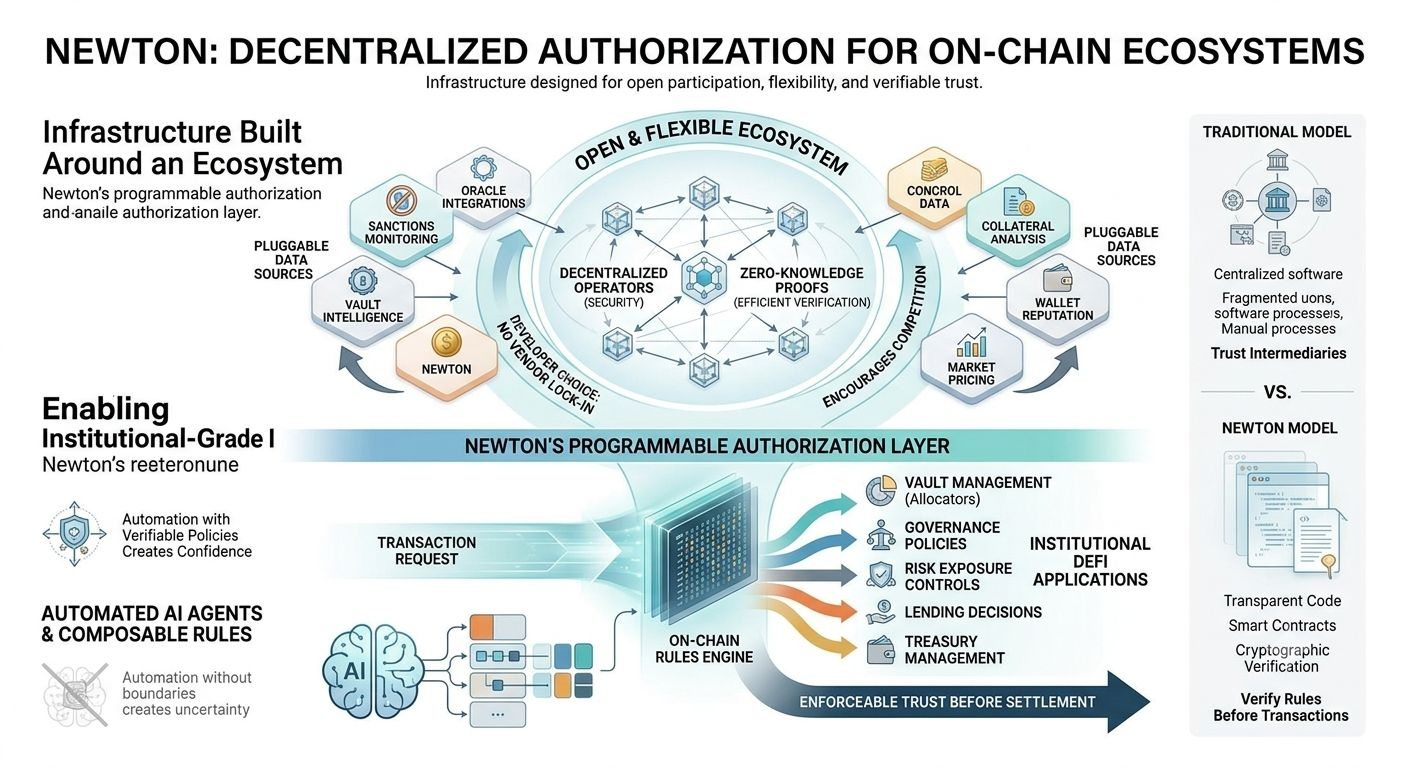
Its security leverages decentralized operators while zero-knowledge technology helps verify computation efficiently.
The protocol also continues expanding its oracle ecosystem by integrating additional providers for sanctions monitoring, vault intelligence, collateral analysis, wallet reputation, and market pricing.
Perhaps the most important aspect is that the ecosystem remains open.
Developers are not locked into a single compliance provider or risk engine.
Instead, they choose whichever data sources best match their application's needs.
This flexibility encourages competition while preventing infrastructure from becoming dependent on any single organization.
Enabling Institutional-Grade DeFi
Institutional adoption has always depended on more than fast settlement.
Large financial participants require enforceable policies that satisfy internal governance, regulatory expectations, and operational controls.
Newton gives vault managers, allocators, and protocol builders the ability to enforce those rules directly on-chain instead of relying on off-chain agreements or centralized gatekeepers.
Because authorization becomes programmable infrastructure rather than application-specific code, institutions gain stronger guarantees without sacrificing blockchain transparency.
This represents an important step toward making decentralized finance compatible with real-world financial requirements.
More Than Compliance
Although compliance is an obvious application, Newton's authorization model extends much further.
Policies can govern lending decisions.
Investment restrictions.
Treasury management.
Vault permissions.
Risk exposure.
Cross-protocol interactions.
Automated AI agents.
As blockchain applications become increasingly autonomous, programmable authorization may become as important as smart contracts themselves.
Automation without boundaries creates uncertainty.
Automation with verifiable policies creates confidence.
Crypto has already demonstrated that decentralized settlement works.
The next phase of blockchain evolution depends on improving everything that happens before settlement.
Authorization has long been treated as an off-chain responsibility handled by centralized organizations, fragmented software, or manual processes.
Newton challenges that assumption by introducing a dedicated authorization layer where policies become transparent, composable, and cryptographically verifiable.
If successful, this model could reshape how decentralized applications manage trust.
Instead of asking users to trust intermediaries, protocols would allow anyone to verify the exact rules governing capital before transactions are executed.
That transformation is larger than a new protocol feature.
It represents a new foundation for decentralized finance—one where openness is matched by enforceable trust, programmable governance, and infrastructure designed for the next generation of on-chain capital.