
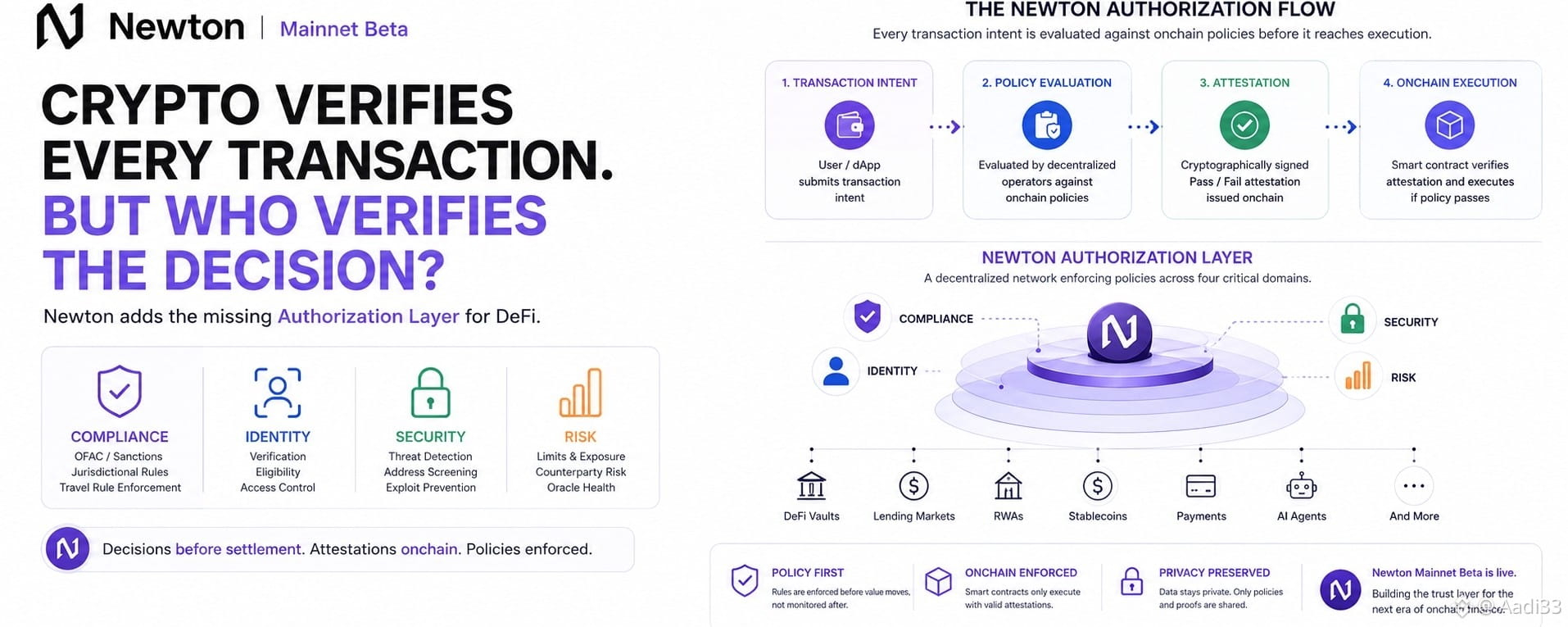
Crypto Verifies Every Transaction. But Who Verifies the Decision?
For the longest time, I thought the hardest part of crypto had already been solved.
A transaction is signed, broadcast, verified by the network, and recorded onchain. If the blockchain accepts it, then everything must be fine... right?
The more I thought about it, the more I realized the blockchain only answers one question:
"Is this transaction valid?"
It never asks another question that might be even more important:
"Should this transaction happen at all?"
That distinction didn't seem meaningful until I looked at where onchain finance is heading.
Stablecoins are becoming payment rails. DeFi vaults now manage billions. RWAs are moving onchain. AI agents are beginning to execute transactions without waiting for a human to click "Confirm."
In all of those cases, a valid signature isn't enough.
You might want to check whether the wallet is sanctioned, whether the user meets eligibility requirements, whether the vault exceeds its risk limits, or whether an oracle feeding the protocol has been compromised.
Most of those checks exist today, but they're scattered across dashboards, monitoring tools, and offchain processes. Many only tell you what went wrong after the transaction has already happened.
Reading Newton Protocol's whitepaper made me look at this differently.
Instead of monitoring transactions after settlement, Newton introduces an authorization layer before settlement. A transaction intent is evaluated against predefined policies, and only after those checks pass does the network produce a cryptographic attestation that smart contracts can verify onchain.
That idea felt surprisingly simple.
It's less about adding another security product and more about giving blockchains something they've never really had: the ability to enforce decisions before value moves.
The current Newton Mainnet Beta starts with DeFi vaults, which makes sense. Vault managers already operate under rules around compliance, identity, security, and risk. Newton's approach is to make those rules programmable and enforceable instead of relying on fragmented operational workflows.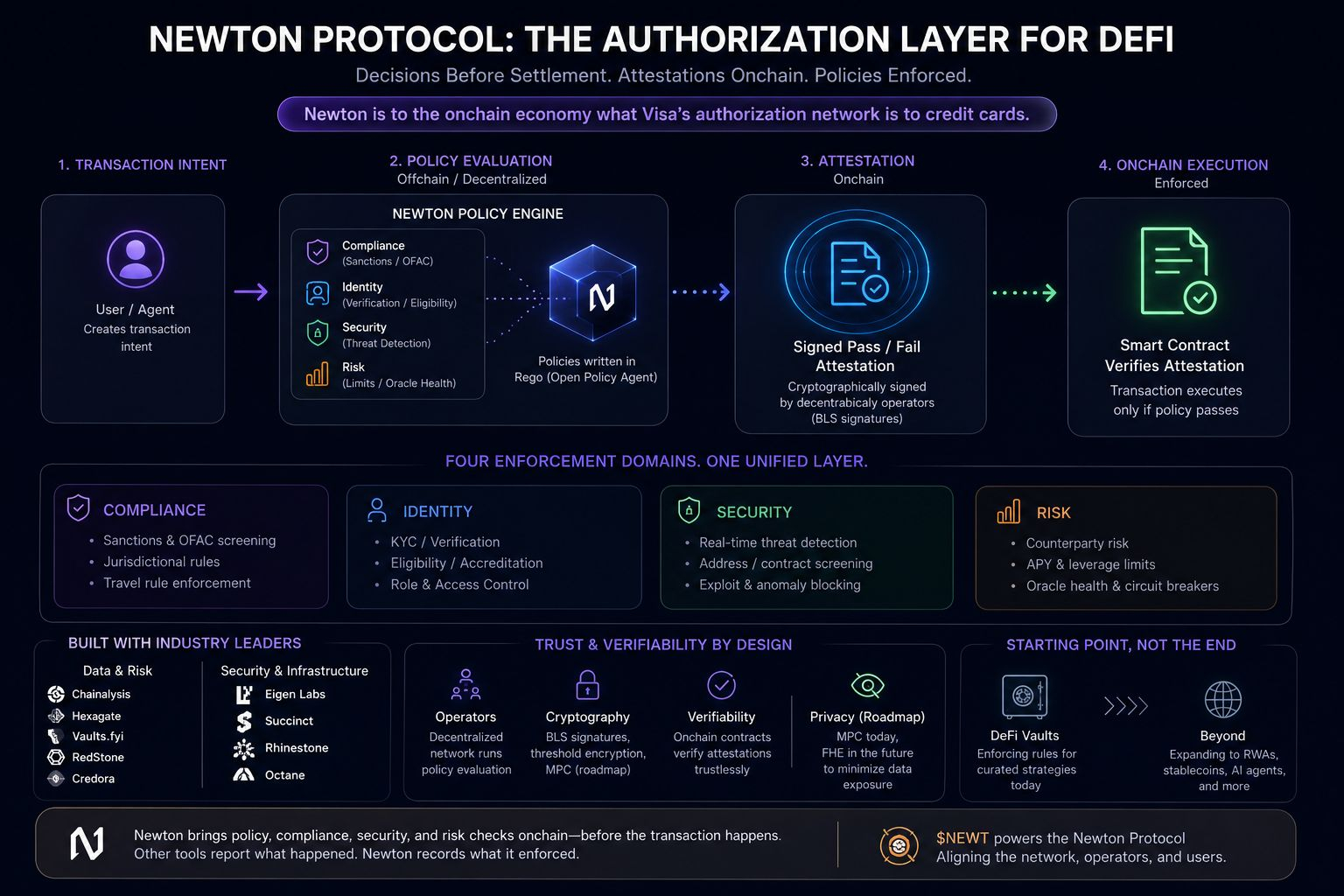
One thing I appreciated is that the whitepaper also acknowledges its own limitations.
Today, certain privacy-sensitive evaluations still rely on threshold decryption, where participating operators temporarily observe decrypted inputs during policy evaluation. The roadmap points toward MPC and, eventually, fully homomorphic encryption to reduce or eliminate that visibility. That tells me privacy isn't being presented as a finished problem but as an evolving engineering challenge.
Whether developers adopt an authorization layer before every meaningful transaction is still an open question.
Every additional step introduces complexity. But as crypto moves toward institutional finance, tokenized assets, and autonomous agents, maybe complexity isn't the enemy. Maybe missing decisions are.
I'm curious whether we'll look back in a few years and wonder why we ever thought transaction verification alone was enough.
What do you think?