
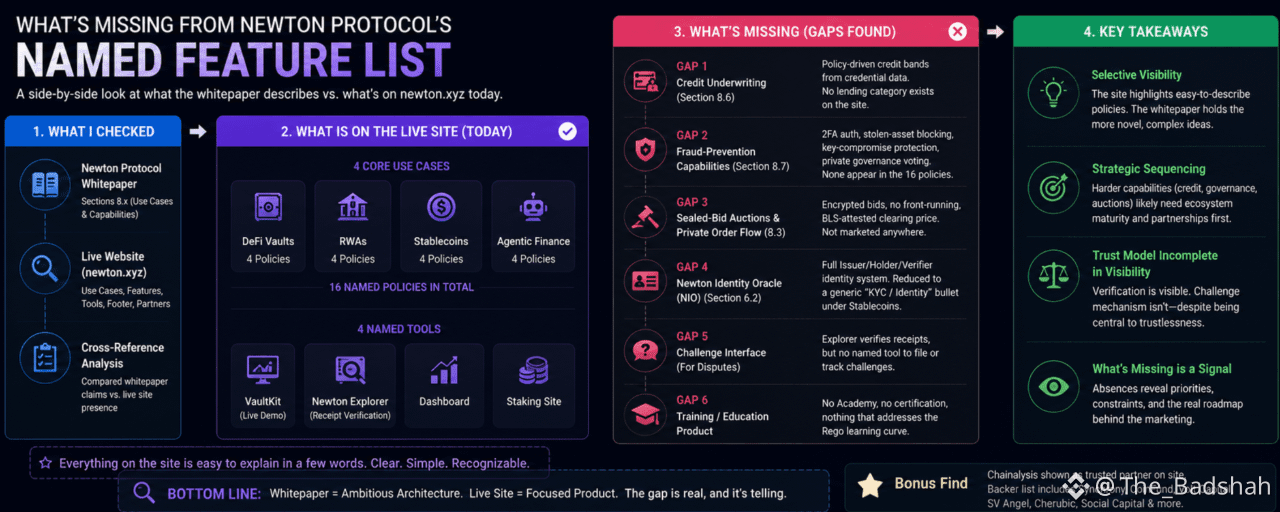

I spent a while going back and forth between Newton Protocol's whitepaper and its website because I wanted to see how closely they matched. I expected the website to be a simplified version of the documentation. What I didn't expect was how selective that simplification would be.
The homepage focuses on four areas. DeFi Vaults RWAs Stablecoins and Agentic Finance. Every example is easy to understand. Spending caps. Sanctions screening. Depeg detection. Concentration limits. Even if you've never heard of Newton before you can probably understand what each one is solving.
Then I went back to the whitepaper.
It felt like I was reading a much bigger product.
One thing that stood out was credit underwriting. The whitepaper gives it enough attention to feel like a real use case yet there isn't a lending category anywhere on the website. That caught my attention because lending is one of the largest parts of onchain finance. My guess is that the technology isn't the difficult part. Building the data partnerships behind underwriting probably takes much longer.
I noticed the same thing with a few other features. Private governance voting. Encrypted auctions that reduce front running. Stolen asset protection. Non custodial two factor authorization. These are some of the ideas that make Newton different but none of them appear on the homepage.
The identity system tells a similar story. The documentation introduces the Newton Identity Oracle as its own framework with separate roles and responsibilities. On the website it becomes a single KYC and Identity bullet. It is easier to explain but it also removes a lot of what makes the design interesting.
Another detail stayed with me after I finished reading. Newton Explorer lets anyone verify policy receipts. I couldn't find an equivalent tool for challenges or disputes. If verification is visible then I expected the challenge process to be visible too because both are part of the same trust model.
After looking through everything I came away with a different conclusion. I don't think the missing features are actually missing. I think they are waiting their turn.
The website highlights ideas that partners can understand quickly and start using today. The whitepaper looks further ahead and shows where the architecture could eventually go.
That changed how I look at Newton Protocol. Sometimes the best way to understand a project isn't by studying what it puts on the front page. It's by paying attention to what it quietly leaves in the background.
@NewtonProtocol #Newt $NEWT $TLM $ALLO