
Honestly I stoped looking at charts days ago, man. everything just flat. No moves, nothing building up, just dead boring sideways action that makes you wanna sleep. So i closd all my trading tabs and went down some random internet hole instead.
and that’s how I tripped over this thing called Newton Protocol’s architecture docs. weird place to land, right?
So lately some people been talking about letting AI agents run around on-chain doing stuff with permisions, and I thought I had it figured out. You know the usual setup strap an agent to a wallet, put some spending caps on it, give it a green light once, and hope it doesn’t go rogue. ephemeral keys, allowance limits, all that account abstraction tool kit stuff. thought I was smart.
Then I actualy read how @NewtonProtocol builds its skeleton and my whole brain model just cracked.
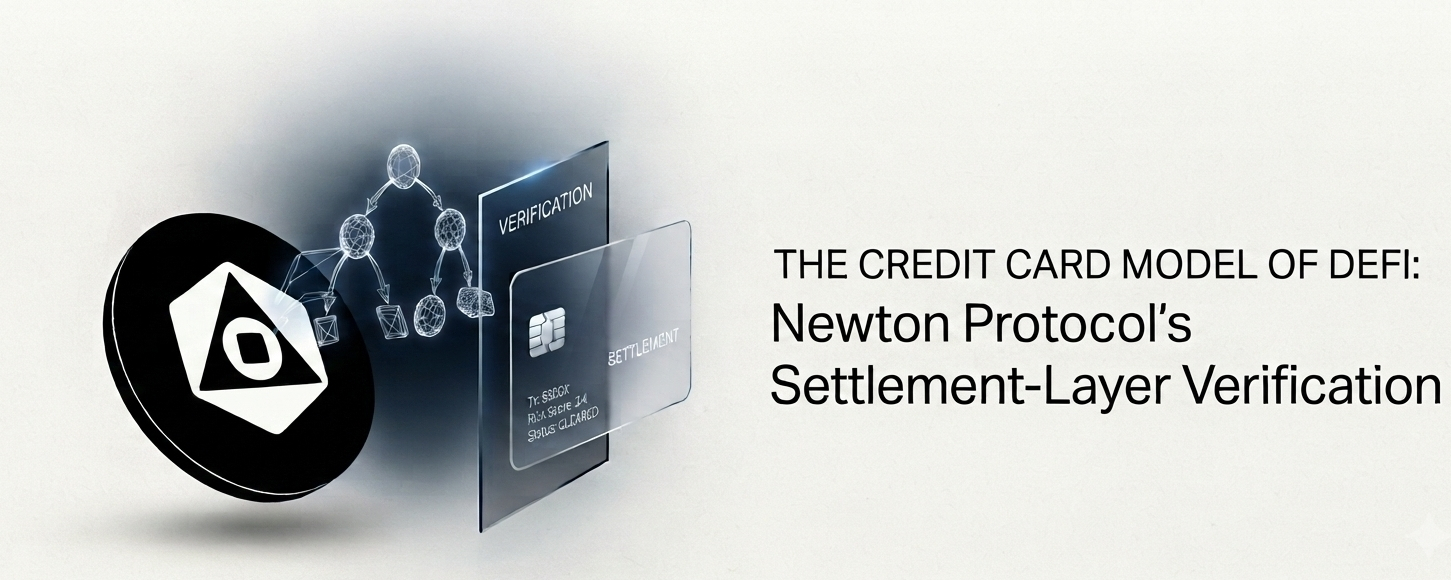
The folks building Newton straight up threw away that whole “wallet permission” language. They’re calling it settlement-layer verification, acting more like a credit network than normal custody design. The safety check doesn’t happen when you first set up the agent. That’s the kicker. It fires right at that exact tiny moment before execution finalizes, every single time. And it runs on a policy engine built with this Rego/OPA thing same machinery giant cloud companies use for governance enforcement.
so what happens is, live intelligence streams into that decision point right then. identity proofs, sanction screning feeds, risk parameters that shift around. it’s not static at all.
That flips the whole assumption upside down. It’s not “accesS was given once, now the agent plays inside the sandbox.” It works exactly like your credit card. The bank don’t check your limit once when they print the plastic and call it done. every single charge gets interrogated amount, merchant, location, time. That’s what Newton does. The autonomous agent never gets unconditional trust just because someone mapped its guardrails right during setup. Each settlement request stands alone under inspection.
i found that reasoning kinda penetrating, not gonna lie. preventative stuff woven into the final execution moment instead of blind faith in a one-time config.
but here’s where the knot is that i can’t untangle. Everything still comes back to who writes the policy and who runs the verification. Newton spreads this across a dispersed operator collective secured through EigenLayer restaking economics. sounds sturdy on the surface, but restaking protection is just economic collateral, bruh. it’s not some cryptographic certainty.
If the policy itself has loopholes baked in from the start, or some tiny fracture hiding in the logic, then “verifiable execution” just certifies that a broken instruction fired perfectly without error. The apparatus catches agents stepping outside their script. It’s got zero capacity to catch the human who wrote a garbage script in the first place.
That bugs me. A lot. Everyone exhausts themselves worrying about whether agents will breach their fences. nobody stops to ask who’s accountable when the fence was drawn wrong at the starting line.
and still if this pre-settlement inspection pattern actually shows where agent-driven defi is heading, then Newton matters way more for boring infrastructure like treasury routing, payment clearance, stablecoin consolidation stuff wher real volume lives and one misconfigured policy becomes actual disaster, not some discord joke.
For now the wider market’s still stuck in range-strangled slumber. no point staring at dead candles. I’ll stay underwater in Newton Protocol’s guts instead. the project raises properly uncomfortalble questions, and those are exactly the ones worth wrestling to the ground.
