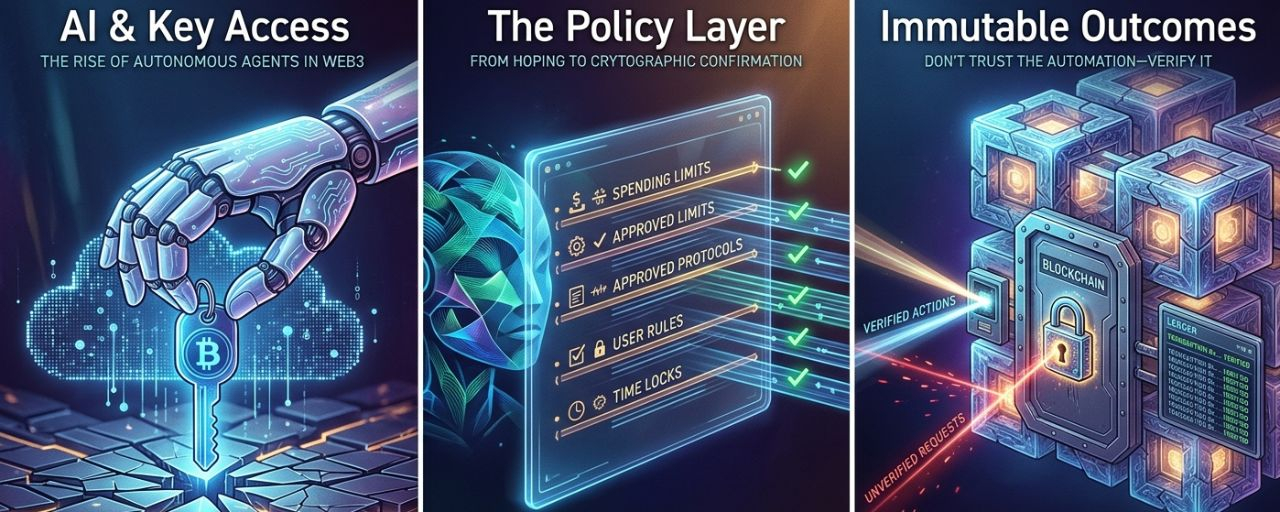
Imagine two blockchain transactions.
Both are signed correctly. Both satisfy every consensus rule. Both execute exactly as the smart contract specifies. From the network's perspective, they are equally valid.
Now imagine that one transaction came from a person who intentionally approved it, while the other was generated by an autonomous AI agent acting on behalf of a user. Suddenly, the two transactions no longer feel equivalent. The blockchain cannot distinguish between careful human judgment and automated reasoning. It only verifies signatures and state transitions.
That observation points to a deeper architectural shift taking place in Web3. As AI agents become capable of managing wallets, monitoring markets, and interacting with decentralized applications, the primary security challenge is no longer execution. It is authorization.
The most interesting aspect of verifiable automation is not that it makes AI safer. Rather, it changes where trust lives within the system. Instead of trusting the intelligence of an autonomous agent, the architecture attempts to trust the evidence that the agent operated within predefined boundaries.
This may seem like a subtle distinction, but it has important implications for how decentralized systems evolve.
The Traditional Trust Model Is Reaching Its Limits
For most of blockchain's history, ownership and authority were tightly connected. Possessing a private key meant possessing the ability to authorize transactions. Consensus mechanisms then verified that the signature was authentic before including the transaction in a block.
This model worked remarkably well because humans remained the primary decision-makers. The blockchain never needed to understand why someone transferred tokens or interacted with a protocol. Intent remained outside the system.
AI automation changes this assumption.
An autonomous agent may monitor lending positions twenty-four hours a day, rebalance liquidity across multiple chains, or execute predefined trading strategies without continuous human supervision. In these situations, users are no longer authorizing individual actions. Instead, they authorize a framework within which software is allowed to act.
That changes the trust boundary.
Instead of asking whether a transaction was signed correctly, the more interesting question becomes whether the transaction stayed within the user's intended policy.
Verification Becomes a Design Philosophy
Many discussions about AI security focus on making models more accurate.
There is certainly value in building better models. However, intelligence is difficult to measure consistently. Even highly capable systems can produce unexpected outputs because they respond to changing inputs, evolving market conditions, or ambiguous instructions.
Verifiable automation approaches the problem differently.
Rather than assuming an AI will always make good decisions, it assumes every decision should be checked against explicit constraints before execution.
This is an important engineering philosophy.
Aircraft are not considered safe because pilots never make mistakes. They are considered safe because independent systems verify altitude, speed, navigation, and operational limits throughout a flight.
Similarly, verifiable automation attempts to surround autonomous software with measurable guardrails instead of relying entirely on confidence in the model itself.
In this sense, verification is not replacing intelligence. It is limiting the consequences of imperfect intelligence.
Policies Become the Real Interface
One consequence of this architecture is that user policies become increasingly important.
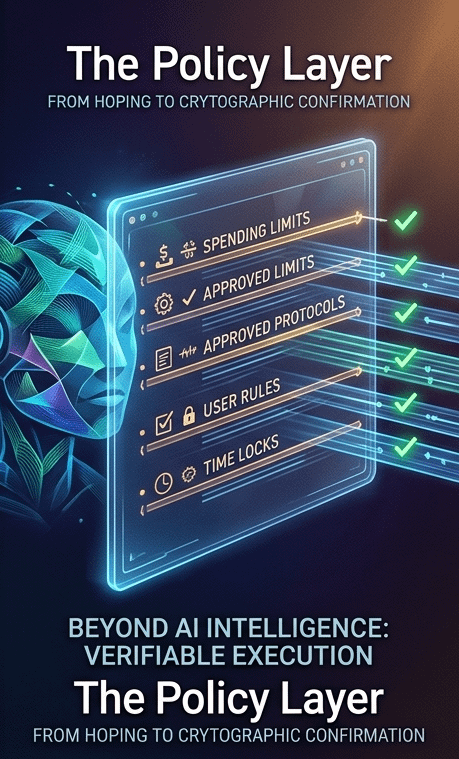
Instead of interacting directly with every blockchain transaction, users define conditions that describe acceptable behavior.
Examples might include maximum daily spending, approved protocols, asset allocation limits, or transaction frequency thresholds.
Notice that these policies describe objectives rather than individual actions.
The AI determines how to achieve those objectives, while the verification layer determines whether each proposed action satisfies the established constraints.
This effectively separates decision generation from decision approval.
That separation resembles a familiar pattern in software engineering. Modern operating systems isolate applications through permissions, sandboxes, and access controls. Applications remain useful because they receive only the privileges necessary to complete their tasks.
Verifiable automation introduces a similar concept to blockchain activity. Rather than granting unrestricted authority, it encourages least-privilege automation.
Cryptographic Evidence Changes Accountability
One aspect that deserves more attention is how verification affects accountability.
Traditional automation often relies on logging events after execution. If something unexpected occurs, engineers reconstruct the sequence of decisions through historical records.
Cryptographic verification introduces a different model.
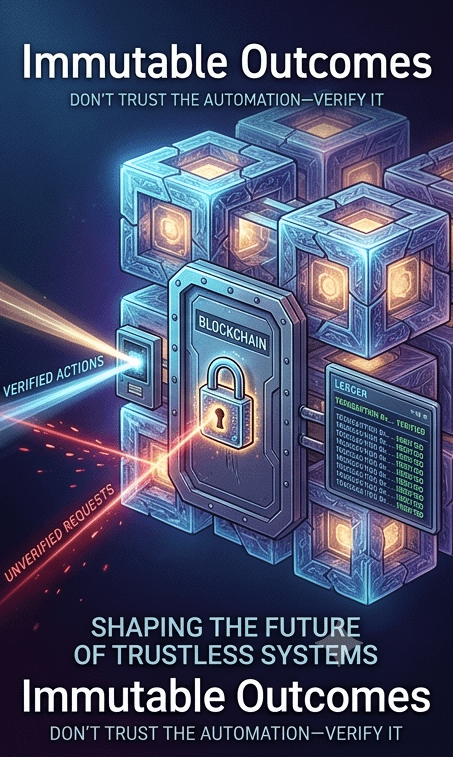
Instead of asking investigators to determine whether software followed policy after an event, the architecture attempts to produce evidence that policy compliance existed before execution.
This seemingly small change influences system design in meaningful ways.
Policies become explicit rather than implicit. Developers must express constraints precisely enough for automated verification. Vague expectations become increasingly difficult to enforce because computers require deterministic rules.
As a result, software architecture gradually shifts toward machine-verifiable intent instead of human interpretation.
The Hidden Tradeoff: Precision Versus Flexibility
Every engineering solution introduces compromises.
Verifiable automation is no exception.
The more detailed a policy becomes, the greater confidence users may have that automation remains within acceptable limits. However, increasingly restrictive policies may reduce adaptability.
Financial markets rarely behave predictably.
An AI responding to rapidly changing liquidity conditions may require flexibility that rigid verification policies cannot easily accommodate. Conversely, overly broad permissions may undermine the very security the system hopes to provide.
This creates an interesting optimization problem.
Rather than maximizing either security or efficiency independently, the architecture attempts to balance both simultaneously.
Different users will likely choose different positions along this spectrum.
Institutional treasury management may prioritize conservative verification with limited autonomy. Active market participants may accept broader operational freedom to reduce latency and improve responsiveness.
Neither choice is universally correct.
Instead, verifiable automation transforms trust into a configurable parameter rather than a binary property.
Formal Policies Cannot Capture Every Human Decision
Perhaps the most important limitation lies outside cryptography altogether.
Verification assumes that user intent can be expressed through formal rules.
Sometimes this is straightforward.
Daily spending limits are easy to define. Approved protocols can be listed explicitly. Asset exposure thresholds are measurable.
Other decisions are considerably more complex.
Should an AI exit a position because market sentiment appears unstable?
Should it ignore temporary volatility if macroeconomic conditions remain favorable?
Should it react differently during periods of extreme liquidity fragmentation?
These questions involve judgment rather than deterministic rules.
No verification framework can eliminate ambiguity if the underlying objective remains ambiguous.
In other words, verification proves compliance with policy. It does not guarantee that the policy itself reflects the user's evolving intentions.
Recognizing this distinction prevents unrealistic expectations.
A Different Way to Evaluate AI Infrastructure
One lesson I took from studying verifiable automation is that we may be evaluating AI infrastructure using the wrong criteria.
Much attention focuses on model quality, reasoning capability, and execution speed.
Those characteristics certainly matter.
Yet decentralized systems ultimately depend on predictable coordination among participants who do not fully trust one another.
Within that environment, explainable and verifiable behavior may become more valuable than increasingly sophisticated decision-making alone.
Perhaps the long-term competitive advantage will belong not to the platform that builds the smartest autonomous agent, but to the one that produces the strongest evidence that autonomous behavior remained within agreed boundaries.
That would represent a meaningful shift in how we think about AI in Web3.
Instead of replacing trust with intelligence, the goal becomes replacing blind trust with verifiable constraints.
It is a quieter innovation than many headlines suggest, but potentially a more durable one because it addresses the architecture of confidence rather than the capabilities of a single model.
As autonomous agents become increasingly common across decentralized finance and on-chain applications, one question seems worth debating:
Should the future of AI in Web3 be measured by how independently agents can act, or by how convincingly they can prove that every action respected the limits we originally intended?
🗳 Community Poll
Which principle do you believe will matter most for the next generation of AI-powered Web3 infrastructure?
🔹 More autonomous AI agents
🔹 Stronger cryptographic verification before execution
🔹 More expressive user-defined policy frameworks
🔹 A balance between intelligent autonomy and verifiable safeguards