
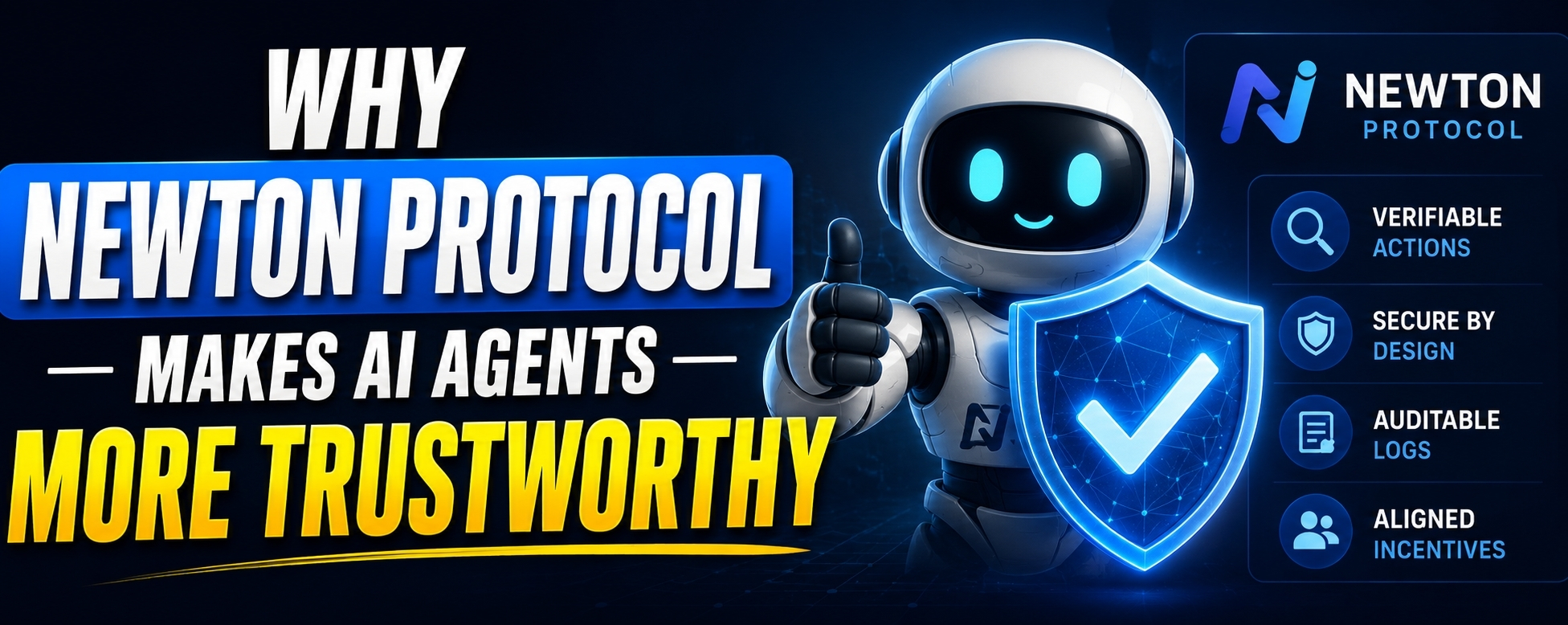
When I first came across Newton Protocol, I assumed it was another project trying to combine AI and crypto. That has become a familiar story over the past couple of years, and I've learned to be a little cautious whenever I see ambitious claims about autonomous agents managing assets or making financial decisions. It sounded interesting, but not necessarily different.
What caught my attention wasn't the AI narrative itself. It was the repeated focus on verification rather than automation. The more I think about it, the more it seems that the difficult part isn't building AI agents that can perform tasks. It's creating a system where those actions can be checked, limited, and trusted before they happen instead of hoping everything works out afterward. That feels like a more practical problem to solve.
One thing I've noticed is that AI agents are becoming more capable, but capability doesn't automatically create trust. If an agent can move funds, execute trades, or interact with multiple protocols, people naturally want to know what prevents mistakes or unexpected behavior. Smart contracts are deterministic, but they usually don't understand real-world context like identity, risk limits, compliance rules, or changing conditions outside the blockchain. That gap seems larger than I initially realized.
Newton Protocol appears to approach this problem by introducing programmable policies that sit between an intended action and its execution. Instead of simply allowing an AI agent to operate freely, the protocol evaluates whether a transaction satisfies predefined rules before it proceeds. Those rules can include spending limits, identity checks, external data, or other conditions, and the outcome is designed to be cryptographically verifiable rather than based on trust alone. From what I've read, the goal isn't to replace smart contracts but to give them access to information and safeguards they normally don't have.
What seems interesting is that this shifts the conversation away from making AI smarter and toward making AI more accountable. That feels like a subtle difference, but maybe an important one. As more financial activity becomes automated, people may care less about whether an agent can execute thousands of transactions and more about whether every transaction stays within boundaries that everyone can verify.
Of course, I'm still not completely sure how easily this vision translates into large-scale adoption. Security models often sound convincing in documentation, yet real-world environments are always more complicated. Developers need incentives to integrate new infrastructure, users need confidence that policies won't create unnecessary friction, and institutions typically move much slower than technology itself. That may be where the real challenge is.
Still, I find the broader direction worth paying attention to. Instead of assuming AI agents should simply be trusted because they're efficient, Newton seems to start from the opposite assumption—that trust has to be earned through transparent rules, cryptographic proofs, and verifiable execution. If that idea works well in practice, it could become useful not only for AI-driven finance but also for stablecoins, tokenized real-world assets, and other systems where automated decisions increasingly interact with real economic value.
For now, I'm treating Newton Protocol as something to observe rather than something to reach conclusions about. I like the fact that it focuses on a problem that feels foundational instead of cosmetic. Whether it ultimately succeeds will depend on execution, adoption, and how well these ideas perform under real-world pressure. But the more I learn about it, the more I think the future of AI in crypto may depend less on intelligence itself and more on whether intelligence can be trusted.