
@NewtonProtocol I'll be honest. After digging through enough blockchain projects over the years, most of them start sounding the same. Better wallets. Faster chains. Cheaper transactions. More scalability. We've heard it all before.
Newton Protocol caught my attention for a different reason.
It isn't trying to build another blockchain or convince everyone its token will change the world. Instead, it's going after something that people don't really talk about—the moment before money moves.
And honestly, that's a much bigger problem than most people realize.
Here's the thing.
Blockchain has gotten incredibly good at proving ownership. If you own a wallet, you sign a transaction, the network verifies it, and the assets move. Simple.
But that's also the problem.
The blockchain checks whether you can move money. It doesn't stop to ask whether you should.
That question usually gets answered somewhere else.
Every company already has internal rules. Treasury teams have spending limits. Compliance teams define what transactions are allowed. Trading firms create risk controls. AI systems get operating instructions. None of that actually lives on-chain. The blockchain settles transactions, while all the decision-making happens somewhere off-chain inside dashboards, internal software, spreadsheets, or plain old company policies.
That's the split we've quietly accepted for years.
Money lives on-chain.
Rules don't.
And as AI starts handling more financial decisions, that gap gets harder to ignore.
Think about where we're heading.
AI agents aren't just writing code anymore. People want them managing treasuries, executing trades, paying invoices with stablecoins, moving liquidity across protocols, even making portfolio decisions on their own.
Sounds exciting.
Also a little terrifying.
An AI doesn't naturally understand company policy. It understands objectives. Tell it to maximize yield, and it'll chase yield. Tell it to optimize payments, and it'll optimize payments. It won't magically understand that your treasury has a daily exposure limit or that compliance doesn't want funds flowing through certain jurisdictions.
People don't talk about this enough.
Optimization isn't the same thing as judgment.
And that's exactly where Newton seems to fit.
Instead of asking one question—"Can this wallet sign?"—it asks another one first.
"Should this transaction even happen?"
Those aren't the same question.
Not even close.
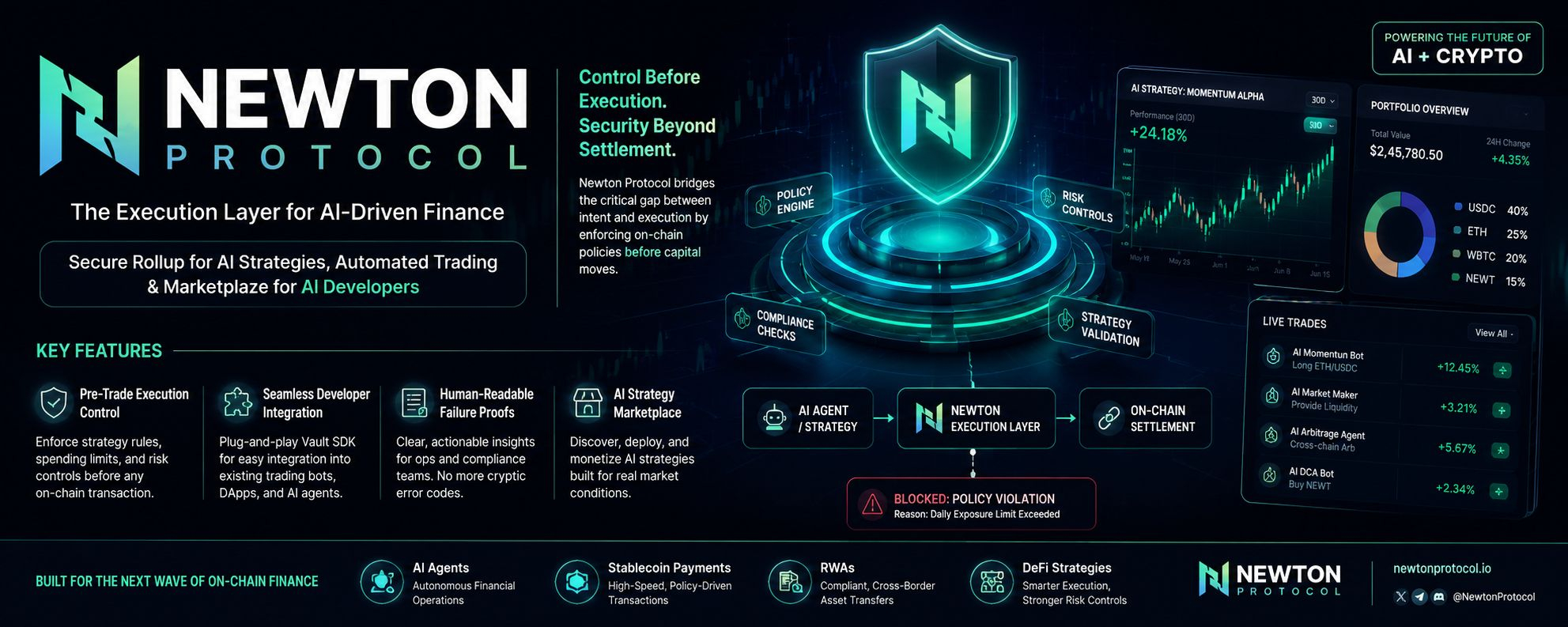
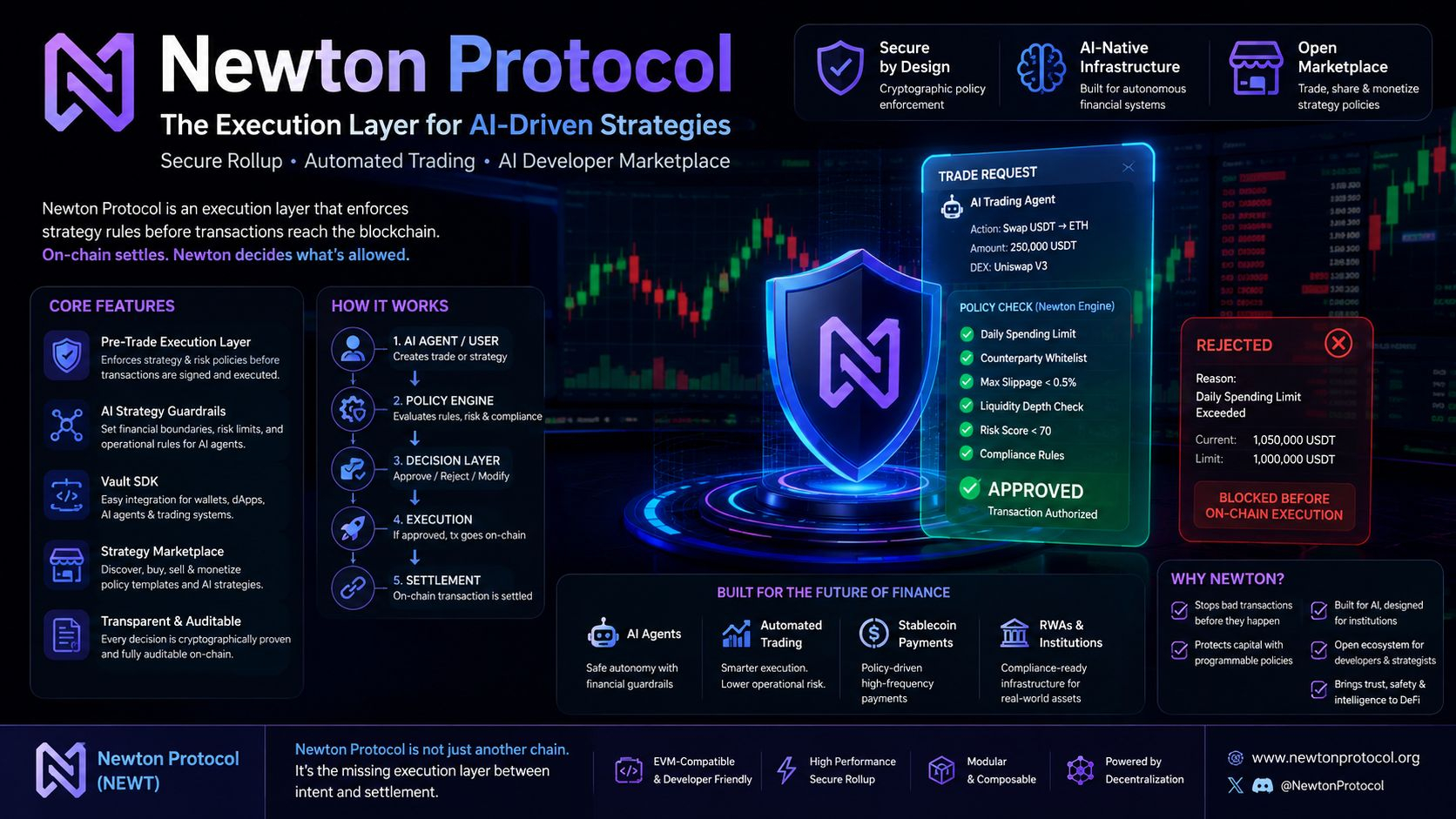
From what I've seen, Newton isn't trying to replace wallets or custody providers. It wants to sit right in the middle of the execution process and evaluate whether a transaction actually follows predefined policies before capital moves.
That sounds simple until you realize how much of today's infrastructure skips that step entirely.
Think about using a credit card.
When you swipe your card, the bank doesn't instantly move money because you know your PIN. Behind the scenes, dozens of systems check fraud signals, spending limits, merchant types, unusual behavior, geographic patterns—you never even notice any of it.
Blockchain mostly doesn't work like that.
If you've got the right signature, you're usually good to go.
Newton basically says maybe there should be another checkpoint before execution.
Honestly, that idea makes a lot of sense.
What's interesting is that Newton isn't really competing with the projects most people compare it to.
Custody platforms solve one problem.
They answer a very specific question:
"Who's allowed to sign?"
Whether it's MPC wallets, multisigs, hardware wallets, or institutional custody solutions, they're protecting keys. That's their job.
Security companies live on the opposite end of the timeline.
They monitor transactions, detect exploits, investigate hacks, simulate risks, and help teams respond after something suspicious happens. Some even catch attacks in real time.
Useful?
Absolutely.
But they're mostly watching events unfold.
Newton seems to care about the moment right before any of that.
There's this weird empty space between identity verification and post-transaction monitoring, and hardly anyone owns it.
That's the vacuum Newton appears to be targeting.
Instead of securing keys or analyzing damage, it focuses on execution itself.
That distinction matters more than people think.
Imagine an AI trading system.
Normally, the logic might be painfully straightforward.
If the signal says buy, then buy.
That's it.
Newton's approach looks more like adding layers of judgment.
Sure, the trading signal exists.
But what if today's exposure already exceeds the treasury limit?
What if the counterparty isn't approved?
What if slippage suddenly jumps outside acceptable limits?
What if an oracle starts returning questionable data?
What if the trade violates an internal compliance rule?
Only after those questions get answered does execution continue.
That feels much closer to how institutional finance actually works.
And honestly, I think that's where blockchain has always been a little too optimistic.
We've built incredibly secure systems around signatures while assuming every signed transaction automatically deserves to happen.
Reality is messier than that.
Now, here's where things get tricky.
A good idea doesn't automatically become good infrastructure.
I've watched plenty of technically impressive crypto projects struggle because they made developers work too hard.
Developers don't fall in love with complexity.
They avoid it.
If Newton's Vault SDK slips neatly into existing applications without forcing teams to rebuild everything, adoption becomes realistic.
If developers need to redesign entire trading systems just to support policy enforcement?
That's a much tougher sell.
Infrastructure wins when people barely notice it's there.
Another thing I've been thinking about—and honestly, this feels underrated—is how the protocol explains rejected transactions.
Let's say an AI agent tries sending funds that violate treasury policy.
What happens next?
Does the operations team get some cryptic message like:
PolicyError(0x14AF...)
Or do they see something useful?
Something like:
"Transaction rejected because today's stablecoin exposure exceeded the organization's approved daily limit."
Those two experiences couldn't be more different.
Engineers might tolerate raw error codes.
Treasury teams won't.
Compliance officers definitely won't.
If people can't understand why execution failed without calling an engineer every time, friction builds fast.
Human-readable failure proofs aren't just a nice feature.
They're operational infrastructure.
Then there's the complexity problem.
Policies never stay simple.
Ever.
Companies always start with basic rules.
A few months later they want emergency overrides.
Then regional exceptions.
Then different permissions for different departments.
Then time-based restrictions.
Then dynamic oracle inputs.
Then approval hierarchies.
You see where this goes.
Eventually, the policy engine risks becoming harder to manage than the assets it's protecting.
Newton can't just scale technically.
It has to stay understandable.
That's an entirely different challenge.
The bigger picture makes this even more interesting.
AI agents are getting more autonomy every year. Whether people like it or not, they'll end up controlling larger pools of capital.
Every autonomous system needs boundaries.
Not suggestions.
Actual boundaries.
Newton's policy layer could become those financial guardrails.
Stablecoins point in the same direction.
Cross-border payments, treasury operations, payroll, merchant settlement—they're all moving toward stablecoins because they settle quickly and operate around the clock.
But businesses don't care only about speed.
They care about control.
They need spending limits.
Approval logic.
Risk management.
Compliance rules.
You can't run enterprise finance on signatures alone.
Real-world assets push the same trend even further.
Once tokenized bonds, private credit, real estate, and other RWAs become more common, financial rules get even more complicated. Jurisdiction matters. Eligibility matters. Counterparty screening matters. Transfer restrictions matter.
Ownership alone won't answer those questions.
Execution policies probably will.
And then there's one question I keep coming back to.
Is Newton building software?
Or is it building a network?
There's a big difference.
If it stays as an execution SDK that companies integrate into their own systems, that's perfectly respectable. Plenty of infrastructure businesses succeed that way.
But the ceiling is easier to see.
Now imagine developers publishing reusable treasury policies, AI governance templates, compliance modules, risk frameworks, and execution strategies that everyone else can adopt, improve, audit, or even monetize.
Now you're not just distributing software.
You're creating a market for operational logic itself.
That changes everything.
Each new policy makes the ecosystem stronger.
Each developer contributes something reusable.
That's how network effects start.
Will Newton actually get there?
Honestly, I don't know.
Nobody does yet.
And I'm not interested in judging the project based on funding announcements, big-name investors, exchange listings, or partnership graphics. Crypto has trained people to get excited about those things, but they don't prove infrastructure works.
Execution does.
I want to see how many risky transactions the protocol actually intercepts before settlement.
I want to know how much latency the execution layer adds.
I want developers to tell me whether integrating the Vault SDK takes days or months.
I want operations teams to show that rejected transactions come with explanations normal humans can understand.
Most of all, I want proof that real organizations rely on these policies every single day—not just polished demos.
That's the standard.
So where do I land?
I think Newton is tackling one of the most overlooked problems in Web3.
Not key management.
Not transaction speed.
Not another Layer 2.
Decision-making.
That's a very different category.
Whether it becomes essential infrastructure depends on execution, not storytelling. If the team delivers an execution layer that's lightweight, developer-friendly, transparent, and flexible enough for real financial operations, Newton could end up defining an entirely new piece of blockchain infrastructure.
If it doesn't, it'll join the long list of technically clever projects that solved the right problem but made adoption harder than the problem itself.
And if I've learned anything from watching this industry, it's this:
The best infrastructure rarely wins because it's the smartest.
It wins because people actually use it.
@NewtonProtocol #Newt $NEWT $KORU $THE
