
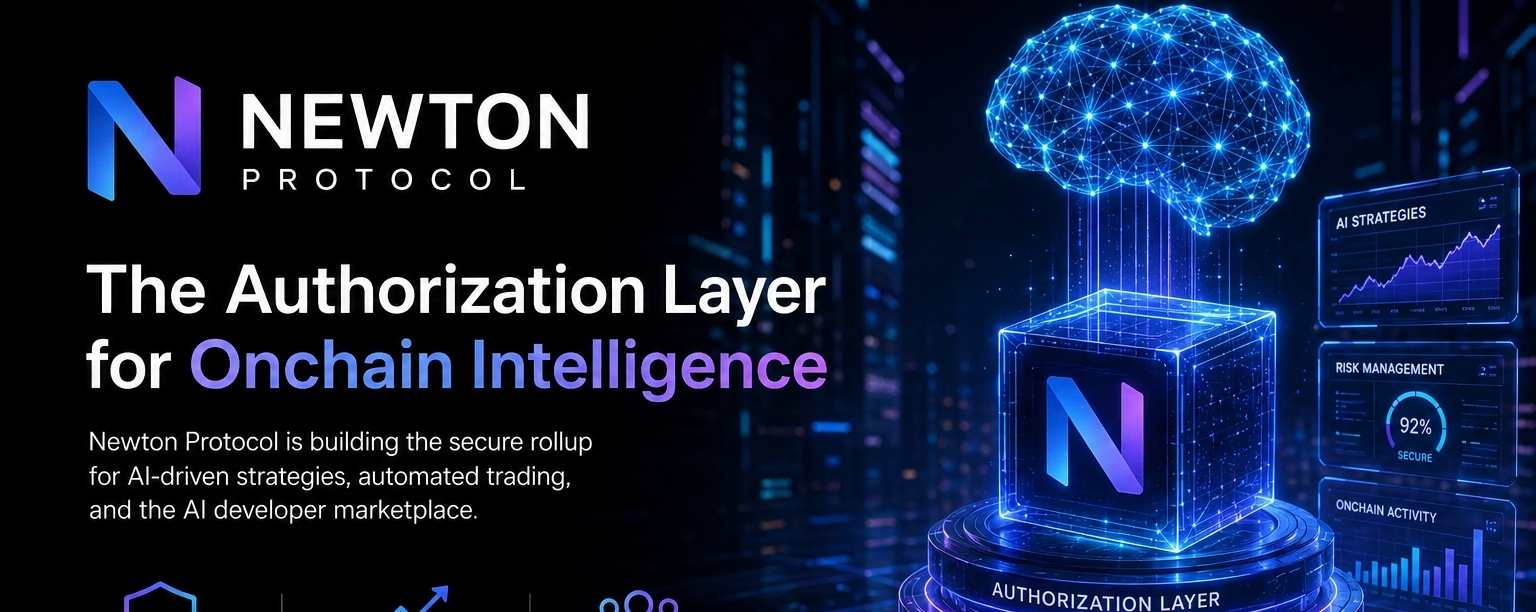
Newton Protocol was never the kind of project that demanded attention the moment it appeared on my timeline. In a market where almost every other announcement tries to combine AI, blockchain, and automation into the next big narrative, it's easy to become numb to the noise. After spending years watching different sectors rise, collapse, and eventually fade into the background, I've learned that the projects worth following usually don't reveal themselves in a single tweet or token launch. They become interesting only after you spend time understanding what they're actually trying to build. That was my experience with Newton. The more I looked beyond the surface, the more it felt like a project focused on solving a problem that has quietly existed for years rather than inventing a new story to fit the current market.
One thing that stood out immediately was that Newton isn't really trying to compete with every blockchain or every AI platform. Instead, it focuses on something that most people rarely think about until something goes wrong: who decides whether a transaction should happen in the first place? Blockchains have become incredibly efficient at executing transactions once they're signed, but they don't naturally understand spending limits, organizational policies, identity requirements, compliance rules, or risk management. Those decisions usually happen outside the blockchain, often relying on centralized systems that users never see. Newton's approach is to move those decisions into a programmable authorization layer where policies can be verified onchain before assets move. It's a subtle idea, but the more I thought about it, the more practical it seemed.
That distinction becomes even more important when AI enters the conversation. Everyone likes to imagine autonomous agents managing portfolios or executing complex strategies twenty-four hours a day. The exciting part is always what happens after the AI makes a decision, but very few people stop to ask what prevents an agent from making the wrong decision. Newton tries to answer that question by placing programmable rules between intent and execution. Instead of assuming every action deserves approval, the protocol evaluates transactions against predefined policies before allowing them to continue. That changes the conversation from blind automation to accountable automation, which feels far more realistic than many of the promises surrounding AI in crypto today.
As I explored the protocol further, I noticed that Newton wasn't built around the idea of replacing existing infrastructure. Instead, it connects different pieces that already exist. Identity providers, security platforms, oracle networks, compliance services, sanctions screening, fraud detection, and risk analytics can all contribute information to the authorization process. Rather than creating another isolated ecosystem, Newton acts as a coordination layer where different services work together before a transaction is finalized. That modular design makes much more sense than trying to rebuild every component from scratch.
Another aspect that caught my attention was VaultKit. On the surface it sounds like another infrastructure product that only developers would care about, but its purpose is surprisingly straightforward. Onchain vaults often depend on managers making responsible decisions, yet those decisions usually rely on trust rather than enforceable rules. VaultKit introduces programmable policies that can evaluate allocations, parameter updates, market access, treasury movements, and other sensitive actions before they happen. It's not trying to replace human judgment. It's trying to make sure human judgment operates within clearly defined boundaries. After everything crypto has experienced over the years—from protocol failures to treasury mistakes—that feels like a sensible direction rather than an unnecessary layer of complexity.
The more I looked into Newton's ecosystem, the more deliberate its growth appeared. Instead of claiming to solve every problem internally, the project has been integrating with established infrastructure providers across identity verification, oracle data, wallet security, sanctions monitoring, and transaction analysis. That approach suggests the team understands that trust is earned through interoperability rather than isolation. In crypto, the strongest infrastructure often disappears into the background because it simply allows everything else to function more reliably. Newton seems comfortable playing that role.
Then there's the NEWT token itself. Like many infrastructure tokens, its long-term value won't be determined by short-term price action alone. The token supports staking, network security, incentives for participants, and governance as the protocol evolves. Whether those mechanics become meaningful depends entirely on adoption. Crypto has shown countless times that token economics can look impressive on paper, but lasting value only comes when developers, applications, and institutions repeatedly choose to build on top of the underlying infrastructure. Newton still has to prove that over time, just like every protocol before it.
What makes Newton interesting to me isn't that it promises a future dominated by AI or automated finance. Plenty of projects have made similar promises before. What feels different is its focus on authorization rather than execution. It's solving a quieter problem, one that doesn't generate the same excitement as faster blockchains or higher yields but becomes increasingly important as more value moves onchain. Institutions, businesses, developers, and eventually autonomous software all need systems that don't simply execute instructions—they need systems capable of enforcing rules before mistakes happen.
Whether Newton eventually becomes a standard piece of blockchain infrastructure or remains a specialized solution is something only time will answer. Markets have a habit of chasing narratives long before appreciating infrastructure, and history has shown that some of the most valuable layers are the ones people barely notice while they're being built. For now, Newton feels like it's sitting in that space between recognition and adoption, quietly developing while the market continues searching for its next headline. Sometimes those are exactly the projects that are worth keeping an eye on, not because they're making the loudest promises, but because they're trying to solve problems that have been hiding in plain sight all along.