One assumption kept bothering me while I was reading about autonomous execution.
We often speak as though delegating a decision somehow reduces the importance of human judgment. In practice, the opposite may be true.
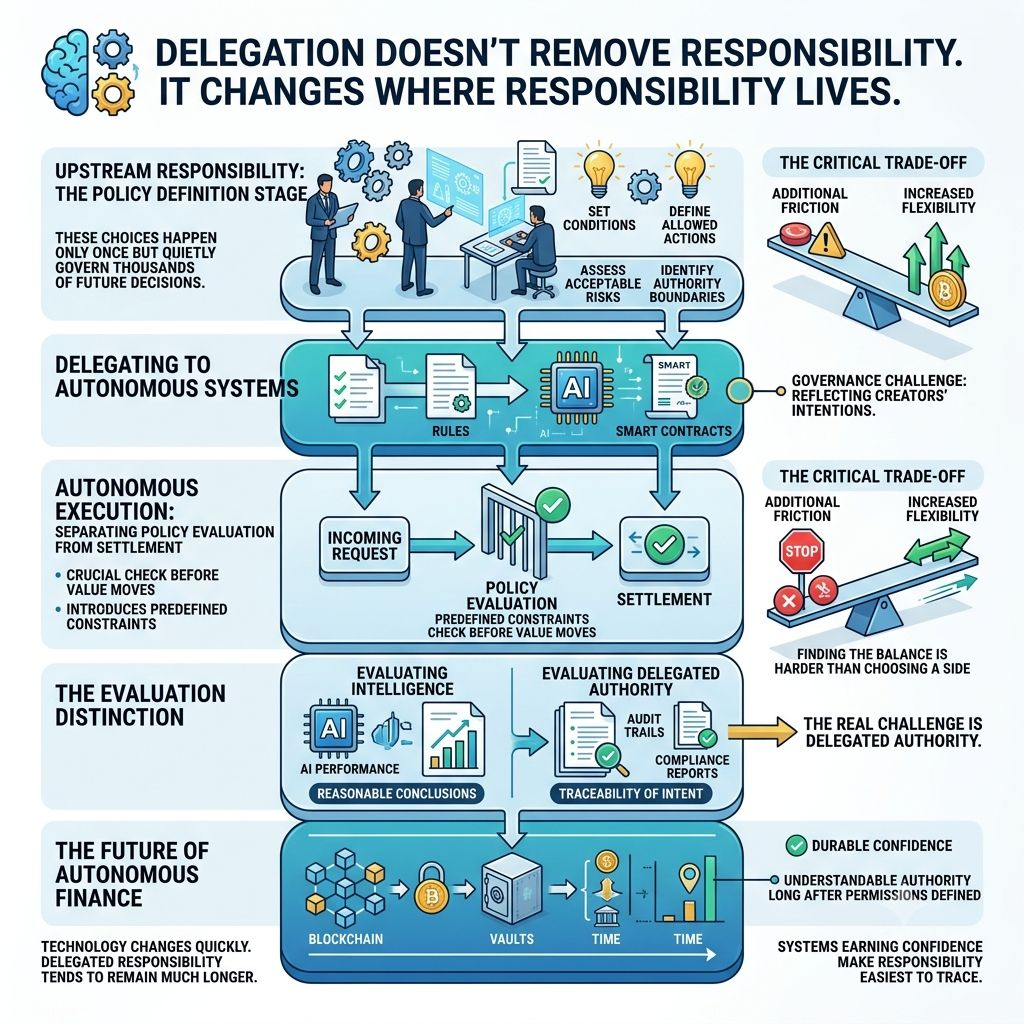
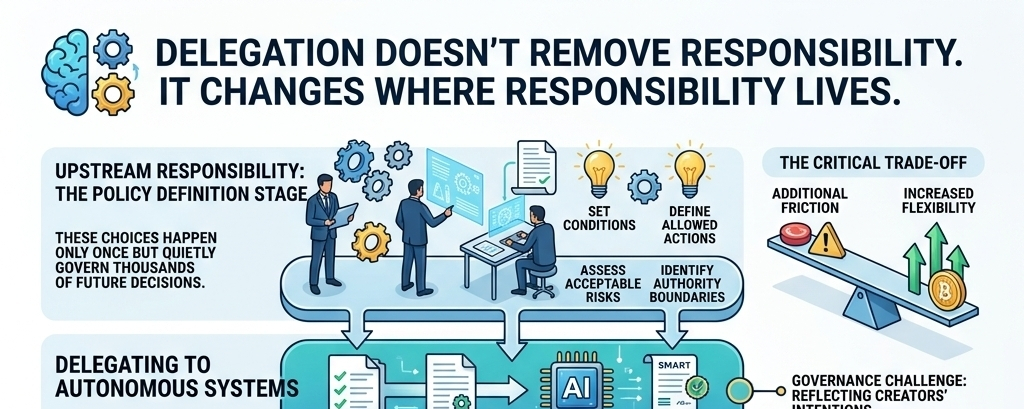
Delegation rarely eliminates responsibility. It simply moves it upstream.
Before an autonomous system executes a transaction someone has already decided what the system is allowed to do, which conditions matter which risks are aceptable, and where its authority ends. Those choices may happen only once but they quietly govern thousands of future decisions.
That's why I think autonomous finance is creating a different kind of governance challenge.
The difficult question is no longer whether an AI can reach a reasonable conclusion. It's whether the boundaries surrounding that conclusion continue reflecting the intentions of the people who created them.
Those are different problems.
One evaluates intelligence.
The other evaluates delegated authority.
While reading more about @NewtonProtocol, I found myself paying less attention to the automation itself and more attention to the architecture surrounding authorization. Separating policy evaluation from settlement changes the role of infrastructure. Instead of treating execution as the natural consequence of a request, the protocol introduces a stage where predefined constraints become part of the decision process before value actually moves.
That distinction feels easy to overlook.
Yet many institutional systems already rely on similar ideas.
Organizations rarely allow every approved proposal to become immediate action. Reviews exist. Waiting periods exist. Independent approvals exist. None of these mechanisms exist because institutions distrust every participant. They exist because authority becomes more reliable when it passes through visible structure instead of individual discretion.
Autonomous systems inherit the same challenge.
As software becomes capable of acting without continuous supervision, confidence depends less on the sophistication of the model and more on the clarity of the authority that model has received.
There is an unavoidable trade-off.
Additional authorization introduces friction.
Fewer authorization boundaries increase flexibility.
Neither extreme produces particularly resilient systems.
Excessive control eventually slows useful activity.
Too little control quietly converts delegated authority into unrestricted authority.
Finding the balance is harder than choosing either side.
That is why I don't think the future of autonomous finance will be determined solely by better models or faster execution.
It may depend on something much less visible.
Whether the authority delegated to autonomous systems remains understandable long after the people who originally defined those permissions have disappeared from the decision itself.
Technology changes quickly.
Delegated responsibility tends to remain much longer.
The systems that earn durable confidence may not be the ones that automate the most decisions.
They may be the ones that make responsibility easiest to trace after those decisions have already been made.