
Newton Protocol (NEWT): Building the Trust Layer for AI-Driven Finance and Verifiable On-Chain Automation
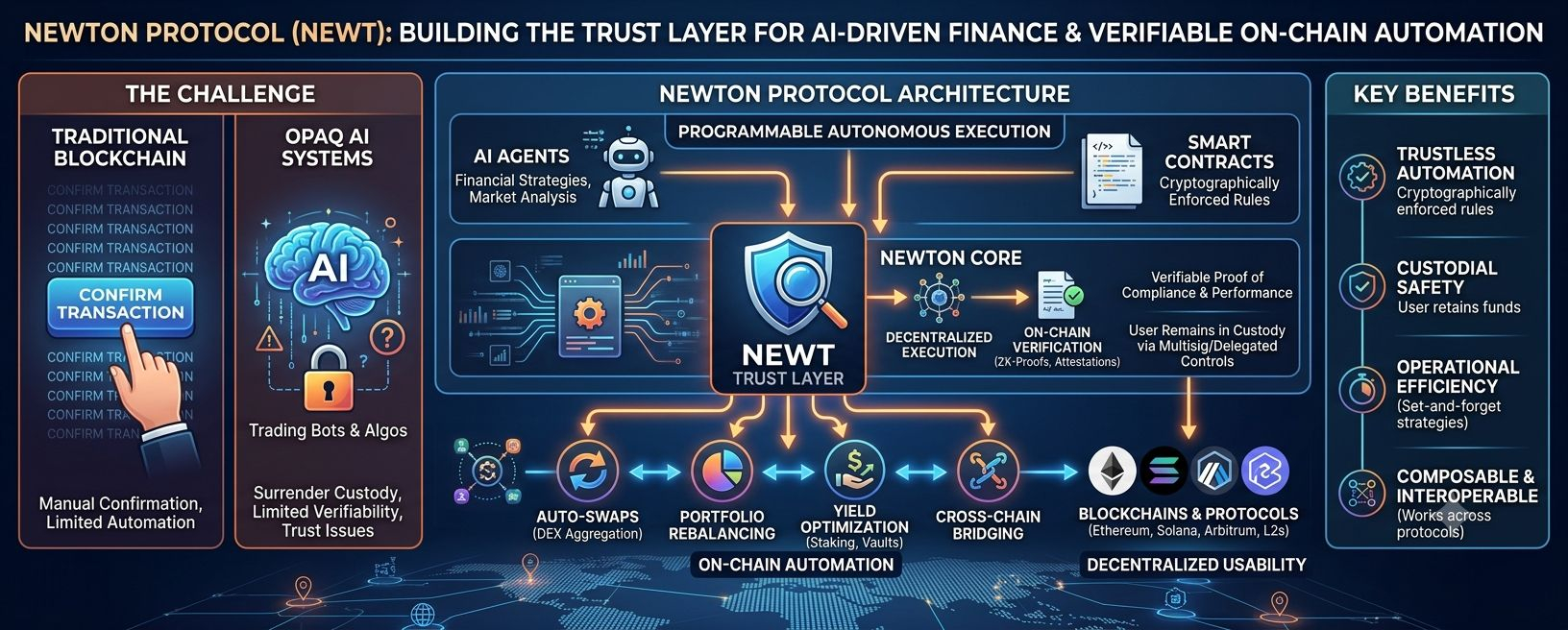
Artificial intelligence is rapidly changing the way financial markets operate. Trading bots, autonomous portfolio managers, algorithmic investment strategies, and AI agents are becoming increasingly sophisticated. Yet despite these advances, blockchain infrastructure still forces users to remain deeply involved in every transaction. Every swap, rebalance, bridge transfer, staking operation, or yield optimization usually requires manual confirmation.
Newton Protocol (NEWT) emerges from a simple but ambitious observation: automation without verifiability creates trust problems, while decentralization without automation creates usability problems.
Instead of asking users to surrender custody to centralized bots or opaque AI systems, Newton attempts to create an infrastructure where autonomous software can execute complex financial strategies under cryptographically enforced rules. This represents an evolution from programmable smart contracts toward programmable autonomous execution.
The Problem Newton Protocol Attempts to Solve
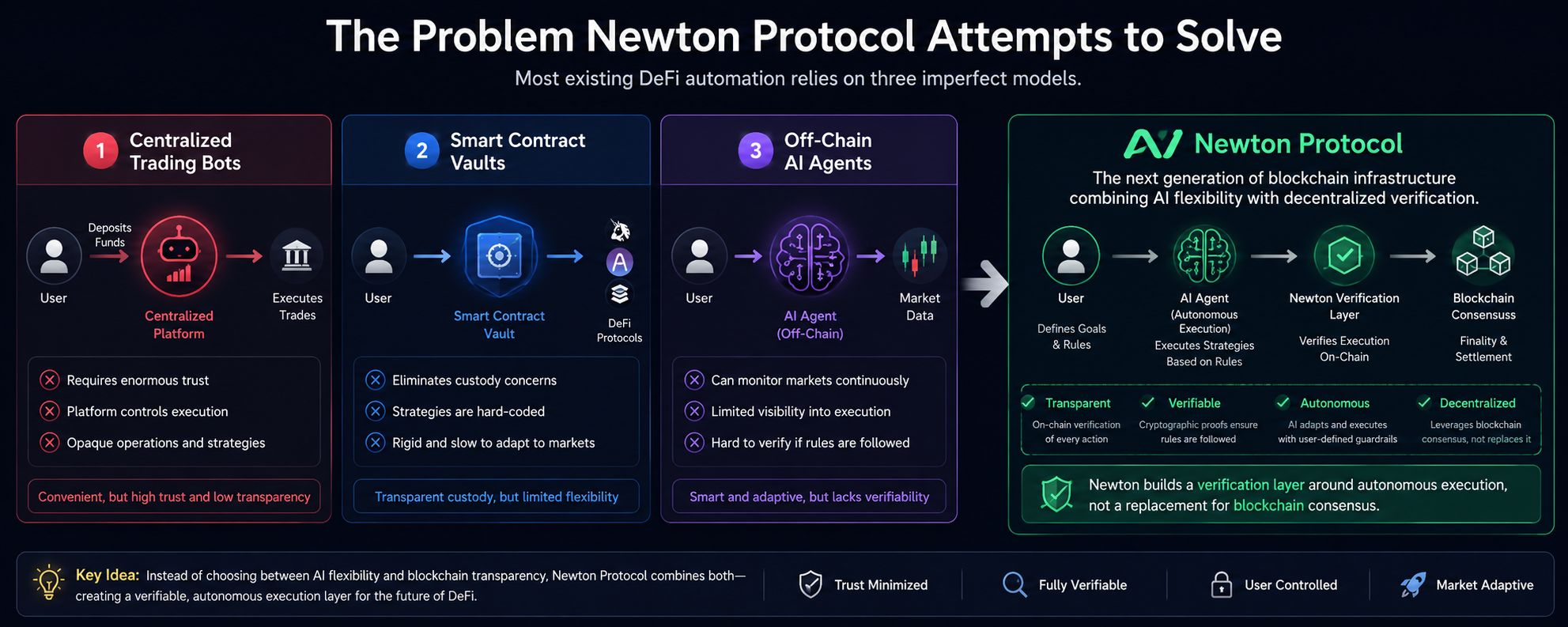
Most existing DeFi automation relies on three imperfect models.
The first is centralized trading bots.
Users deposit funds into third-party platforms that promise automated trading or yield optimization. While convenient, these systems require enormous trust because the platform often controls execution.
The second model uses smart contract vaults.
These eliminate custody concerns but remain relatively rigid. Most strategies must be hard-coded, making adaptation to changing market conditions difficult.
The third relies on off-chain AI agents.
AI models can monitor markets continuously, but users have limited visibility into whether these agents are actually following predefined instructions.
Newton Protocol argues that the next generation of blockchain infrastructure should combine the flexibility of AI with the transparency of decentralized verification.
Rather than replacing blockchain consensus, Newton builds a verification layer around autonomous execution.
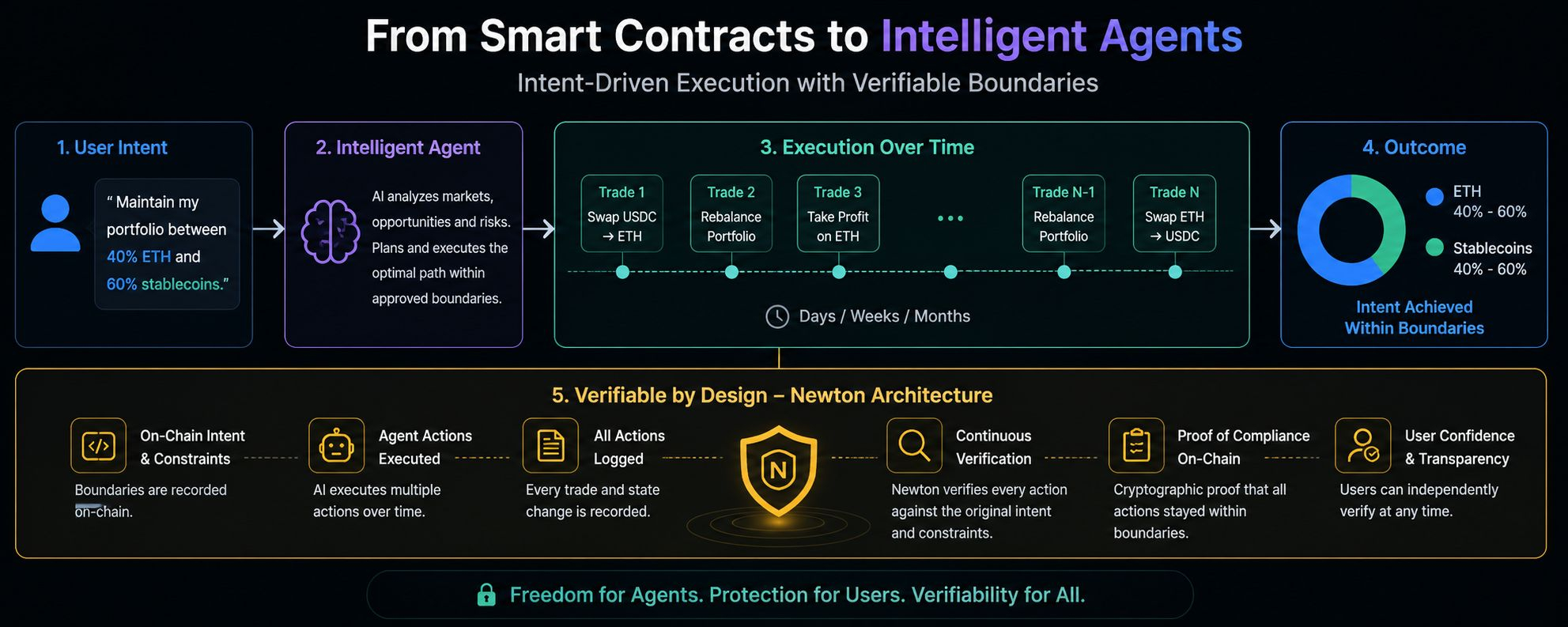
From Smart Contracts to Intelligent Agents
Traditional smart contracts execute deterministic code.
Newton introduces a different paradigm.
Instead of coding every possible future decision directly into a contract, users define intent while intelligent agents determine the optimal execution path within strict boundaries.
Imagine telling an AI:
"Maintain my portfolio between 40% ETH and 60% stablecoins."
The AI may perform dozens of trades over several months.
The important question becomes:
How can users verify every action stayed inside their original authorization?
This is where Newton focuses its architecture.
Verifiable Automation Instead of Blind Automation
Many crypto automation platforms emphasize convenience.
Newton emphasizes proof.
Every automated action should be mathematically verifiable rather than trusted.
Instead of assuming an AI behaved honestly, the network attempts to generate cryptographic evidence demonstrating that every transaction complied with previously approved permissions. �
This subtle distinction separates Newton from traditional automation tools.
Automation answers:
"Can this task be executed automatically?"
Newton asks:
"Can everyone verify that automation never violated the user's rules?"
The Security Architecture
Several technologies work together.
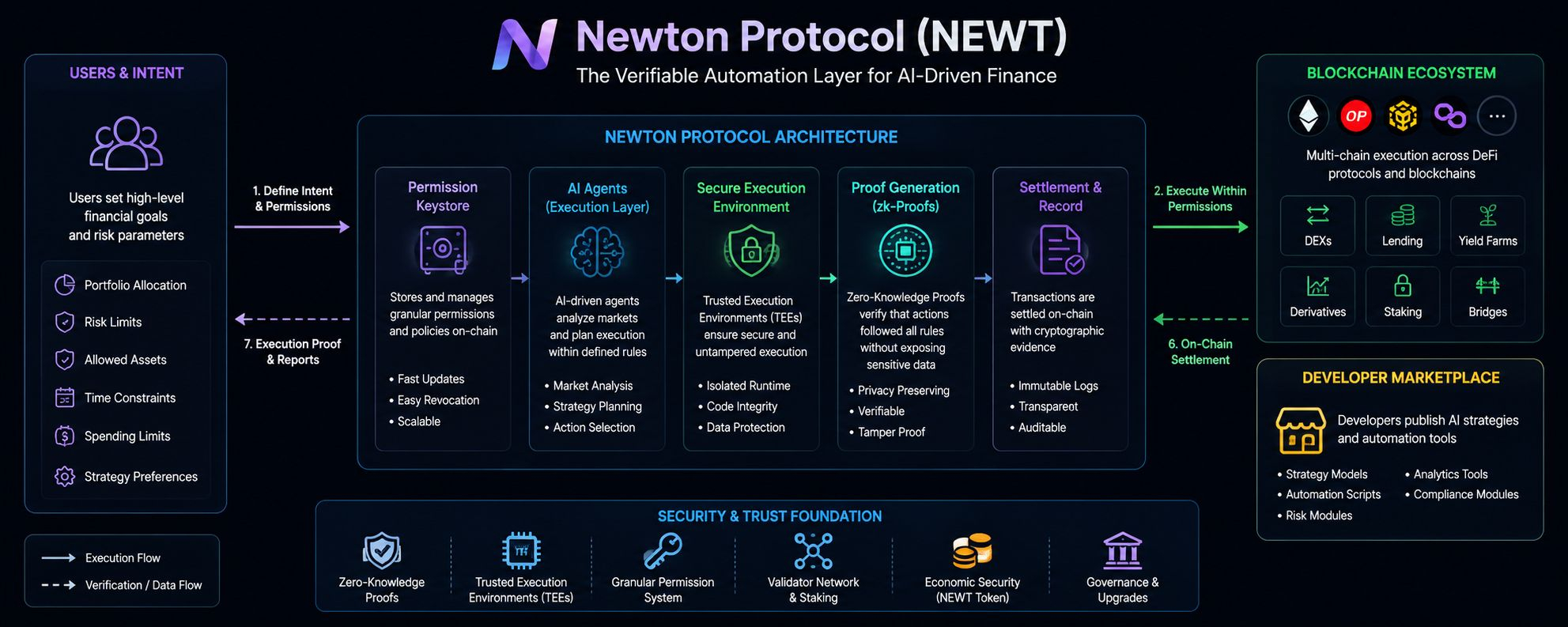
Zero-Knowledge Proofs
Zero-knowledge proofs allow systems to prove something happened correctly without exposing all underlying information.
For Newton, this means an agent can prove it respected execution rules without revealing unnecessary sensitive data.
This preserves privacy while maintaining accountability.
Trusted Execution Environments (TEEs)
AI models usually operate off-chain.
TEEs create isolated execution environments that reduce the possibility of manipulation while software performs calculations.
This helps ensure AI agents execute code exactly as expected.
Granular Permissions
Rather than giving software unrestricted wallet access, Newton introduces highly specific permissions.
Examples include:
Maximum trade size
Allowed tokens
Approved protocols
Time restrictions
Spending limits
Risk thresholds
Instead of sharing a private key, users share limited authority.
This dramatically reduces risk if an agent behaves unexpectedly.
The Newton Keystore
One of Newton's most technically interesting components is its dedicated permission-management layer.
Instead of embedding every permission inside a wallet, Newton stores and updates authorization policies within a specialized rollup architecture.
This creates several advantages:
Faster permission updates
Lower execution costs
Easier revocation
Better scalability for thousands of automated actions
The keystore becomes a continuously updated record describing exactly what autonomous agents are allowed to do.
AI Agents Become Financial Operators
Most discussions around AI in crypto focus on chatbots.
Newton looks beyond conversation.
Its architecture assumes AI agents may eventually become independent economic participants capable of:
Portfolio management
Liquidity allocation
Treasury optimization
Cross-chain arbitrage
Yield farming
Stablecoin management
Institutional compliance
Instead of treating AI merely as an interface, Newton treats AI as an execution engine constrained by mathematical rules.
Cross-Chain Automation
Modern crypto portfolios rarely exist on one blockchain.
Assets often span multiple ecosystems.
This creates operational complexity.
Newton attempts to coordinate automated strategies across different networks while maintaining unified permission management.
Rather than granting separate permissions on every chain, users define higher-level execution policies that remain enforceable throughout cross-chain operations.
Why This Matters for Institutional Adoption
Institutions generally avoid uncontrolled automation.
Regulated entities require:
Audit trails
Compliance checks
Risk management
Permission controls
Transparent execution
Newton's policy-based infrastructure attempts to satisfy these requirements without sacrificing decentralization.
Instead of viewing compliance as an external process performed after transactions, Newton embeds policy enforcement directly into execution logic.
That design philosophy may become increasingly important as tokenized real-world assets and regulated stablecoins expand.
Developer Marketplace
Another significant component is Newton's marketplace for developers.
Rather than building every automation strategy internally, Newton allows developers to publish specialized agent models.
Potential examples include:
Automated DCA strategies
Delta-neutral trading
Market making
Treasury balancing
Liquid staking optimization
Tax-aware portfolio rebalancing
Developers can contribute increasingly sophisticated AI strategies while users select those matching their investment objectives.
This creates an ecosystem where intelligence itself becomes a decentralized service.
Economic Role of NEWT
The protocol's native token serves several infrastructure purposes instead of existing solely as a speculative asset.
Among its expected functions are:
Validator staking
Network security
Governance participation
Agent registration
Execution fees
Economic collateral for service providers
By requiring participants to stake value, Newton aligns incentives between developers, validators, operators, and users.
Strengths
Newton introduces several compelling ideas.
1. Verifiable AI
Few blockchain projects attempt to mathematically verify autonomous decision-making.
2. Permission-Based Automation
Instead of all-or-nothing wallet access, permissions become programmable.
3. Institutional Compatibility
Compliance becomes part of protocol architecture rather than an external service.
4. Modular Ecosystem
Independent developers can contribute automation models.
5. Cross-Chain Vision
Automation increasingly needs to operate across fragmented blockchain ecosystems.
Potential Challenges
Despite its technical ambition, Newton also faces significant challenges.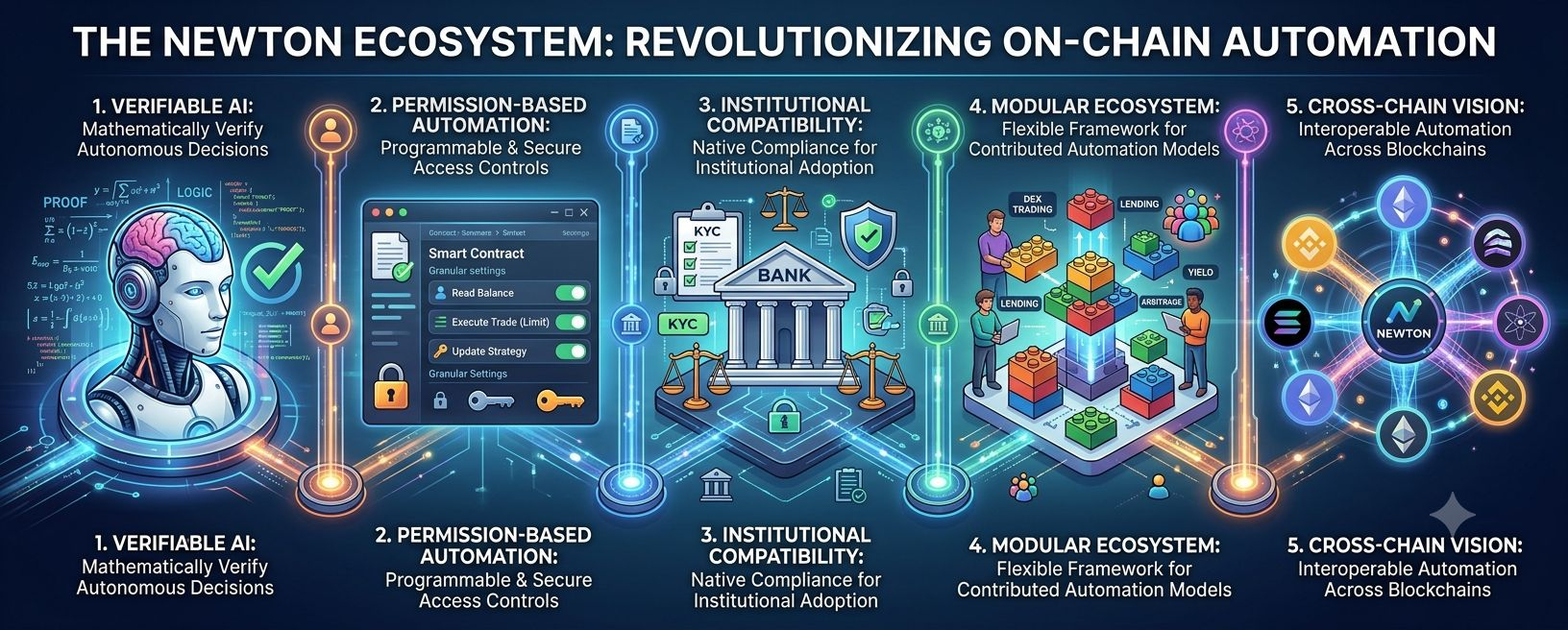
Complexity
Its architecture combines AI, cryptography, rollups, permission systems, validators, and cross-chain execution.
Such complexity may slow adoption among everyday users.
Security
Autonomous execution introduces entirely new attack surfaces.
Even with cryptographic verification, implementation quality remains critical.
Network Effects
A marketplace succeeds only if developers build valuable automation models.
Without a thriving developer ecosystem, the protocol risks becoming underutilized.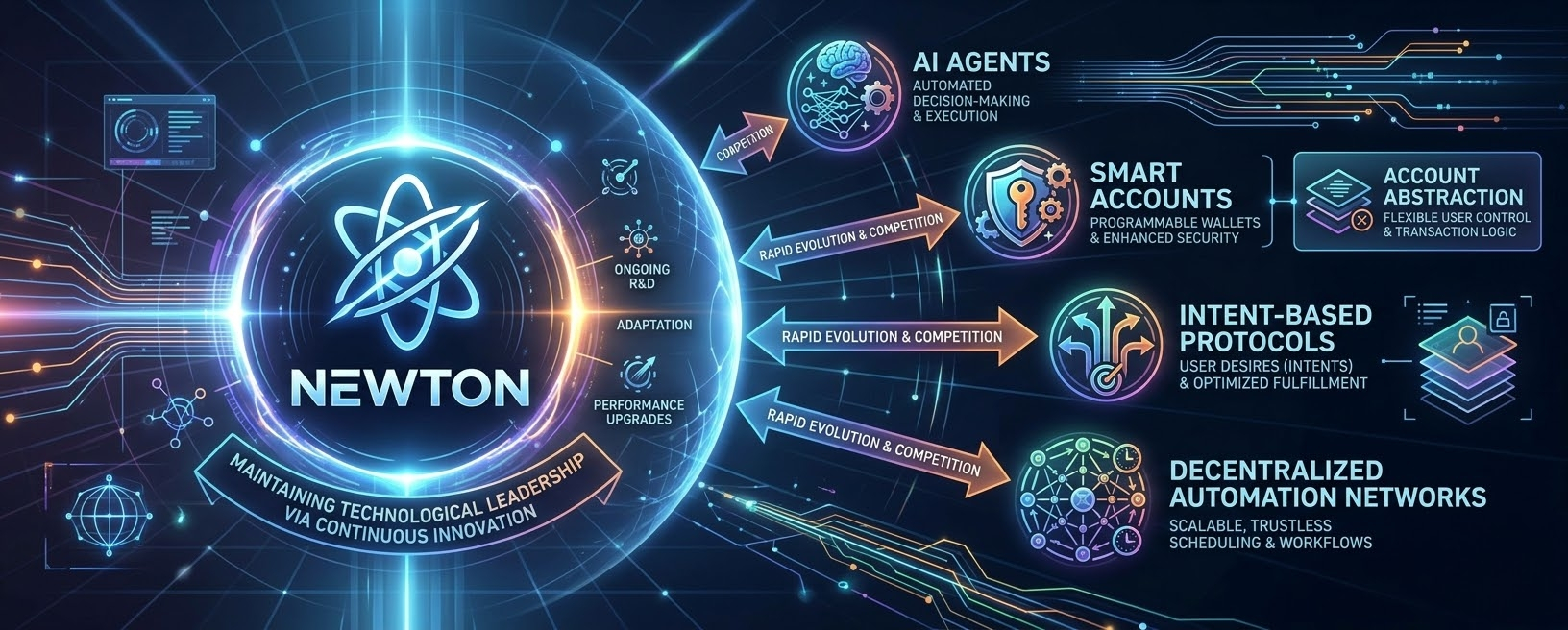
Competition
Newton enters a rapidly evolving landscape that includes AI agents, smart accounts, account abstraction, intent-based protocols, and decentralized automation networks.
Maintaining technological leadership will require continuous innovation.
Broader Industry Significance
Perhaps Newton's biggest contribution is philosophical rather than technical.
Crypto has historically focused on decentralizing ownership.
AI focuses on automating decision-making.
Newton attempts to combine both by decentralizing trusted execution.
If successful, future blockchain users may spend less time clicking wallet confirmations and more time defining high-level objectives.
Instead of manually managing every transaction, people could specify intentions while autonomous agents securely execute strategies within mathematically enforced boundaries.
That shift could transform decentralized finance from an ecosystem requiring constant human attention into one where intelligent software acts as an accountable financial assistant rather than an uncontrolled intermediary.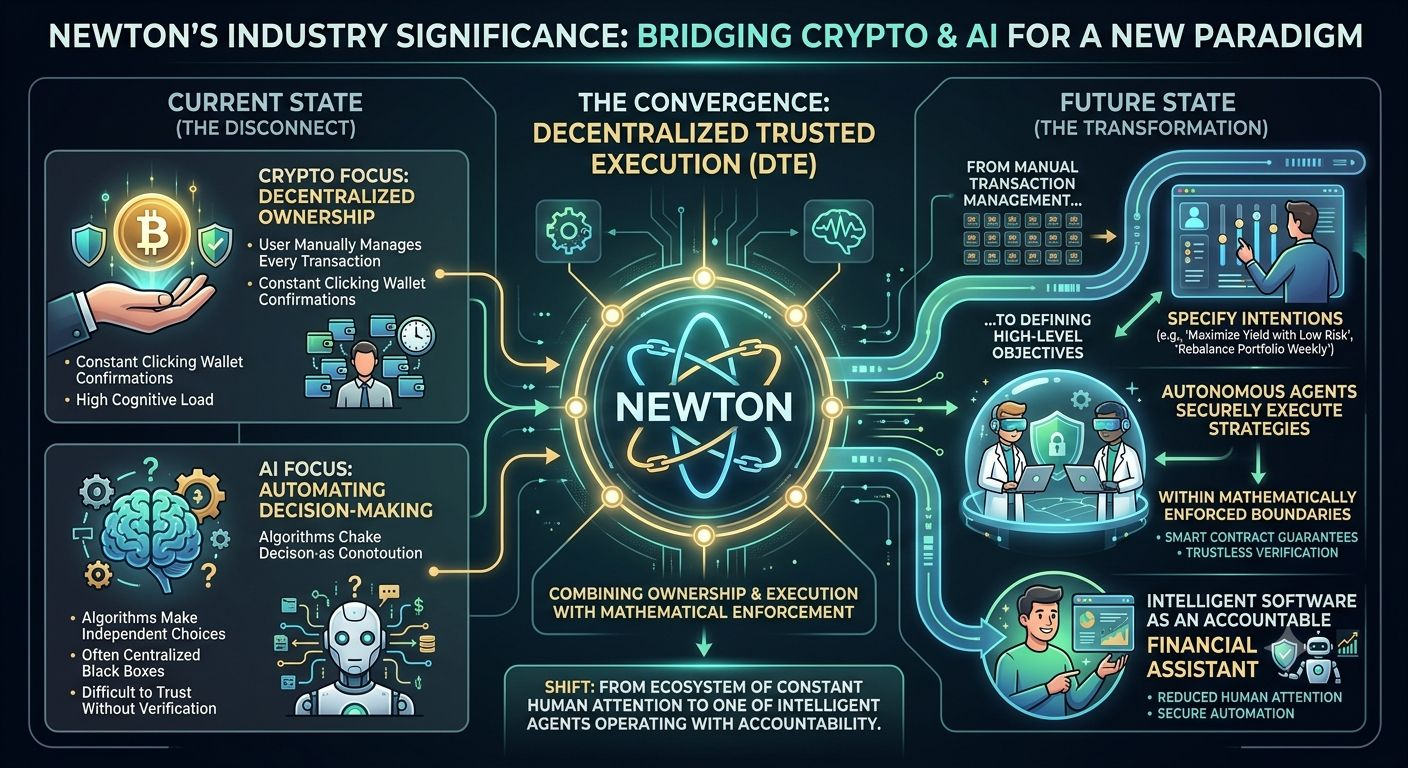
Final Thoughts
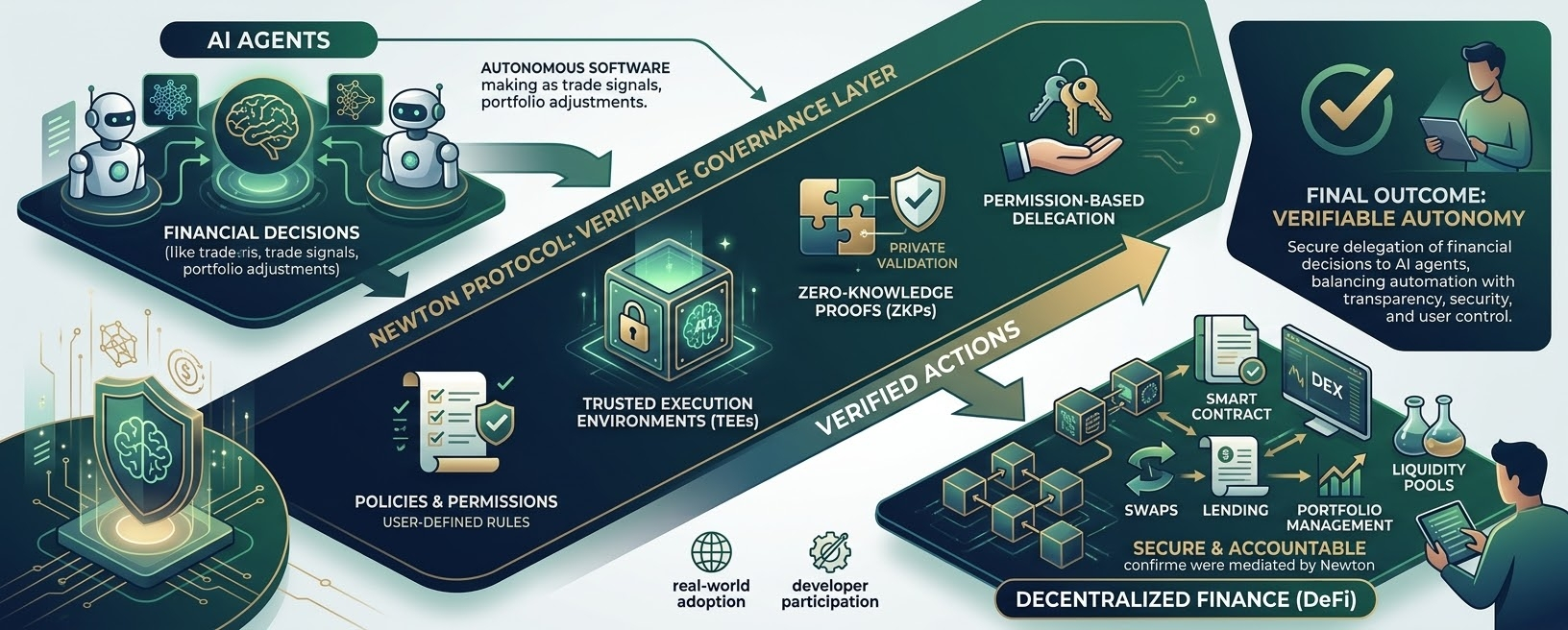
Newton Protocol represents an ambitious attempt to solve one of Web3's emerging challenges: how to safely delegate financial decision-making to autonomous software without sacrificing transparency, security, or user control.
Rather than competing directly with existing blockchains, it seeks to become the infrastructure layer that governs how AI agents interact with decentralized finance. Its combination of zero-knowledge proofs, Trusted Execution Environments, permission-based delegation, and policy-driven execution offers a novel approach to balancing automation with accountability.
Whether Newton becomes a foundational protocol will depend on real-world adoption, developer participation, and its ability to prove that AI can operate securely in open financial systems. Regardless of its long-term success, the project highlights an important direction for the blockchain industry: the future may not simply be decentralized—it may also be autonomous, provided that autonomy remains verifiable.