
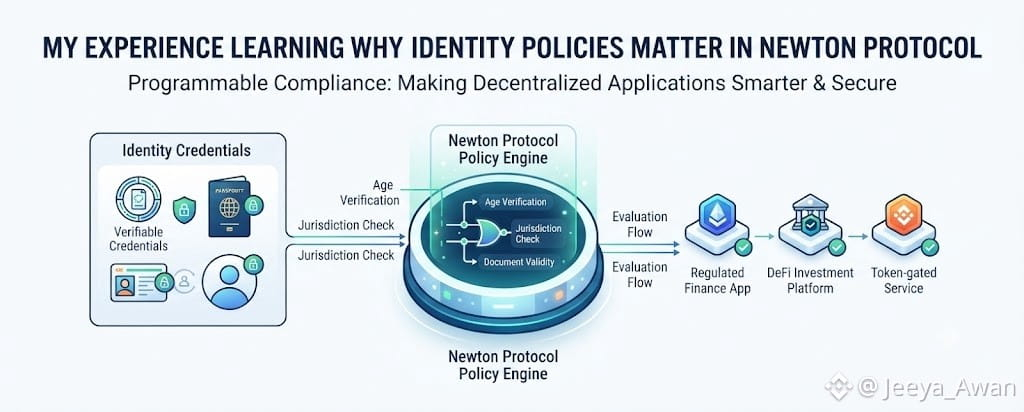
One thing I have learned while exploring blockchain infrastructure is that moving assets onchain is actually the easy part. The difficult part is deciding who should be allowed to perform certain actions in the first place. That question became much clearer to me after spending time reading about Newton Protocol's Verifiable Credentials and Identity Policy system.
Initially, I assumed identity verification was simply another KYC process that happened once during registration. @NewtonProtocol completely changed that assumption.
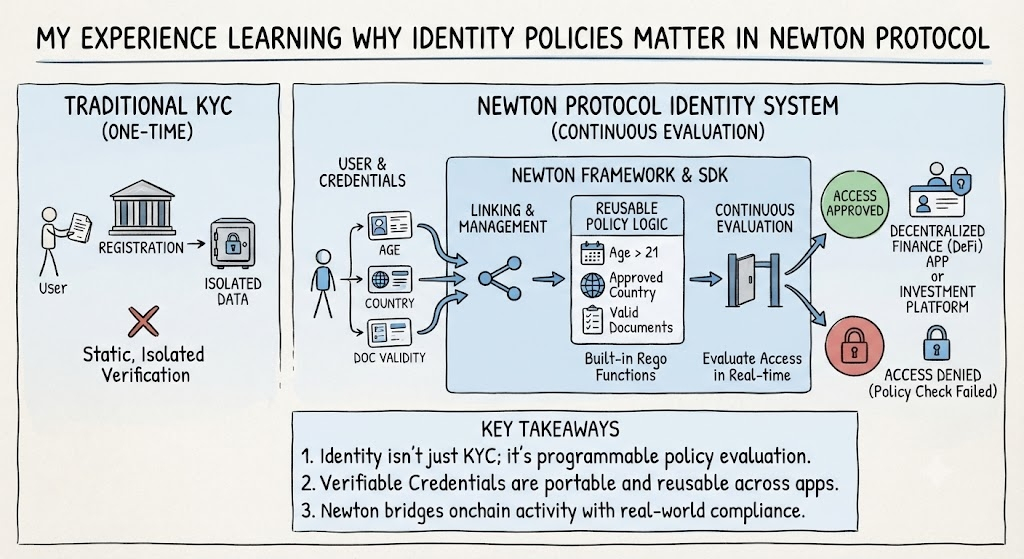
As I worked through the documentation, I realized Newton doesn't just verify users, it allows applications to continuously evaluate trusted identity information whenever policies require it. That distinction may sound small, but I think it makes a huge difference for modern decentralized applications.
The integration guide helped me understand the complete flow from credential registration to policy evaluation. Everything felt connected instead of being isolated features. Developers can integrate verified identity into their applications while allowing policies to decide whether a transaction should proceed based on trusted credential data.
What stood out most to me was the flexibility of the Identity Policy Reference. Instead of relying on simple wallet addresses, Newton gives developers built-in Rego functions that evaluate meaningful information such as user age, country of residence, and document validity.
I immediately understood why this matters.
Imagine a financial application that can only serve users from approved jurisdictions. Another platform may require customers to meet a minimum age. Yet another may need valid identity documents before allowing access to regulated investment products. Without a policy engine, developers would have to rebuild these checks repeatedly.
Newton transforms those requirements into reusable policy logic.
That approach genuinely impressed me because compliance stops feeling like an obstacle and starts becoming part of intelligent application design.
Another reason I appreciate Newton is its developer-focused mindset. Reading through the SDK reference, I noticed that developers receive dedicated methods for linking, managing, and updating identity credentials. Instead of creating custom identity databases or complicated verification systems, much of the heavy lifting is already organized through Newton's framework.
Personally, I always enjoy technologies that reduce unnecessary complexity without sacrificing security. Newton seems to follow exactly that philosophy.
I also think this creates a better experience for users. People don't want to repeatedly submit the same information to every application they use. Verifiable Credentials make identity more portable while still allowing applications to enforce their own requirements through policy evaluation. That combination feels much smarter than traditional verification systems.
After exploring these features, my appreciation for Newton grew beyond transaction authorization alone. I started seeing it as infrastructure that helps bridge decentralized technology with real-world regulatory expectations.
For me, that is where Newton stands out. It doesn't try to remove compliance from blockchain, it makes compliance programmable, reusable, and significantly easier for developers to integrate. After understanding how Verifiable Credentials and Identity Policies work together, I came away believing that this approach could become one of the most valuable building blocks for the next generation of secure onchain applications.
