
Most of what gets discussed about Newton is vaults and AI agents — makes sense, that's where mainnet beta actually launched. But buried further down their own use-case docs is something with a way bigger addressable market and way higher stakes: stablecoins and real-world assets.
Global stablecoin supply is sitting around $310 billion as of early 2026, Tether and Circle dominating. RWA tokenization — bonds, treasuries, credit — is smaller but growing fast on top of that. Both share the same tension: they're financial instruments that increasingly have to satisfy real regulatory obligations, running on infrastructure that was never built with those obligations in mind.
**What "compliance" actually means here**
For a stablecoin issuer, Newton's use case is pretty specific — not "compliance" as a vague buzzword. Per their own docs: block mints or redemptions tied to elevated-risk entities, enforce transfer-level compliance, checking a transaction against sanctions lists before it settles, not after someone notices a shady transfer later. They frame it almost like programmable, VISA-style payment rails — but onchain and checkable, instead of living in a private company's backend.
That separation matters. Right now, if an issuer wants to block a sanctioned address from redeeming, that logic's usually stuck in a centralized backend or hardcoded rigidly into the token contract. Newton splits policy from contract — update a sanctions list without redeploying the token, and every enforcement decision produces a receipt anyone can independently check, not just a private log only the issuer sees.
**Why this might actually matter more than vaults**
Vaults are a reasonable place to prove the concept — contained, sophisticated users, moderate stakes. Stablecoins and RWAs are a different order of magnitude. A meaningful chunk of that $310B is issued by entities that already answer to regulators in some form — GENIUS Act in the US, MiCA in the EU, both still evolving.
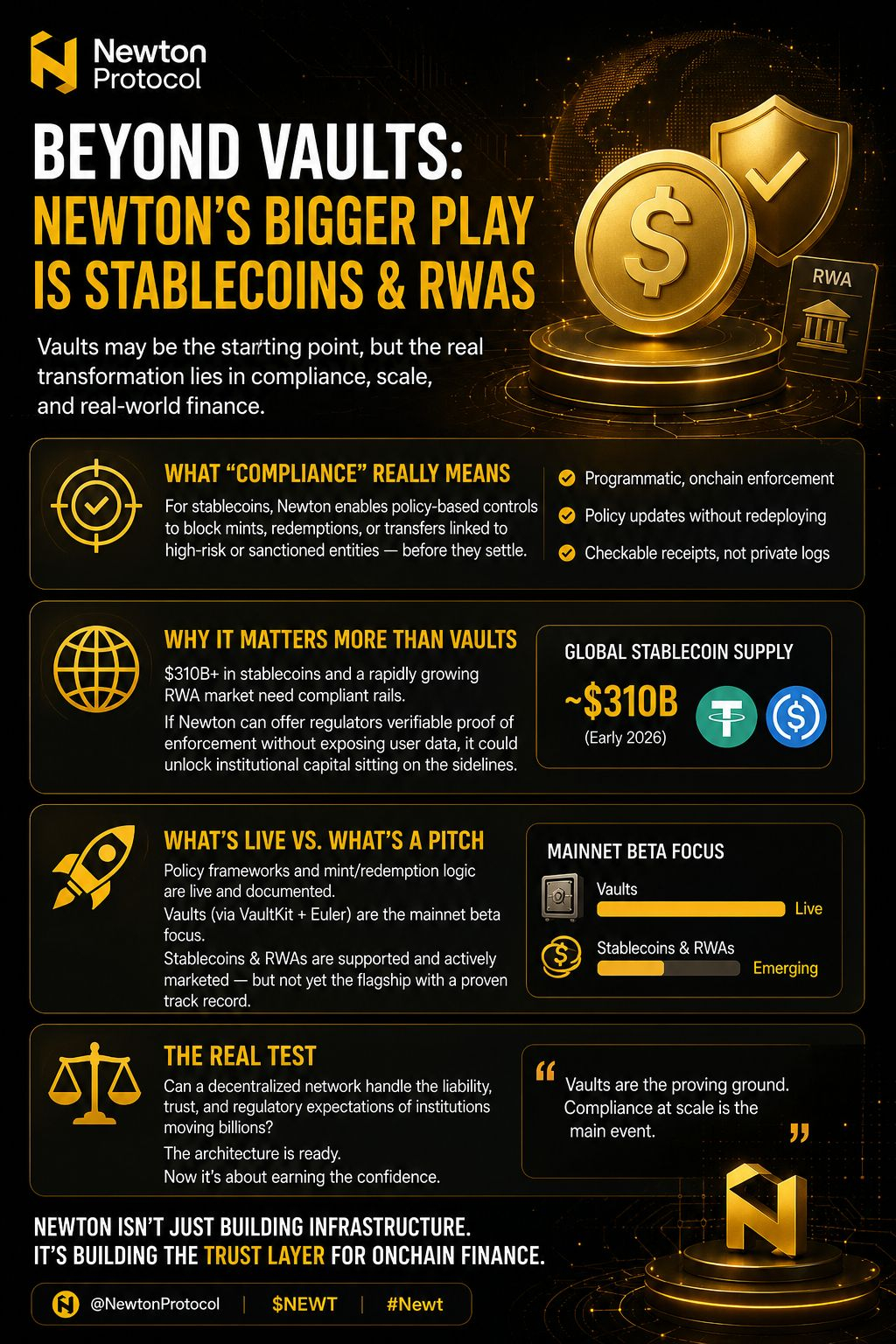
If a protocol can credibly say "here's proof to a regulator that your compliance controls were actually enforced, transaction by transaction, without exposing customer data" — that's a genuinely different pitch than "better yield vault." That's the kind of thing that could actually unlock institutional capital that's sitting out of DeFi specifically because the compliance story isn't checkable enough for legal teams to sign off on.
**What's live vs. what's still a pitch**
Being straight about this — the policy framework and the mint/redemption logic exist and are documented for developers. What's genuinely unclear is how many actual stablecoin or RWA issuers have integrated this in production, at what volume, for how long. Mainnet beta's headline launch and initial focus was vaults, via VaultKit with Euler. Stablecoin/RWA looks like a supported, actively marketed use case — not the flagship one with a comparable public track record yet
**The actual test**
The question isn't whether the architecture could work for a stablecoin issuer — the mechanism (policy separated from contract, checkable receipts, privacy-preserving checks) is a coherent answer to a real gap. The question is whether an issuer moving billions is willing to route mint/redeem decisions through a relatively new decentralized network instead of keeping that logic in-house where they control everything. That's a trust and liability call as much as a technical one. Institutions move slow on this stuff, usually only after watching someone else run it successfully first.
My guess: vaults end up being less the main event and more the proving ground — where Newton has to demonstrate years of reliable operation before a stablecoin issuer with real regulatory exposure is willing to go first.