
Maybe I've just been around crypto long enough to become skeptical.
There was a time when every new project felt exciting. I'd read the announcements, scroll through the comments, and wonder if I'd just discovered the next big thing. These days, I don't react like that anymore. I've seen too many projects go from "this changes everything" to complete silence a few months later.#bitcoin
The cycle is almost boring now.
A new narrative appears, everyone rushes in, people make bold predictions, and then the market finds something else to obsess over.
That's why Newton Protocol wasn't even on my radar at first.
I saw another AI-related project and thought, "Here we go again."
It wasn't meant as criticism. It's just that AI has become the easiest buzzword in crypto. Every other project seems to have an AI angle, whether it actually needs one or not.
Still, I decided to spend some time reading instead of making assumptions.
What surprised me was that the part I found most interesting had very little to do with AI itself.
It was the focus on setting boundaries.
That stood out.
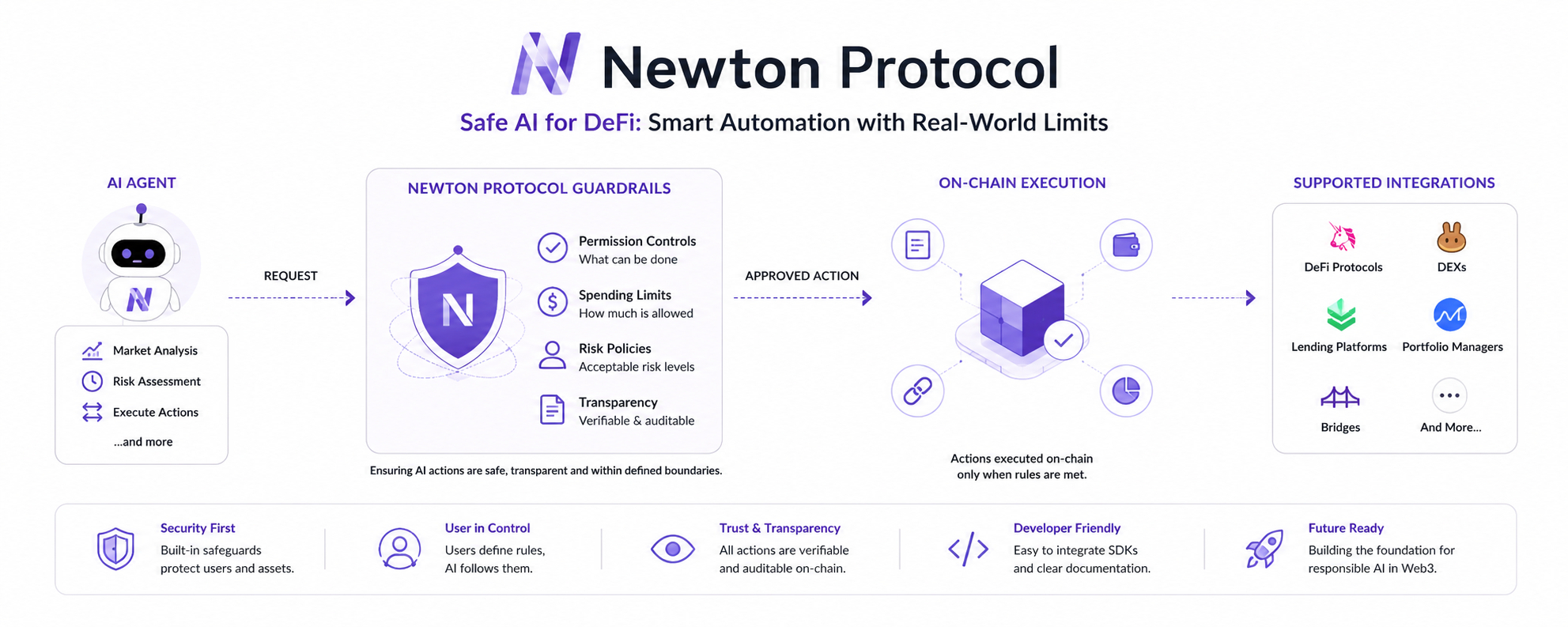
Most conversations around AI are about making it more powerful, more independent, and capable of doing more on its own. Newton Protocol seems to be asking a different question: if software is handling valuable assets, who decides what it's allowed to do?#Polygon
I actually think that's a healthier discussion.
We've spent years trying to remove friction from crypto. Faster trades. Faster settlements. More automation. But speed isn't always the same as safety.
If anything, moving faster often means mistakes spread faster too.
We've all watched incidents where one small error snowballed into something much bigger because everything happened automatically.
That's the reality of this industry.
So no, I'm not interested in Newton Protocol because I think it's guaranteed to explode in value.
I'm interested because it's trying to address a problem that already exists.
Whether it succeeds is a completely different question.
A good idea is only the starting point.
Crypto is full of smart teams that built solid technology but never found enough users. At the same time, we've all seen projects with very little real utility capture the market's attention for reasons that have nothing to do with technology.
That's why I don't make predictions anymore.
If someone asks me whether NEWT will become one of the biggest projects in crypto, my answer is simple:
I honestly don't know.
It depends on execution.
It depends on adoption.
It depends on whether developers choose to build with it six months from now—not just while everyone is talking about it this week.
Those are the things that really matter.
I also think we're entering a stage where people are becoming a little too comfortable handing important decisions over to AI.
Maybe I'm overly cautious.
Maybe that's just experience talking.
Either way, I don't think intelligence should ever replace accountability.
Whether mistakes come from humans or machines, they still have consequences.
The difference is that machines can make those mistakes at a much larger scale if nobody puts sensible limits in place.
That's probably the biggest reason I'm still following Newton Protocol.
Not because I'm convinced it'll be the next success story.
I'm following it because it's trying to solve a real problem, and I'd rather watch projects that focus on practical challenges than projects built around hype alone.
We'll see where it goes.
I've learned that crypto has a way of surprising everyone—including the people who sound the most confident.
#newtrend #NHHB639ProtectsDigitalAssetSelfCustody #BitcoinReboundsAbove$61K

