
The conversation around AI in crypto usually starts with speed.
Faster trading.
Faster execution.
Faster decisions.
Newton Protocol begins somewhere else entirely.
It asks a less exciting question, but probably the more important one: who decides what an AI agent is actually allowed to do?
That sounds small until real money is involved.
An AI can rebalance a portfolio in seconds. It can move liquidity, interact with lending markets, claim rewards and execute complex strategies without waiting for a human wallet click. The technology already exists. The uncomfortable part has never been execution.
It has been permission.
Today, many automated systems still rely on broad wallet access, centralized infrastructure or trust in the operator behind the software. If something goes wrong, the blockchain faithfully records the mistake—but only after it happens.
Newton Protocol wants that sequence to change.
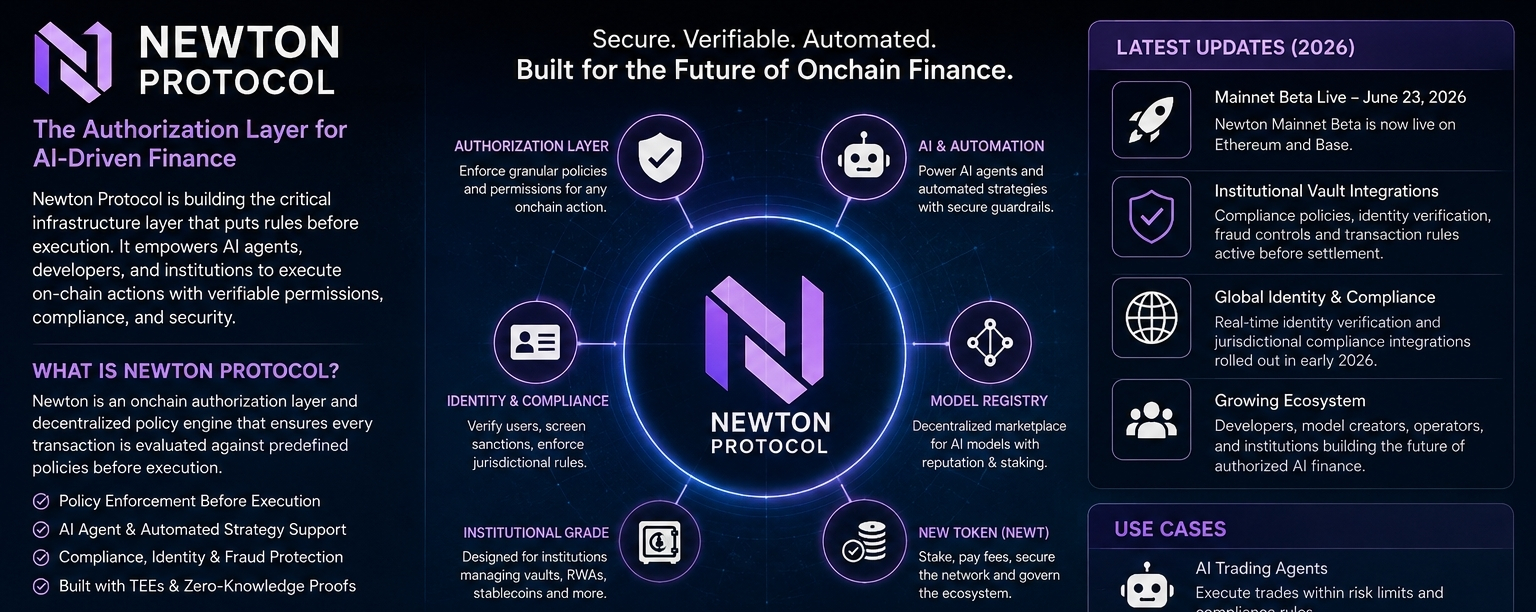
Instead of checking transactions after execution, it introduces programmable authorization before execution. Every action can be evaluated against predefined policies before assets move. That is the protocol's central idea and it shapes almost every component in the ecosystem.
The timing isn't random.
Throughout 2025 and into 2026, crypto has continued moving beyond simple token transfers. Stablecoins are processing enormous volumes, tokenized real-world assets continue expanding, automated vaults have become more sophisticated, and AI agents are beginning to handle increasingly complex financial tasks.
Each step creates another question.
Can software be trusted with larger responsibilities?
Newton's answer isn't "trust us."
Its answer is "verify every permission."
That difference matters.
The protocol combines Trusted Execution Environments (TEEs) with Zero-Knowledge Proofs so automated agents can prove they followed authorized instructions without exposing unnecessary information. Rather than depending solely on reputation, the architecture is designed around verifiable execution.
Think about a treasury manager controlling millions in digital assets.
Maybe the organization wants an AI agent to earn yield overnight.
But only on approved protocols.
Only below a certain risk score.
Only during specific market conditions.
Only if exposure remains inside treasury limits.
Those instructions become policy rather than informal guidelines.
If the conditions aren't satisfied, execution simply doesn't happen.
That is a very different model from giving an automated bot unrestricted wallet control and hoping everything works out.
It's less dramatic.
It's also more practical.
Another interesting layer is the Newton Model Registry.
Instead of treating AI models as invisible software running somewhere in the background, Newton proposes an onchain marketplace where developers can register models while operators provide services backed by collateral. Operators earn fees when their services perform correctly, but their collateral can also be reduced if they violate protocol rules.
Good behavior receives incentives.
Bad behavior carries consequences.
The design tries to align economics with security instead of assuming participants will always act honestly.
Then there is NEWT.
Many projects introduce tokens first and explain utility later.
Newton approached the problem differently.
According to the Foundation documentation, NEWT supports network security through delegated proof-of-stake staking, pays protocol fees, secures participation in the Model Registry ecosystem and eventually enables governance as decentralization expands.
The supply is fixed at 1 billion tokens with no planned inflation after launch, while governance is expected to evolve gradually as the protocol matures.
A tiny detail stood out while reading the documentation.
Permission updates themselves require protocol interaction.
That sounds ordinary.
It isn't.
Changing who or what can act on behalf of an account becomes part of the network's economic system rather than an invisible background process. Small design choices like that often reveal how a protocol thinks about long-term security.
In June 2026, Newton reached another milestone by launching its Mainnet Beta, describing itself as an authorization layer for onchain finance. Alongside the network launch, integrations focused on institutional vaults highlighted how compliance policies, identity verification, fraud controls and transaction rules could all operate before settlement rather than afterward.
That shift may look subtle from the outside.
Operationally, it changes where risk gets managed.
Developers also benefit from that architecture.
Instead of rebuilding authorization logic for every decentralized application, they can build on a shared policy infrastructure. Institutions gain configurable compliance. Users gain programmable permissions. AI developers gain a marketplace for models. Validators secure execution through delegated proof-of-stake and are expected to support the protocol as it transitions toward its own rollup architecture over time.
Crypto has spent years proving that value can move without banks.
The next challenge is proving that autonomous software can move value responsibly.
Those are different problems.
Newton Protocol isn't trying to create another trading narrative or another yield opportunity. It is attempting to build the invisible rulebook sitting underneath autonomous finance, where permissions become programmable infrastructure instead of legal paperwork or manual approvals.
If AI agents eventually handle meaningful portions of onchain economic activity, they won't only need intelligence.
They'll need boundaries.
And boundaries, oddly enough, may become one of the most valuable pieces of infrastructure in Web3.
$ESPORTS $BR $NEWT #Newt @NewtonProtocol
