I wanted to actually understand how a Newton policy check runs, mechanically, instead of just repeating "it's verifiable" like that explains anything. Turns out there are two different pieces doing two different jobs, and mixing them up is easy.
**Piece one: where the policy actually runs**
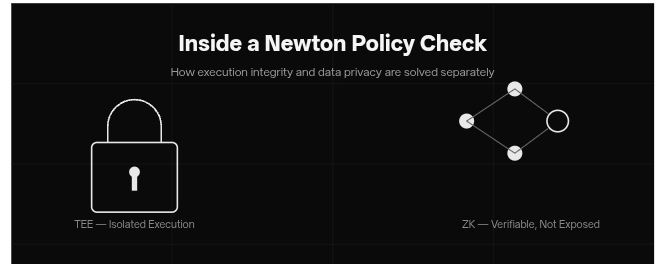
When a transaction comes in, operators evaluate the relevant policy inside a Trusted Execution Environment — a TEE. If you haven't run into the term, think of it as a locked box built into the hardware itself: even the operator running the machine can't peek inside while the code executes or tamper with the result without it being detectable. That's different from just "trust the operator's server." The hardware itself is part of the guarantee.
The policy logic is written in Rego — a declarative language, same one the Open Policy Agent project uses. Inside the TEE, the operator runs the transaction data against that policy and produces two things: an approve/deny result, and a cryptographic proof that the evaluation actually ran correctly, untampered.
**Piece two: proving it without exposing everything**
This is where zero-knowledge proofs come in, and they're solving a different problem than the TEE. A TEE gets you "this ran correctly, on real hardware." A zk proof gets you "this rule was satisfied" without necessarily revealing the private data that satisfied it — an identity check, a financial detail, whatever the policy needed to look at.
Put together: TEE handles integrity of execution, zk proofs handle privacy of the underlying data. Neither one alone gets you both.
**Why this matters more than it sounds**
Compliance systems in traditional finance mostly work by trusting an institution's word — "we checked, it's fine." Newton's pitch is that you don't have to take that on faith. The output is a receipt anyone can verify on Newton's own explorer, without needing the underlying sensitive data ever exposed to get that verification.
That's a genuinely different trust model than "here's our audit report, trust us." It's closer to "here's cryptographic proof the check happened and passed, go verify it yourself if you want."
**Where I'd push back a little**
TEEs aren't a magic bullet. They've had real vulnerabilities discovered in the past across the industry — side-channel attacks, hardware bugs — and "trust the chip manufacturer's security guarantees" is still a form of trust, just a different one than "trust the company running the server." I haven't seen Newton's own materials go deep on which specific TEE vendor/hardware they're relying on or how they handle a scenario where a TEE vulnerability gets discovered later. That's a fair question to ask them directly rather than assume it's a solved problem forever.
And zk proof generation isn't free — there's real computational cost and latency to generating these proofs, which matters if the system needs to handle a lot of transactions quickly. How that scales under real load is something to watch, not something I'd assume works perfectly just because the whitepaper says so.
**The honest takeaway**
This is a legitimately more rigorous approach than "trust our backend," combining hardware isolation with cryptographic privacy in a way that's fairly deliberate. It's also not magic — it inherits real, known limitations from both TEEs and zk systems, and Newton being mainnet beta means none of this has been stress-tested over years yet.
@NewtonProtocol $NEWT #Newt

ලිපිය
Why This Matters More Than It Sounds