
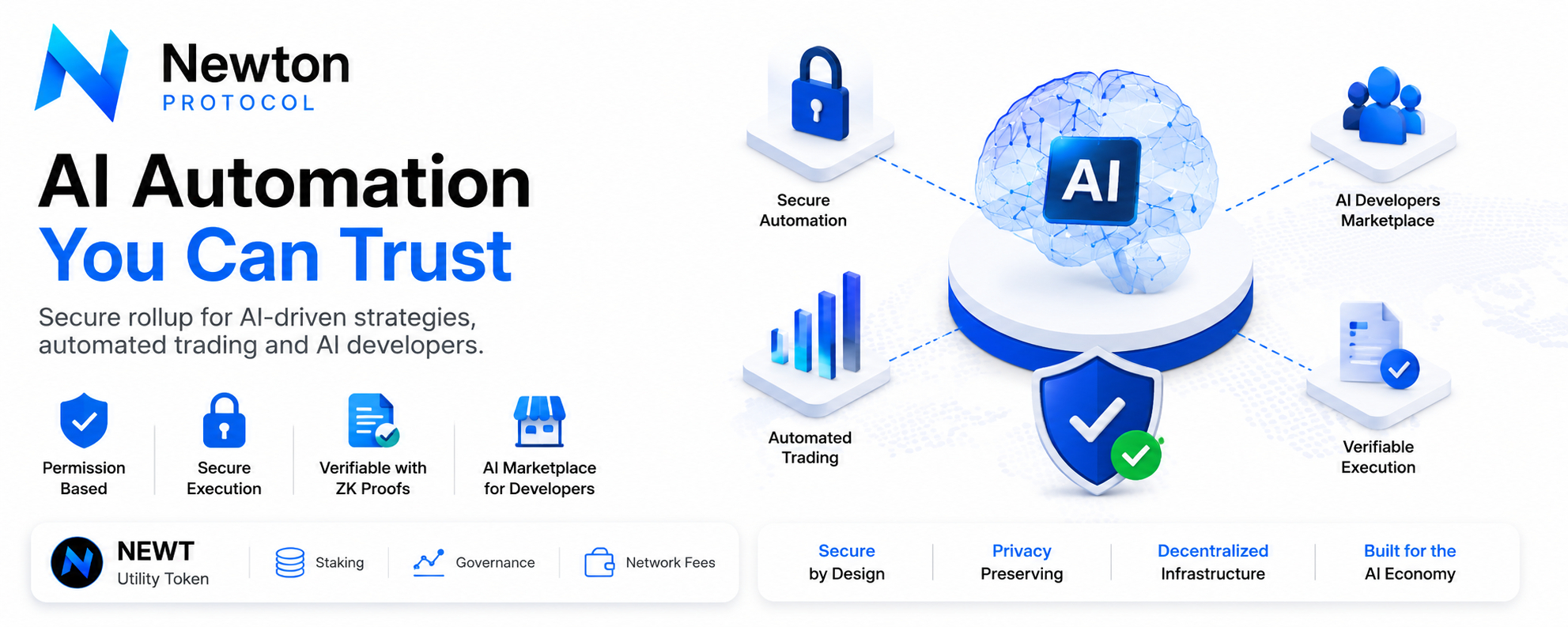
I've been seeing more crypto projects connect AI with blockchain, but one question keeps coming back to me: who is actually in control when an AI agent starts moving assets on-chain? That's what made me spend some time researching Newton Protocol (NEWT). Instead of trying to build the smartest trading bot, Newton is focused on making AI automation verifiable and permission-based. I think that's a much more practical place to start.
From what I've learned, Newton Protocol is building a decentralized infrastructure layer for AI-powered on-chain automation. The idea is simple: users should be able to let AI perform specific tasks without giving it unlimited control over their wallets. The protocol uses Trusted Execution Environments (TEEs) together with zero-knowledge proofs (ZKPs) so AI actions can be verified while keeping sensitive information private. That approach stood out to me because security usually gets less attention than flashy AI features.
The NEWT token sits at the center of the network. It is designed for staking, paying network fees, governance, and registering AI models in Newton's marketplace. The project has a fixed supply of 1 billion NEWT with no planned inflation after launch, which makes the long-term supply easier to understand. Of course, a fixed supply alone doesn't guarantee value. Real demand has to come from people actually using the network.
One feature I find interesting is the planned marketplace for AI developers. Instead of relying on closed systems, developers can publish AI models while users choose which ones they trust. If that ecosystem grows, it could create healthy competition where builders are rewarded for useful and reliable automation instead of marketing alone. At the same time, attracting developers is never easy. Many projects launch marketplaces, but only a small number reach meaningful activity.
Competition is another reason I'm staying realistic. AI has become one of crypto's busiest sectors, with projects working on AI agents, automation, smart accounts, and infrastructure. Newton isn't competing only on technology. It also has to convince developers, wallets, and DeFi applications that its permission framework solves a real problem better than existing solutions. That's a much harder challenge than releasing a token.
I also spent time reading the token allocation instead of just looking at the price chart. Community incentives, ecosystem funds, validator rewards, contributor allocations, and treasury funding are publicly documented with vesting schedules. I always appreciate transparent tokenomics because future unlocks can influence market supply, and they're something every investor should keep an eye on rather than ignore.
As for adoption, I think it's still early. The technology sounds promising, but crypto has shown many times that good ideas don't automatically become successful products. Developer activity, integrations, user growth, and on-chain usage will tell a much clearer story than short-term price movements.
For me, Newton Protocol is interesting because it's trying to solve a trust problem instead of simply adding AI to its branding. Whether it becomes an important infrastructure layer will depend on execution, not marketing. Before I become more confident, I'll be watching developer participation, growth of the AI marketplace, staking activity, ecosystem integrations, and whether real users continue relying on the protocol after the initial excitement fades.
If I were adding visuals to this article, I'd use Newton Protocol's official architecture diagrams, tokenomics dashboard, blockchain activity dashboards, or a TradingView chart showing NEWT's market history. Those provide real context without relying on AI-generated artwork or promotional graphics.



#VitalikOutlinesLeanEthereumRoadmap #BrazilCentralBankSaysStablecoinsElectronicMoney #BitcoinFallsOver50%FromOctoberHigh #MoonbeamToMigrateGLMRToBase