
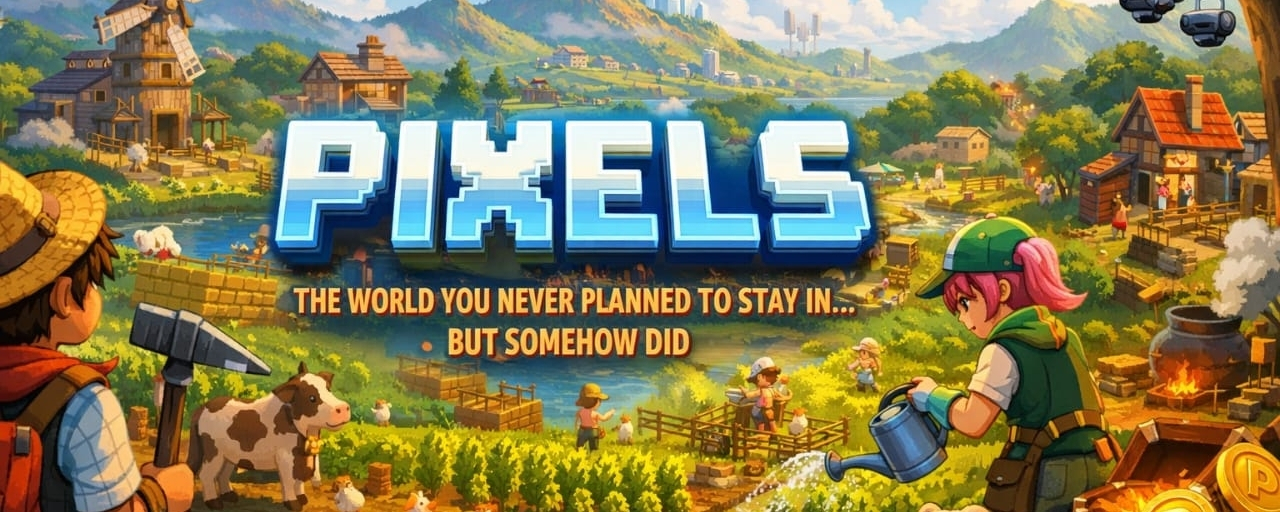
When I first opened Pixels, I wasn’t expecting anything meaningful, and I think that’s the most honest way to begin because most of us already carry a quiet resistance toward Web3 games, where everything feels like it wants something from you before you even understand it, and I was ready for that same feeling again, ready to close it within minutes, but that didn’t happen, and what surprised me wasn’t what the game showed me, but what it didn’t show me, because there was no urgency, no loud direction, no immediate push toward earning or optimizing, and instead of reacting to a system, I just moved through a space that felt calm, almost indifferent to whether I stayed or left, and that lack of pressure created something unusual, because it gave me room to settle without realizing I was settling.
At first, everything feels simple, almost too simple, like it’s just a soft farming loop where you plant, wait, return, and repeat, but the longer you stay, the more you begin to notice that something deeper is quietly shaping how everything connects, and it doesn’t reveal itself all at once, it unfolds slowly, almost in the background of your attention, where small actions start forming patterns, where time begins to matter in subtle ways, where resources stop feeling like isolated items and start becoming part of a flow, and before you can clearly point to when it happened, you realize that what felt like a casual game has started behaving like a system that remembers you, that responds to your presence, that quietly builds a reason for you to return.
At some point, I started noticing how smooth everything felt, how nothing interrupted the experience, and that’s where the role of Ronin Network becomes important even if you never think about it while playing, because technically, this is still a blockchain-based environment, there are assets, ownership, transactions happening beneath the surface, but none of it breaks your flow, none of it forces you to think about gas fees or confirmations or wallets, and that invisibility changes the entire experience, because when the infrastructure disappears, the focus shifts completely toward interaction, toward presence, toward the feeling of simply being inside a world instead of managing a system, and that’s not something that happens by accident, it’s a deliberate architectural choice to prioritize human attention over technical exposure.
What I found even more interesting is how the $PIXEL token exists inside this world but doesn’t immediately define it, because in most Web3 environments, the token leads everything, it shapes behavior from the first moment, but here it feels like it follows instead, like it waits for you to understand the world before it reveals its role, and that creates a very different kind of engagement, because you’re not entering with the intention to earn, you’re entering with the freedom to explore, and only later do you begin to notice that your actions are part of something larger, that the resources you collect have value, that the time you spend connects to output, that the system has an economy that was always there but didn’t demand your attention from the beginning, and by the time you realize it, you’re already inside it, already forming habits that are harder to break than any incentive.
As time passes, the structure becomes more visible, and you start noticing differences between players, not in an aggressive or obvious way, but in how they move, what they can access, how quickly they progress, and that’s where elements like NFT land begin to matter, not just as assets but as infrastructure within the world itself, because certain activities and opportunities are tied to ownership, creating a kind of quiet hierarchy where everyone shares the same environment but not the same experience, and this is where the system becomes more complex, because it has to balance openness with depth, it has to allow new players to feel included while still rewarding those who invest more time or resources, and if that balance shifts too far in either direction, it can change how the entire world feels.
When people look at Pixels from the outside, they might focus on the token or its presence on platforms like Binance, but after spending time inside, it becomes clear that price alone doesn’t explain what’s happening here, because the real signals are behavioral, they show up in whether players return without being pushed, whether the world feels active rather than static, whether resources move instead of getting stuck, whether new players still find a place without feeling behind, and most importantly, whether the experience still feels like something you choose rather than something you have to manage, because the moment that shift happens, the entire dynamic changes from habit to effort.
What Pixels is quietly trying to solve is something deeper than just gameplay or economy, it’s trying to merge the two in a way that doesn’t feel forced, because most systems either lean too heavily into financial mechanics or ignore them completely, but here the approach is slower, more patient, it allows attachment to form before expectation, it lets players exist before asking them to optimize, and that changes how people engage, because once you’re attached, you don’t need constant incentives to return, you come back because it feels natural, because something about the loop fits into your rhythm without demanding control over it.
But even with all of this, there are risks that sit beneath the surface, and they don’t always show themselves immediately, because as the system grows, behavior naturally shifts, players begin to understand more, to calculate more, to optimize more, and if that becomes dominant, the emotional layer that made the experience feel effortless can start to fade, turning something that once felt like a quiet escape into something that feels like a structured routine, and alongside that, there’s the question of accessibility, because while the entry feels open, deeper layers often require more commitment, more assets, more time, and that can create visible gaps between players that weren’t obvious at the beginning, and beyond the game itself, there’s always the influence of the broader market, where perception can shift quickly regardless of what’s actually happening inside the system.
If Pixels continues evolving in this direction, it might become more than just a game, it might turn into a persistent digital environment where people don’t just log in for rewards but return because it feels like a place they belong to, a space where small actions accumulate meaning over time, where presence itself becomes part of the system, and that kind of evolution doesn’t happen through hype, it happens through consistency, through maintaining the balance between simplicity and depth, between freedom and structure, between play and economy, and that balance is fragile, because if it leans too far in one direction, it risks losing what made it feel special in the first place.
I didn’t plan to stay in Pixels, and I don’t think most people do when they first open it, but somehow it becomes one of those things you check without thinking, something that fits quietly into your day without demanding attention, and maybe that’s what makes it different, because it doesn’t try to convince you, it doesn’t try to pull you in aggressively, it just creates a space where staying feels easy, and if it can protect that feeling while everything around it continues to grow, then maybe it’s not just building a game, maybe it’s building a world that people return to not because they have to, but because they want to.
